
‘Double Diwali Gift’: PM Narendra Modi Announces Next-Gen GST Reforms From Red Fort
Prime Minister Narendra Modi used India’s 79th Independence Day address to outline a bold vision for economic growth and reforms, giving citizens reason to expect a “Double Diwali” this year.
- Republic Business
- 4 min read

;'%3e%3cpath%20d='m8,15.99c4.41,0,7.99-3.58,7.99-7.99S12.41,0,8,0,0,3.59,0,8s3.58,7.99,7.99,7.99Z'%20style='stroke:%23fff;%20stroke-miterlimit:10;%20stroke-width:.02px;'/%3e%3cpath%20d='m3.08,3.37l3.82,5.11-3.84,4.15h.87l3.37-3.64,2.72,3.64h2.94l-4.04-5.39,3.58-3.87h-.86l-3.1,3.35-2.5-3.35h-2.94Zm1.27.64h1.35l5.97,7.99h-1.35l-5.97-7.99Z'%20style='fill:%23fff;'/%3e%3c/g%3e%3c/svg%3e)


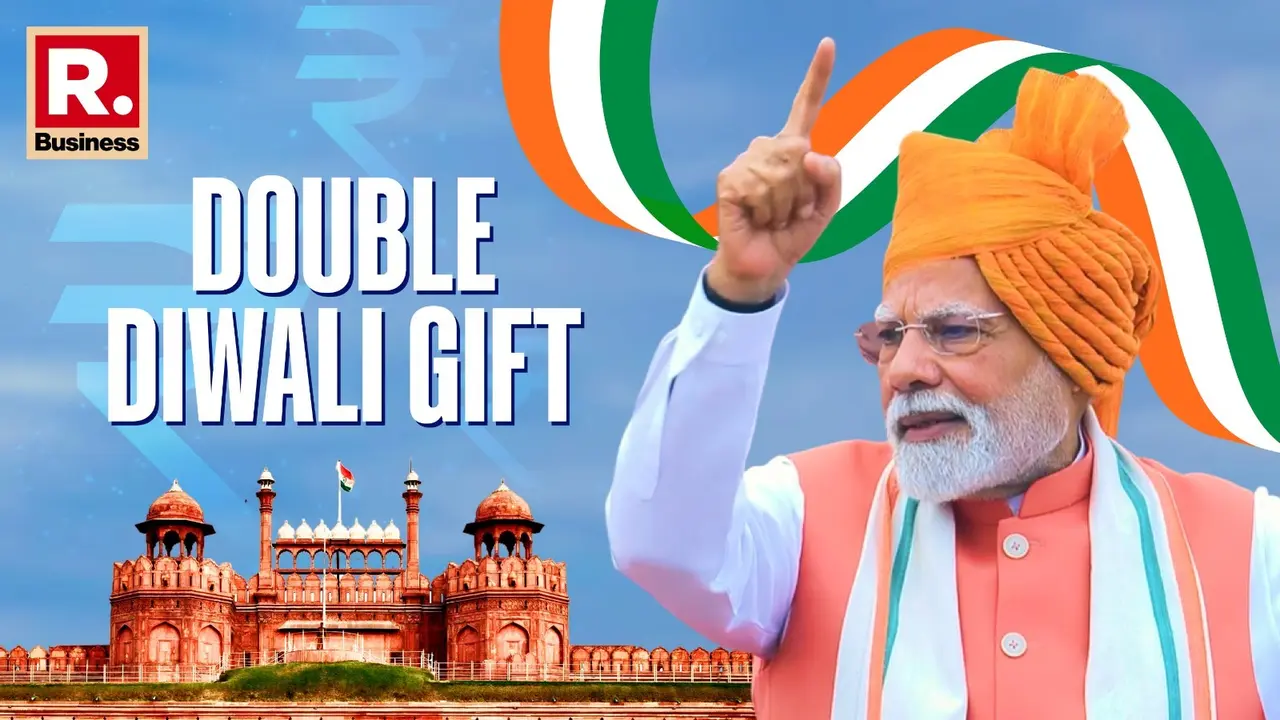
Prime Minister Narendra Modi used India’s 79th Independence Day address to outline a bold vision for economic growth and reforms, giving citizens reason to expect a “Double Diwali” this year.
Speaking from the historic ramparts of the Red Fort, Modi highlighted recent reforms in the income tax laws and promised sweeping next-generation GST reforms as a Diwali gift to the people of India.
Great Gift On Diwali
Modi began by emphasising the need for a strong and self-reliant India. “The need of the hour is to take a resolve for building a ‘samarth’ Bharat, just like our freedom fighters had envisioned a ‘free India’,” he said.
Drawing attention to economic measures, he announced that after the recent simplification of income tax laws, the next step would be major GST reforms designed to benefit every citizen, especially small businesses and MSMEs.
Advertisement
“I am going to give a great gift on Diwali. In the last eight years, we did a big reform in GST, tax was simplified. Now it is the demand of the time to make a review, we did, also talked to states, we are bringing ‘next generation GST reform,’” Modi said.
The Prime Minister explained that under the reforms, taxes on common individual services would be reduced significantly, making everyday products cheaper and providing a boost to small businesses and the economy at large.
Advertisement
GST Reforms In Three Main Areas
The government has proposed reforms based on three main areas: structural reforms, rate rationalisation, and ease of living. These proposals have been sent to the Group of Ministers (GoM) under the GST Council for review.
Structural reforms: It aims to correct inverted duty structures, resolve classification issues, and provide stability in rates and policies.
These changes are expected to reduce disputes, simplify compliance, and support domestic industries.
Rate rationalisation: It will focus on lowering taxes on essential items and aspirational goods, making them more affordable.
The government plans to simplify the tax structure with fewer slabs, ideally moving to two main slabs, with special rates for only a few items. The removal of the compensation cess provides flexibility to adjust rates within GST.
Ease of living measures: It will make registration, filing of returns, and processing of refunds simpler and faster. Pre-filled returns and automated refunds for exporters and certain sectors will reduce manual work and help small businesses and startups.
The Centre will work with the States to build consensus on these reforms. The GoM will review the proposals, and the GST Council will discuss them to enable early implementation, so the benefits can reach people and businesses within the current financial year.
"While GST remains one of India’s most significant tax reforms, it still presents several areas for improvement. The existence of multiple tax slabs ranging from 5% to 28%, including applicable cesses, is a visible area where simplification is needed. A streamlined rate structure would ease pricing decisions for industry and reduce classification disputes, a major source of contention between taxpayers and authorities. The complexity of the Input Tax Credit framework, with restrictions on eligible credits for items such as employee benefits and capital goods, alongside dependency on suppliers’ filings, further complicates compliance. Refund processing is often cumbersome and time-consuming, and registration procedures face procedural hurdles that delay onboarding. Addressing these issues is critical to encouraging broader participation in the GST system. Tax and regulatory reforms remain essential, particularly amid geopolitical and trade challenges faced by India. Improving the tax framework can bolster local industry, offset global market volatility, attract capital inflows, and advance the 'Make in India' initiative. The announcement by the Hon’ble Prime Minister is an extremely important and welcoming step," stated CA Gaurav Makhijani, Associate Partner and Head of Tax (North India & Gujarat), Rödl & Partner India