
Economic Survey Flags Resilient Growth, Strong Consumption Ahead of Budget 2026–27
The Economic Survey 2025–26 projects India’s GDP growth at 7.4% in FY26, flags strong domestic demand and fiscal consolidation, highlights gains in manufacturing and services, and underscores reform momentum even as global trade and geopolitical risks persist.
- Republic Business
- 4 min read

;'%3e%3cpath%20d='m8,15.99c4.41,0,7.99-3.58,7.99-7.99S12.41,0,8,0,0,3.59,0,8s3.58,7.99,7.99,7.99Z'%20style='stroke:%23fff;%20stroke-miterlimit:10;%20stroke-width:.02px;'/%3e%3cpath%20d='m3.08,3.37l3.82,5.11-3.84,4.15h.87l3.37-3.64,2.72,3.64h2.94l-4.04-5.39,3.58-3.87h-.86l-3.1,3.35-2.5-3.35h-2.94Zm1.27.64h1.35l5.97,7.99h-1.35l-5.97-7.99Z'%20style='fill:%23fff;'/%3e%3c/g%3e%3c/svg%3e)


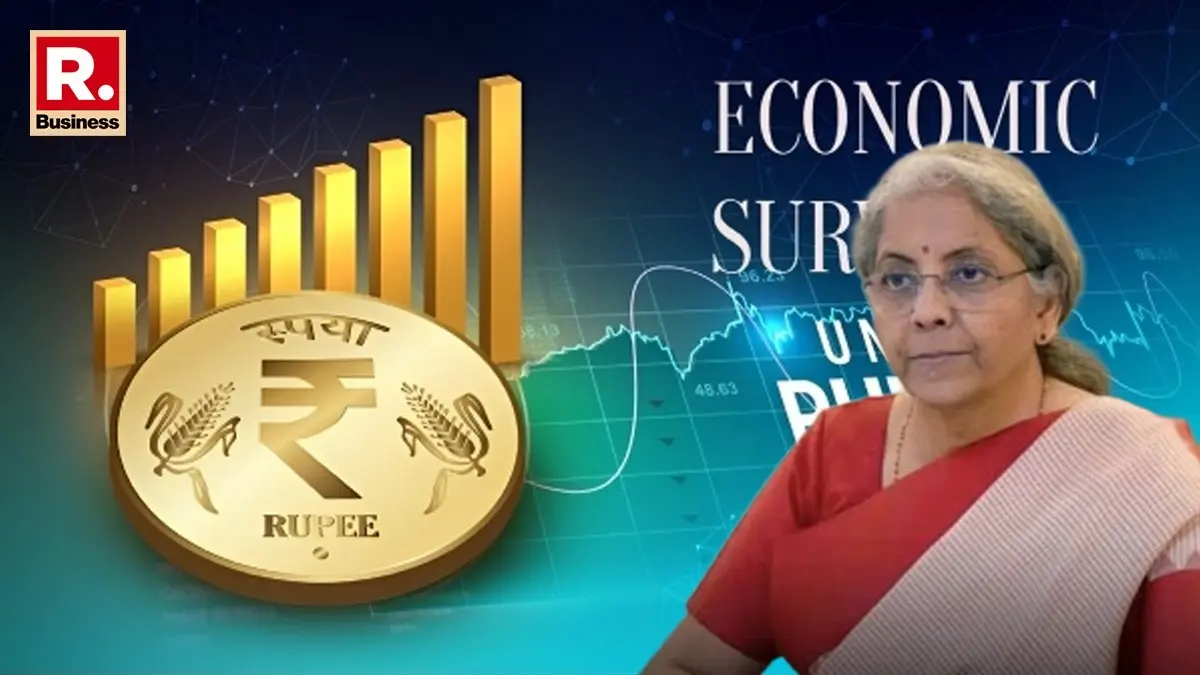
Finance Minister Nirmala Sitharaman tabled the Economic Survey 2025–26 in Parliament on Thursday, presenting a detailed picture of India’s economic performance and prospects ahead of the Union Budget 2026–27. The Survey highlights a resilient economy, supported by robust domestic demand, strong fiscal management, and structural reforms, even as global uncertainties remain.
FY26 Growth: Maintaining the World’s Fastest-Growing Status
According to the Survey, India’s real GDP growth for FY26 is estimated at 7.4%, reinforcing its position as the world’s fastest-growing major economy for the fourth consecutive year. Gross Value Added (GVA) growth is estimated at 7.3%, showing broad-based activity across sectors.
The medium-term potential growth rate has been revised upward to 7.0%, up from 6.5% three years ago, reflecting gains from infrastructure development, domestic reforms, and productivity improvements.
The Survey frames FY27 as a year of adjustment, where domestic investment, household consumption, and policy interventions are expected to sustain activity despite elevated global volatility.
Advertisement
Management and Sovereign Strength
The Union government’s fiscal prudence is highlighted as a key strength:
- Fiscal deficit for FY25: 4.8% of GDP (better than the budgeted 4.9%)
- FY26 target: 4.4% of GDP
- Weighted average coupon (WAC) on government borrowings: 6.65% in FY26, down from 7.11% in FY25
In a notable endorsement of India’s macroeconomic credibility, S&P upgraded India’s sovereign credit rating from BBB- to BBB in August 2025, the first major rating upgrade in nearly two decades.
Advertisement
Sectoral Performance: Services, Manufacturing, and Agriculture
The Survey points to broad-based sectoral resilience:
- Services: Estimated growth of 9.1%, remaining the primary engine of expansion.
- Manufacturing: Estimated at 7.0%, driven by mobile phone production, electronics, and other high-value manufacturing.
- Construction: Projected growth of 7.0%, reflecting ongoing infrastructure activity.
- Agriculture: Expected growth of 3.1%, with record cereal production of 3,320 lakh tonnes in 2024-25.
Private Final Consumption Expenditure (PFCE) reached 61.5% of GDP, the highest level since FY12, underscoring the importance of domestic demand as a growth driver.
Banking and Financial Stability
India’s banking sector shows continued improvement in asset quality and stability:
- NPA recovery rates in Scheduled Commercial Banks have doubled from 13.2% in FY18 to 26.2% in FY25.
- Slippage ratio (new NPAs as a percentage of standard loans) improved from 7.1% in FY18 to 1.3% by September 2025.
- Banks maintain healthy liquidity and capital adequacy, supporting credit growth and financial resilience.
Inflation and Monetary Environment
Retail inflation (CPI) dropped to 1.7% in FY25-26, largely due to a sharp decline in food prices, including vegetables, pulses, and spices. This low inflation, combined with falling borrowing costs, has bolstered purchasing power and domestic consumption.
External Sector: Exports, Trade, and Challenges
India’s external sector remains a strength, although geopolitical and trade risks persist:
- Export growth (CAGR since 2020): 9.4% overall, with services exports growing 9.4% versus merchandise exports at 6.4%.
- Electronics exports rose sharply, positioning India as the world’s second-largest electronics exporter by FY26.
- Trade tensions: The U.S. imposed an additional 25% penal tariff on Indian merchandise exports in August 2025, following earlier reciprocal tariffs, highlighting ongoing global challenges.
- The government concluded a Free Trade Agreement (FTA) with the European Union after three years of negotiations, aiming to diversify markets and reduce trade vulnerability.
Structural Reforms
The Economic Survey emphasizes reforms across multiple domains:
- Energy & Industry: Private sector entry allowed in nuclear power generation; 100% FDI permitted in insurance.
- Labor & Environment: Four labor codes notified; industrial green cover mandates relaxed according to environmental impact rather than a uniform 33% requirement.
- Digital Transformation: Government initiatives support an “Entrepreneurial State,” moving from inspection-based oversight to trust-based compliance through mission-mode platforms, particularly in semiconductors and green hydrogen.
Medium-Term Outlook
The Survey underscores that India’s growth trajectory is anchored in domestic demand, investment, and structural reforms, with the potential to sustain a 7% growth path in the medium term. Key priorities include:
- Maintaining fiscal discipline while supporting infrastructure and social investment
- Boosting manufacturing and export competitiveness
- Navigating global volatility, including capital flow shifts and trade frictions
With a demographic dividend expected to peak around 2030, roughly 65% of India’s population will be in the working-age group (15–59 years), providing further impetus for growth, consumption, and innovation.
Takeaways Ahead of the Union Budget
The Economic Survey 2025–26 lays the groundwork for the Union Budget 2026–27, highlighting a resilient, reform-driven economy that is prepared to balance growth promotion with cautious fiscal management. Analysts and policymakers are likely to focus on:
- Encouraging private investment while sustaining public infrastructure
- Expanding digital and green economy initiatives
- Supporting manufacturing, exports, and technology-driven sectors
- Maintaining macroeconomic stability amid global uncertainties