
From COVID Triumph to Self-Reliance: Major Bio-Pharma Boost in Union Budget 2026
Finance Minister Nirmala Sitharaman allocated ₹10,000 crore for biopharma manufacturing. Analysts said that India has silently built a strong manufacturing base for medicines and medical devices since COVID-19, when it produced vaccines & PPE kits not only for domestic use but also for global export
- Republic Business
- 4 min read

;'%3e%3cpath%20d='m8,15.99c4.41,0,7.99-3.58,7.99-7.99S12.41,0,8,0,0,3.59,0,8s3.58,7.99,7.99,7.99Z'%20style='stroke:%23fff;%20stroke-miterlimit:10;%20stroke-width:.02px;'/%3e%3cpath%20d='m3.08,3.37l3.82,5.11-3.84,4.15h.87l3.37-3.64,2.72,3.64h2.94l-4.04-5.39,3.58-3.87h-.86l-3.1,3.35-2.5-3.35h-2.94Zm1.27.64h1.35l5.97,7.99h-1.35l-5.97-7.99Z'%20style='fill:%23fff;'/%3e%3c/g%3e%3c/svg%3e)


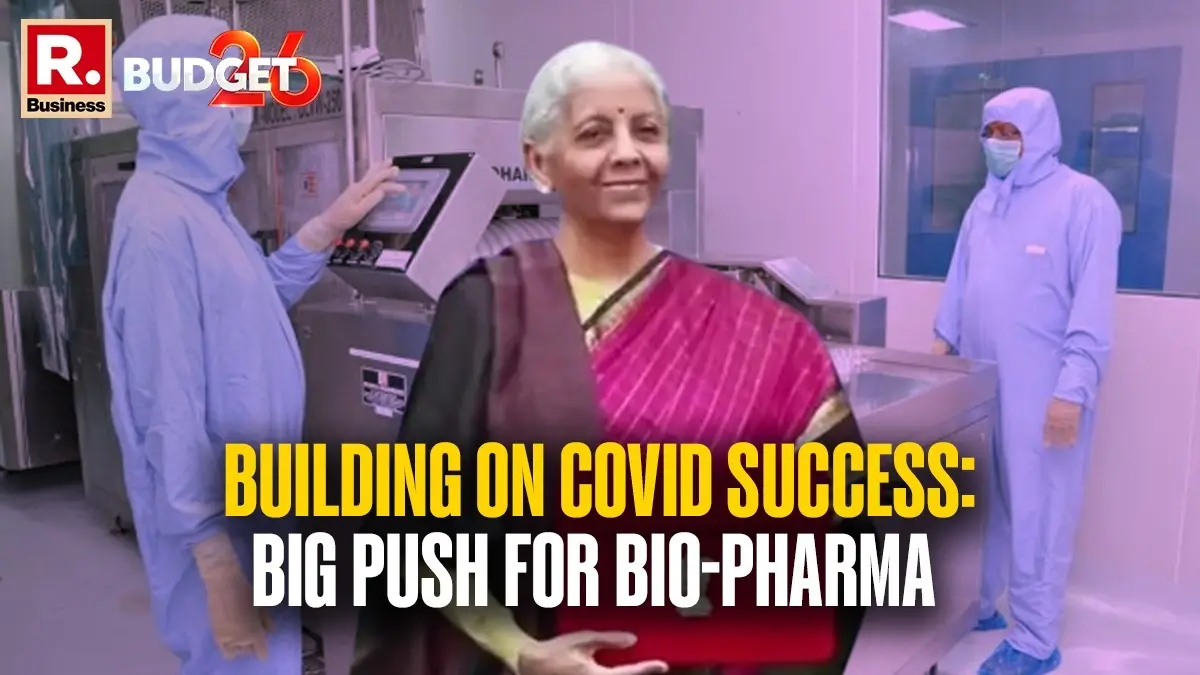
New Delhi: Union Budget 2026: In a significant move to bolster India's healthcare infrastructure and reduce dependency on imports, Finance Minister Nirmala Sitharaman unveiled the 'Biopharma SHAKTI' initiative in the Union Budget 2026-27, allocating ₹10,000 crore over the next five years to position India as a global hub for biopharma manufacturing.
This strategy, formally known as the Strategy for Healthcare Advancement through Knowledge, Technology, and Innovation, targets the domestic production of biologics and biosimilars, addressing the growing burden of non-communicable diseases like diabetes, cancer, and autoimmune disorders.
The initiative includes key components such as establishing three new National Institutes of Pharmaceutical Education and Research (NIPERs) and upgrading seven existing ones to form a dedicated biopharma-focused network.
Additionally, it aims to create a network of over 1,000 accredited clinical trial sites across India to accelerate research and development.
Advertisement
The budget also proposes strengthening the Central Drugs Standard Control Organisation (CDSCO) with a specialized scientific review cadre to align with global standards and reduce approval timelines.
To enhance affordability and access, the government has exempted basic customs duty on 17 drugs and medicines, while extending duty-free personal imports for treatments related to seven additional rare diseases under the National Policy for Rare Diseases.
Advertisement
These measures are expected to lower costs for critical therapies, particularly for cancer patients and those with rare conditions.
Some ananlysts say that this focus on bio-pharma builds directly on lessons from the COVID-19 pandemic, which highlighted vulnerabilities in global supply chains and India's heavy reliance on imported active pharmaceutical ingredients (APIs), medicines, and medical devices.
During the crisis, India accelerated its 'Atmanirbhar Bharat' (Self-Reliant India) campaign, introducing Production Linked Incentive (PLI) schemes for pharmaceuticals and medical devices to promote domestic manufacturing and reduce dependence on countries like China.
The PLI initiatives have already spurred investments, helping India emerge as a key exporter of vaccines and generics, but the bio-pharma segment, involving complex biologics, remained a gap that Biopharma SHAKTI now aims to fill.
Industry experts have welcomed the announcements, viewing them as a step toward true self-reliance.
The initiative aligns with India's broader goal of becoming a developed nation by 2047, enhancing its status as the 'Pharmacy of the World' while ensuring resilience against future health emergencies.
Overall, the budget's healthcare allocations have risen to ₹99,859 crore for FY26, up from revised estimates of ₹89,974 crore in FY25, underscoring the government's commitment to long-term capacity building in the sector.
Analysts predict this will not only drive innovation and job creation but also attract global investments, further solidifying India's role in the international bio-pharma landscape.
This push for for Bio-Pharma manufacturing comes nearly five years after India showcased its strengths in manufacturing and exporting medicines and vaccines during the COVID-19 pandemic. Analysts point out that India has silently developed a strong manufacturing base for medicines and medical devices/equipment since COVID-19, when it produced vaccines and PPE kits not only for domestic use but also for global export.
Medicines (Generics and APIs):
India, known as the "pharmacy of the world," supplies -20% of global generic medicines by volume. During the early pandemic, supply chain disruptions (especially from China for APIs and key starting materials) forced temporary export restrictions on critical drugs like paracetamol and antibiotics in March 2020 to prioritize domestic needs. The crisis exposed vulnerabilities in upstream dependencies but underscored India's resilience in producing and exporting finished generics, supporting global access to affordable essential medicines.
Vaccines:
India's vaccine sector shone brightly. As the world's largest vaccine producer by volume (supplying over 60% of global demand pre-pandemic), it scaled up production of Covishield (by AstraZeneca/Serum Institute of India) and Covaxin (indigenous, Bharat Biotech). Through the Vaccine Maitri initiative and COVAX, India exported/supplied over 240-300 million doses to nearly 100 countries (including grants, commercial supplies, and COVAX obligations) by early 2022, despite pausing exports during India's severe second wave in 2021 to meet domestic needs. This highlighted India's manufacturing capacity and commitment to global equity, even as domestic vaccination crossed 1 billion doses.
Medical Devices:
India remained heavily import-dependent (70-80% for many categories, especially high-tech items like ventilators, diagnostic equipment, and imaging devices), with low global export share (-0.7%). The pandemic caused shortages and spurred rapid domestic ramp-up in items like PPE, oxygen concentrators, and basic consumables (e.g., gloves, syringes, test kits). Exports of certain COVID-related products surged significantly. However, self-reliance was limited compared to pharmaceuticals/vaccines, prompting post-pandemic policies.
Atmanirbhar Bharat:
The pandemic acted as a wake-up call, revealing "interdependent" rather than full self-reliance (especially for APIs and devices). It accelerated initiatives like the Production Linked Incentive (PLI) schemes (launched 2020 onward) for APIs, KSMs, and medical devices, plus the National Medical Devices Policy (2023), to boost domestic manufacturing, reduce import reliance, and enhance export capabilities.
India proved to be a critical global supplier of affordable medicines and vaccines during COVID-19, while the crisis exposed and catalyzed efforts toward greater self-reliance in the broader health sector, particularly devices.