
From EVs to Chips: PM Modi’s Critical Mineral Mission Aims to End India’s Rare Earth Shortage
PM Modi launched the National Critical Mineral Mission to boost self-reliance in rare earths, urged states to push manufacturing reforms, inaugurated India’s EV battery plant in Gujarat, and highlighted India-Japan ties ahead of his visit to Tokyo.
- Republic Business
- 3 min read

;'%3e%3cpath%20d='m8,15.99c4.41,0,7.99-3.58,7.99-7.99S12.41,0,8,0,0,3.59,0,8s3.58,7.99,7.99,7.99Z'%20style='stroke:%23fff;%20stroke-miterlimit:10;%20stroke-width:.02px;'/%3e%3cpath%20d='m3.08,3.37l3.82,5.11-3.84,4.15h.87l3.37-3.64,2.72,3.64h2.94l-4.04-5.39,3.58-3.87h-.86l-3.1,3.35-2.5-3.35h-2.94Zm1.27.64h1.35l5.97,7.99h-1.35l-5.97-7.99Z'%20style='fill:%23fff;'/%3e%3c/g%3e%3c/svg%3e)


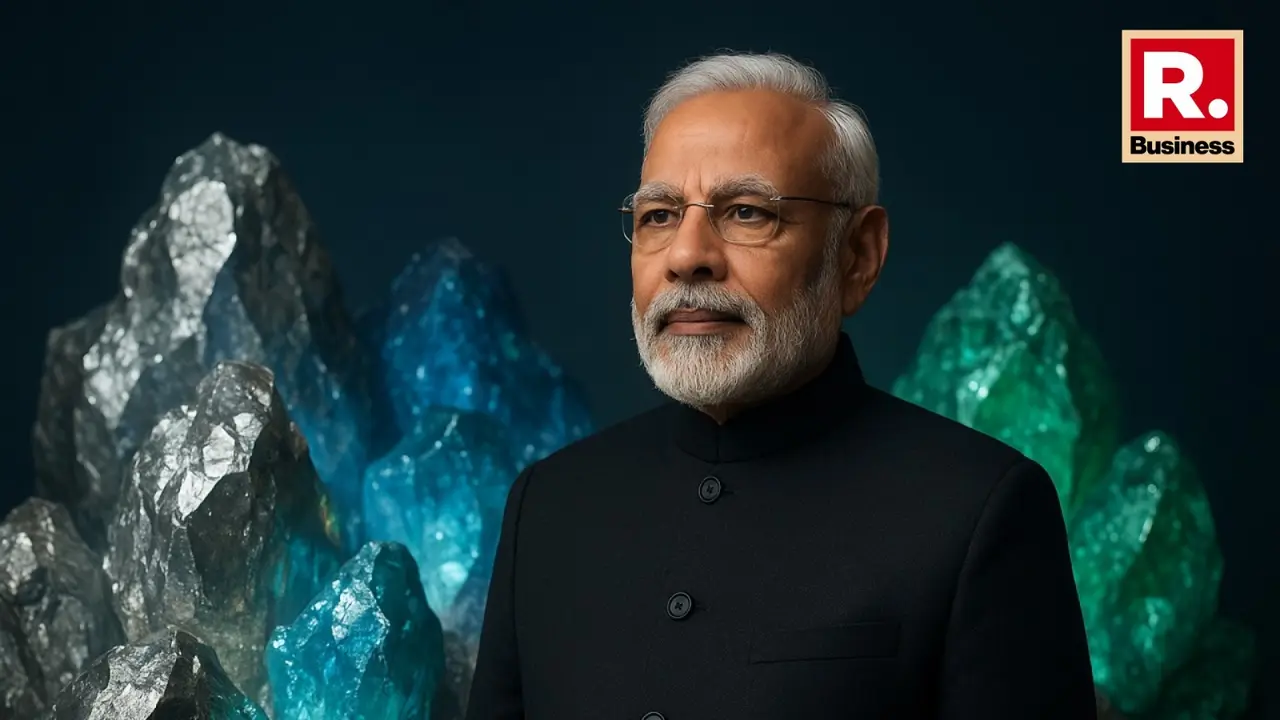
Prime Minister Narendra Modi on Tuesday underlined India’s push towards self-reliance in critical sectors, stressing that the government is conscious of the shortage of rare earth minerals and is committed to addressing it through the newly launched National Critical Mineral Mission (NCMM).
National Critical Mineral Mission
Speaking at an event in Ahmedabad, Modi said the mission will help identify and unearth critical minerals essential for industries such as semiconductors, electronics, and electric mobility.
“The Indian government is aware of the shortage of rare earth manganese for the auto industry. To increase capacity in this direction, we have also launched the National Critical Mineral Mission. Under this, more exploration missions will be conducted at different places in the country, and critical minerals will be discovered,” he said.
Industrial growth and mission manufacturing
Modi noted that India’s industrial growth story is gathering pace, but the country cannot afford to slow down.
Advertisement
“India is not going to stop here. In the sectors where we have performed well, we aim to do even better. That is why we are emphasizing Mission Manufacturing. In the coming time, our focus will be on futuristic industries. In the semiconductor sector, India is taking off,” the Prime Minister said.
Advertisement
Surge in domestic production
Highlighting the sharp rise in domestic production, Modi pointed out that mobile phone manufacturing has surged by 2,700% since 2014, while defence production has grown more than 200% over the past decade.
He urged state governments to proactively compete for investment by keeping policies simple, transparent, and investor friendly.
“The whole world is looking at India, and no state should lag behind. Every state should seize opportunities, creating competition that compels investors to choose India over any other country,” he said.
Battery ecosystem advancement
The Prime Minister also inaugurated the next phase of India’s battery ecosystem at the TDS Lithium-Ion Battery plant in Gujarat, a joint venture of Toshiba, Denso and Suzuki, where local production of hybrid battery electrodes has begun.
“We all know that the most critical part of the EV ecosystem is the battery. Until a few years ago, batteries were entirely imported. With this vision, we laid the foundation of the TDSG battery plant here in 2017,” Modi recalled.
Strategic partnerships and India-Japan Relations
Touching on India’s strategic partnerships, Modi said he would soon travel to Japan, underlining the depth of India-Japan ties.
“The relationship between India and Japan goes far beyond diplomatic ties; it is a bond of culture and trust. The journey we began with Maruti Suzuki has now reached the speed of a bullet train,” he said.
Modi added that cars manufactured in India by Suzuki are now being exported to Japan, calling it a symbol of global confidence in India.
“In a way, companies like Maruti Suzuki have become brand ambassadors of Make in India. Now, EVs that will run in dozens of countries will have written on them—Made in India,” he said.