
From Rare Earths to EVs: ACMA Leaders Map India’s Journey to a Global Mobility Hub by 2030
At its 65th Annual Session, ACMA projected India’s auto component industry to reach USD 200 billion by 2030, backed by government reforms and rising exports. Leaders including Gadkari, Kumaraswamy, Goyal, and EU’s Šefčovič stressed resilient supply chains, clean mobility, and global partnerships.
- Republic Business
- 3 min read

;'%3e%3cpath%20d='m8,15.99c4.41,0,7.99-3.58,7.99-7.99S12.41,0,8,0,0,3.59,0,8s3.58,7.99,7.99,7.99Z'%20style='stroke:%23fff;%20stroke-miterlimit:10;%20stroke-width:.02px;'/%3e%3cpath%20d='m3.08,3.37l3.82,5.11-3.84,4.15h.87l3.37-3.64,2.72,3.64h2.94l-4.04-5.39,3.58-3.87h-.86l-3.1,3.35-2.5-3.35h-2.94Zm1.27.64h1.35l5.97,7.99h-1.35l-5.97-7.99Z'%20style='fill:%23fff;'/%3e%3c/g%3e%3c/svg%3e)


India’s auto component sector is gearing up for a transformative decade, with industry leaders and policymakers joining forces to build a resilient and competitive ecosystem that can withstand global shocks and seize new opportunities. This was the central message at the 65th Annual Session of the Automotive Component Manufacturers Association of India (ACMA), held in New Delhi under the theme “Navigating Geopolitical Challenges – Creating a Resilient Automotive Supply Chain in India.”
India’s rising strength
Opening the session, ACMA President Shradha Suri Marwah highlighted the industry’s steady growth despite global volatility. The sector touched USD 80 billion in FY25, with exports crossing USD 23 billion, underscoring India’s emergence as a reliable partner in global supply chains. But she cautioned that supply security around rare earths, semiconductors, and battery materials is becoming a strategic challenge, requiring government intervention and global partnerships.
“Opportunities are immense, but challenges such as geopolitical volatility, tariff escalations, and trade wars are redefining supply chains,” Marwah said. She called for closer cooperation with the government to secure critical inputs and to ensure India stays competitive in an era of rapid technological change.
Also Read: Green Mobility in Focus: PM Modi Highlights Opportunities for India’s Auto Sector | Republic World
A $200 billion vision
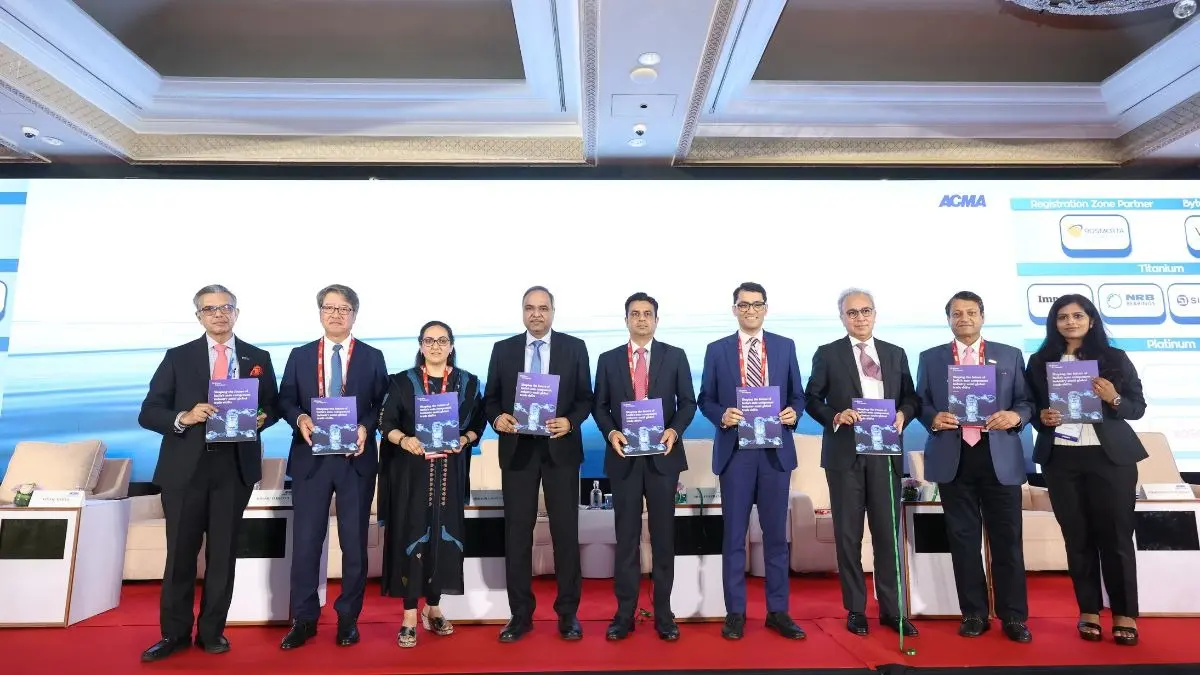
A major highlight was the release of the ACMA–McKinsey study, which projects the industry to expand to USD 200 billion by 2030, driven by strong domestic demand, a widening export base, and growth in both internal combustion engine (ICE) components and new-age EV and connected technologies. The report also flagged potential risks from carbon taxes, tariffs, and overdependence on concentrated imports, particularly for raw materials.
Advertisement
Government’s reform push
Heavy Industries Minister H.D. Kumaraswamy pointed to policy measures such as the PLI scheme, which has already attracted Rs 29,500 crore in investments and generated more than 45,000 jobs. He also announced that the PM-eDRIVE programme will give a fresh push to e-mobility, spanning two-wheelers, buses, and trucks, ensuring cleaner mobility becomes mainstream.
Reinforcing the long-term vision, Road Transport Minister Nitin Gadkari said India aims to be the world’s leading hub for smart, safe, sustainable, and affordable mobility by 2030. He emphasized a diversified clean-fuel strategy, including electricity, hydrogen, ethanol, biofuels, LNG, and CNG, supported by continued government incentives and infrastructure.
Commerce Minister Piyush Goyal added that India is working with the EU towards a balanced Free Trade Agreement (FTA), which would secure greater market access and new investments. He also cited the recent cut in GST on auto parts to 18%, calling it a step to formalize supply chains and spur growth.
Global and industry perspectives
From a global standpoint, European Commissioner Maroš Šefčovič highlighted the EU’s $140 billion trade engagement with India and said stronger collaboration could help both regions develop resilient supply chains and meet climate goals.
Industry voices echoed these priorities. SIAM President Shailesh Chandra noted that supply chains can no longer focus only on cost efficiency; they must also be agile, diversified, and disruption-proof. He urged deeper government-to-government partnerships with resource-rich countries to ensure raw material security and access to critical technologies.