
GST Council Approves Major Reforms: Arrest Powers Scrapped, Prosecution Threshold Raised To Rs 5 Crore
The 57th GST Council meeting approved major GST 2.0 reforms, including scrapping arrest powers, raising the prosecution threshold to Rs 5 crore, faster refunds, simpler registration and returns, easier compliance for small businesses and fewer physical checks on goods in transit.
- Republic Business
- 10 min read

;'%3e%3cpath%20d='m8,15.99c4.41,0,7.99-3.58,7.99-7.99S12.41,0,8,0,0,3.59,0,8s3.58,7.99,7.99,7.99Z'%20style='stroke:%23fff;%20stroke-miterlimit:10;%20stroke-width:.02px;'/%3e%3cpath%20d='m3.08,3.37l3.82,5.11-3.84,4.15h.87l3.37-3.64,2.72,3.64h2.94l-4.04-5.39,3.58-3.87h-.86l-3.1,3.35-2.5-3.35h-2.94Zm1.27.64h1.35l5.97,7.99h-1.35l-5.97-7.99Z'%20style='fill:%23fff;'/%3e%3c/g%3e%3c/svg%3e)


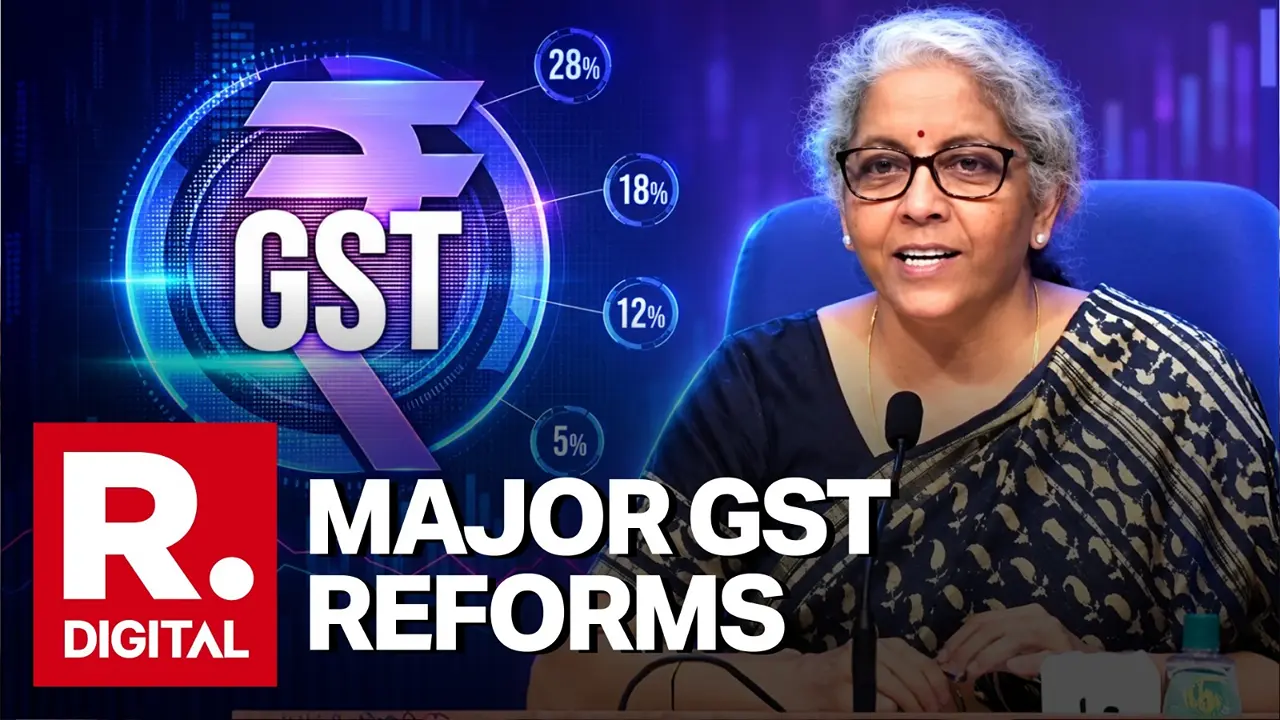
New Delhi: The GST Council on Thursday approved a series of major reforms aimed at making the Goods and Services Tax regime simpler and more business-friendly, with the removal of GST officers' arrest powers, a five-fold increase in the prosecution threshold and measures for faster refunds and easier compliance.
The decisions were taken at the 57th meeting of the GST Council chaired by Union Finance Minister Nirmala Sitharaman in New Delhi. The latest measures mark the second phase of GST 2.0, with the focus shifting from tax-rate rationalisation to simplifying the day-to-day functioning of the tax system.
GST Arrest Powers Scrapped
One of the biggest decisions is the removal of the power of arrest under the GST law. The Council has also raised the threshold for launching prosecution from Rs 1 crore to Rs 5 crore.
The move is aimed at shifting GST enforcement towards identifying tax evasion through data and analytics rather than criminal action in routine compliance matters.
Advertisement
The minimum punishment provision has also been removed. The nature of punishment, including fine, imprisonment or both, will now be left to judicial discretion in cases where prosecution is initiated.
Under the earlier framework, GST officers could arrest individuals in cases involving major offences such as tax evasion, fraudulent input tax credit or wrongful refunds above the prescribed threshold.
Advertisement
The changes are intended to reduce the scope for criminal proceedings in routine GST disputes while retaining the government's ability to recover unpaid taxes, interest and penalties.
Faster GST Refunds
The Council has also approved measures to speed up the refund process for businesses, particularly exporters and firms facing inverted duty structures.
The time limit for acknowledging a refund application has been reduced from 15 days to 10 days. If neither an acknowledgement nor a deficiency memo is issued within 10 days, the application will be treated as acknowledged.
Under the revised system, 90 per cent of the refund claim will be sanctioned based on risk assessment, with the order to be issued within three working days of acknowledgement, compared with seven days at present.
Refunds of excess balances in the cash ledger will also become fully automatic. The Council has further expanded refund eligibility for input services in cases involving inverted duty structures from November 1, 2026. Refunds related to plant and machinery will be allowed from April 1, 2027, with the credit spread over the working life of the asset.
No Double Taxation, ITC Relief
The GST Council has approved input tax credit on several categories of ordinary business expenditure, including health and life insurance taken for employees, telecommunications towers and pipelines outside factories, free samples and stock written off after expiry where destruction is required by law.
However, the Council has not yet approved blanket protection for genuine buyers whose suppliers default on their GST obligations.
Instead, a committee of officers will examine how buyers who possess proper invoices, have received the goods and have paid suppliers in full can be protected from losing their input tax credit because of a supplier's default. The committee has been given three months to submit its findings, after which the issue will return to the GST Council.
Easier GST Registration And Returns
The Council has approved measures to simplify the GST registration process. Registration is already being granted within three working days without officer intervention for low-risk applicants meeting the prescribed conditions, with 61 per cent of registrations currently coming through the automated route.
The GST registration form will now be redesigned to show applicants only the fields relevant to them and provide explanations regarding the documents required.
Businesses will also be allowed to correct errors relating to earlier periods in their GST returns, including mistakes such as an incorrectly entered buyer registration number. The Invoice Management System will be used for settling credit, with the buyer's accepted details flowing into the return.
Relief For Small Businesses & E-Commerce Sellers
The Council has approved in principle an optional compliance scheme for small taxpayers with an annual turnover of up to Rs 5 crore who supply only to consumers.
Under the proposed system, eligible taxpayers will file returns once a year while paying GST quarterly. The detailed framework and necessary amendments will be placed before the Council at its next meeting.
Small businesses operating through e-commerce platforms will also get relief. Sellers will be able to declare an e-commerce operator's warehouse in another state as their principal place of business there, subject to the prescribed conditions and the operator's consent through the system.
Fewer Checks For Goods In Transit
The Council has also changed the rules governing physical checks of goods in transit.
Vehicles carrying goods can now be stopped only on the basis of specific intelligence and with prior authorisation from an officer not below the rank of Joint Commissioner.
Only the state from which the goods originate and the destination state will be permitted to inspect the consignment. States through which the goods are merely passing will not be allowed to stop the vehicle.
The move is aimed at reducing delays and making the movement of goods more predictable for businesses.
Export And Services Sector Reforms
The Council has approved changes relating to exports of services and contract manufacturing.
An Indian company providing services to a foreign client through its own overseas branch will receive export benefits. Work carried out in India on goods belonging to a foreign client - including testing, repair, certification, research or processing - will also qualify as an export of service even when the goods do not leave India.
The changes could benefit sectors including analytics, design, engineering and contract manufacturing.
No GST Rate Changes
The GST Council did not make any changes to GST rates at Thursday's meeting.
The government said the rate structure is now settled, with the Council expected to focus on resolving remaining inconsistencies and ambiguities. Rate-related matters will now be taken up once a year at a dedicated meeting.
The latest decisions therefore mark a shift in GST 2.0 from changing tax rates to simplifying registration, filing, refunds, input tax credit and enforcement for taxpayers and businesses.