
Updated 30 July 2025 at 19:12 IST
Hyundai Motor India Unfazed by Rare Earth Magnet Crunch Amid China's Export Controls
Hyundai Motor India said its production remains unaffected by China’s rare earth export curbs due to sufficient inventory. Despite an 8% dip in Q1 FY25 profit and 5.5% fall in revenue, the company sees no disruption in EV or ICE output. Stock stayed stable at Rs 2,084.95.
- Republic Business
- 2 min read

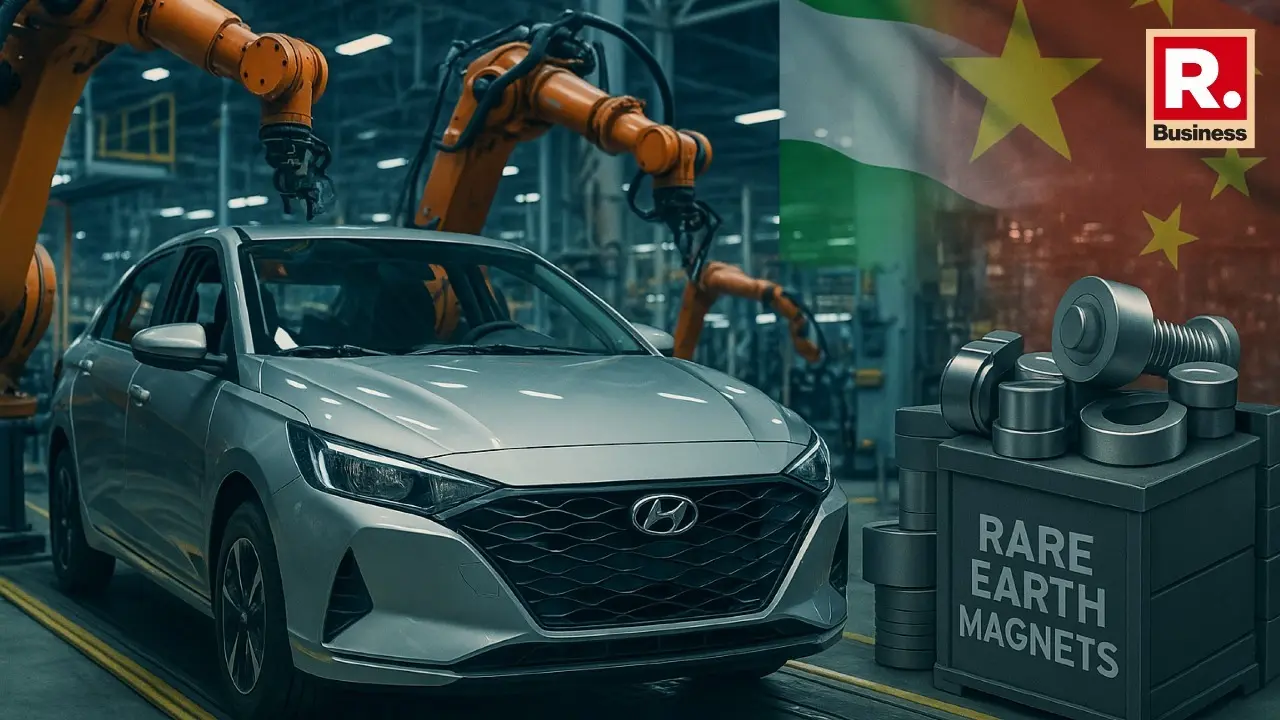
Hyundai Motor India has assured that its production operations remain unaffected despite global concerns stemming from China’s export curbs on rare earth magnets — critical components in both electric and internal combustion engine (ICE) vehicles.
During the company's recent earnings call, K.S. Hariharan, Head of Investor Relations, confirmed that Hyundai is maintaining sufficient inventory levels of rare earth magnets and continues to collaborate closely with supplier partners to manage inventory and mitigate any potential disruptions.
"We are not facing any issue. We are continuously working with our vendor partners and already have adequate inventory for the near term," Hariharan told reporters in a post earnings conference call.
This comes in the wake of China tightening its grip on rare earth exports, which are essential for various industries, including automotive, electronics, and renewable energy. Automakers globally are watching the situation closely, as magnets like Neodymium-Iron-Boron (NdFeB) and Samarium-Cobalt (SmCo) are vital for electric motors, steering systems, turbochargers, and audio units.
Since April 2025, Beijing has mandated export licences for seven key rare earth elements and associated magnets, aiming to regulate supply and restrict potential military applications.
China commands over 90% of the world’s refined rare earth magnet output, making its policy shifts globally consequential.
Despite the tightening supply chain, Hyundai India’s Whole-Time Director and COO, Tarun Garg, emphasized that the company faces no production hurdles for either EV or ICE models, thanks to robust backing from the Hyundai Motor Group.
Hyundai’s EV portfolio in India currently includes the Creta Electric and Ioniq 5, while its ICE lineup spans 12 models such as the Grand i10 Nios, Creta, Verna, and Alcazar. EVs typically require 1.5–3 kg of rare earth magnets due to their use in traction motors and other advanced systems, compared to roughly 100 grams in ICE vehicles.
Advertisement
Also REEad: Hyundai Motors India Share Price Jumps to All-Time High: Should You Buy Now? | Republic World
Hyundai Motor India's Q1 FY25 results
Hyundai Motor India reported a dip in its financial performance for the quarter ended June 30, 2025, with its consolidated net profit falling 8% year-on-year to Rs 1,369.23 crore, compared to Rs 1,489.65 crore in the corresponding quarter of the previous fiscal.
Advertisement
The South Korean carmaker's revenue also saw a decline, slipping 5.5% to Rs 16,179.61 crore from Rs 17,131.24 crore a year earlier.
Despite the subdued earnings, Hyundai Motor India’s stock remained largely unchanged, trading at Rs 2,084.95 per share on the BSE in late market hours.
Published By : Avishek Banerjee
Published On: 30 July 2025 at 19:12 IST