
IDFC First Bank Stock Surges Up to 9% as Q1 Net Profit More Than Doubles to ₹1,075 Crore
Shares of IDFC First Bank Limited surged near its 52-week high on Monday, July 27, 2026, after the private sector lender reported a record-high quarterly net profit for the April-June period, boosted by robust loan growth and lower credit costs.
- Republic Business
- 2 min read

;'%3e%3cpath%20d='m8,15.99c4.41,0,7.99-3.58,7.99-7.99S12.41,0,8,0,0,3.59,0,8s3.58,7.99,7.99,7.99Z'%20style='stroke:%23fff;%20stroke-miterlimit:10;%20stroke-width:.02px;'/%3e%3cpath%20d='m3.08,3.37l3.82,5.11-3.84,4.15h.87l3.37-3.64,2.72,3.64h2.94l-4.04-5.39,3.58-3.87h-.86l-3.1,3.35-2.5-3.35h-2.94Zm1.27.64h1.35l5.97,7.99h-1.35l-5.97-7.99Z'%20style='fill:%23fff;'/%3e%3c/g%3e%3c/svg%3e)


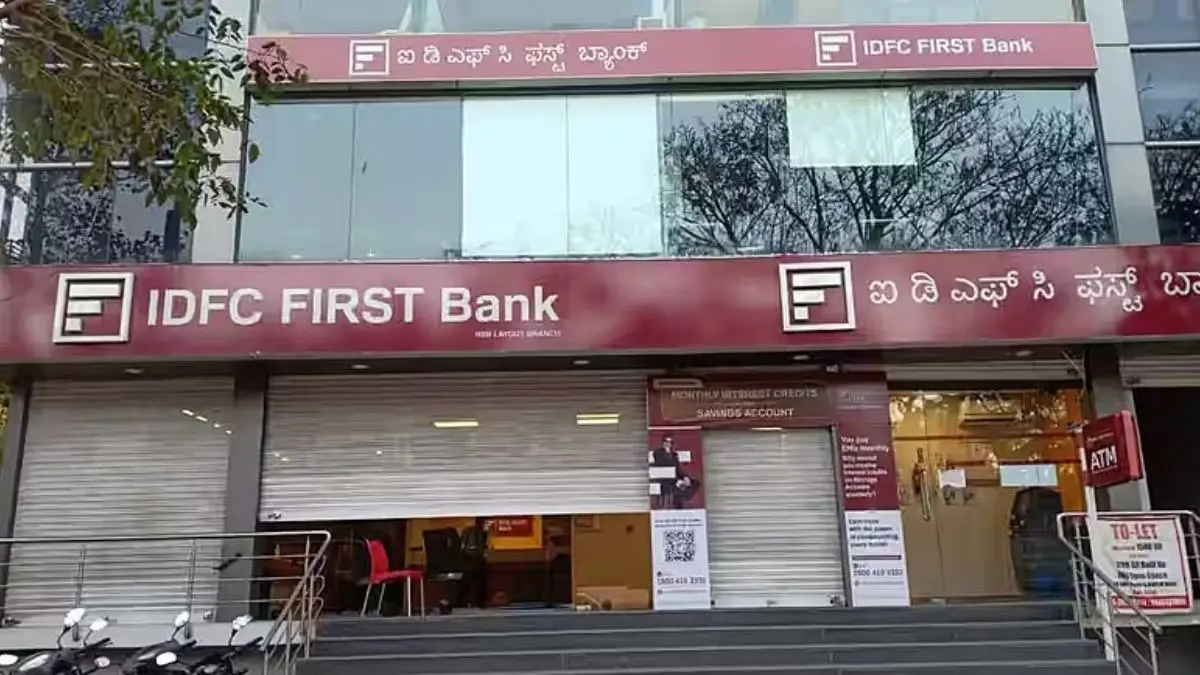
Shares of IDFC First Bank Limited surged near its 52-week high on Monday, July 27, 2026, after the private sector lender reported a record-high quarterly net profit for the April-June period, boosted by robust loan growth and lower credit costs.
The bank’s stock opened significantly higher at ₹86.30 against its previous close of ₹80.79 on the National Stock Exchange (NSE). Buying pressure accelerated during morning hours, pushing the stock up nearly 10% to an intraday high of ₹88.76.
As of 12:15 PM IST, IDFC First Bank was trading at ₹85.47, up ₹4.68 or 5.79%, with a volume-weighted average price (VWAP) standing at ₹86.70.
Q1 FY27
The stock rally follows the lender’s weekend earnings report. IDFC First Bank crossed the ₹1,000 crore quarterly net profit milestone for the first time in its history, posting a standalone Profit After Tax (PAT) of ₹1,075 crore for Q1 FY27—a 132.4% jump from ₹463 crore reported in the same period last year.
Advertisement
What's driving market optimism?
- Net Interest Income (NII): Grew 21.1% year-on-year to ₹5,972.3 crore from ₹4,933 crore.
- Net Interest Margin (NIM): Expanded by 25 basis points YoY to 5.96%.
- Deposits & CASA: Customer deposits rose 16.6% YoY to ₹2,99,405 crore, while the CASA ratio strengthened to 50.8%.
- Loan Book: Total customer business reached ₹6,04,776 crore, expanding 18.6% YoY.
Assets
Asset quality metrics showed broad-based improvement across retail and corporate books. Gross Non-Performing Assets (GNPA) fell 45 basis points YoY to 1.51%, while Net NPA improved to 0.44%.
Advertisement
The bank’s annualised Return on Assets (ROA) surpassed the 1.0% threshold to reach 1.05%, prompting management to lower its full-year credit cost guidance to 150–160 basis points. Analysts noted that operating leverage from earlier tech and branch investments is now translating directly into bottom-line expansion.