
India AI Impact Summit Sees Major Announcements on Infrastructure and Investment
The India AI Impact Summit 2026 featured announcements covering AI compute expansion, global investment commitments, sovereign AI models, private capital inflows, enterprise partnerships and AI-driven commerce demonstrations. The developments signal a broad-based push toward scaling AI infrastructure and deployment in India.
- Republic Business
- 3 min read

;'%3e%3cpath%20d='m8,15.99c4.41,0,7.99-3.58,7.99-7.99S12.41,0,8,0,0,3.59,0,8s3.58,7.99,7.99,7.99Z'%20style='stroke:%23fff;%20stroke-miterlimit:10;%20stroke-width:.02px;'/%3e%3cpath%20d='m3.08,3.37l3.82,5.11-3.84,4.15h.87l3.37-3.64,2.72,3.64h2.94l-4.04-5.39,3.58-3.87h-.86l-3.1,3.35-2.5-3.35h-2.94Zm1.27.64h1.35l5.97,7.99h-1.35l-5.97-7.99Z'%20style='fill:%23fff;'/%3e%3c/g%3e%3c/svg%3e)


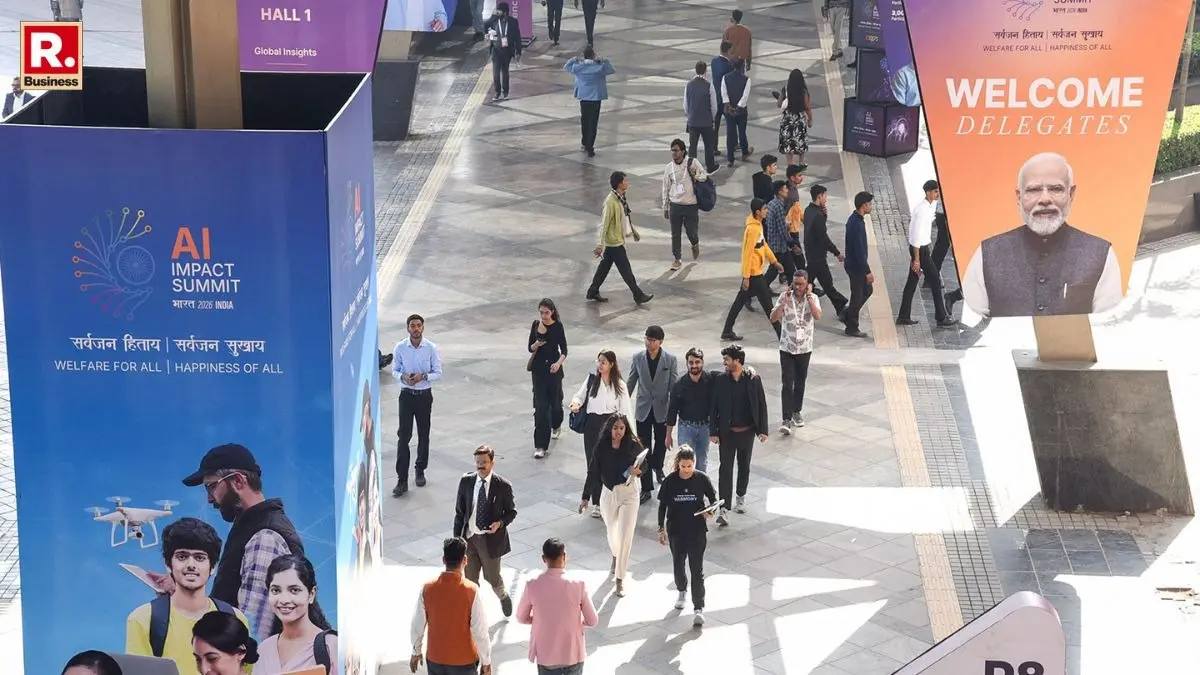
The India AI Impact Summit 2026 marked a significant shift in India’s artificial intelligence roadmap, with announcements spanning compute capacity expansion, multi-billion-dollar investments, sovereign AI models, and enterprise partnerships, underscoring the country’s push to position itself as a global AI hub.
1. India to scale domestic AI compute capacity under the national AI mission
Government officials confirmed that India’s national AI mission will see a phased rollout of high-performance compute infrastructure, including large-scale GPU clusters, aimed at reducing dependence on overseas cloud providers.
According to officials familiar with the programme, the initiative targets tens of thousands of GPUs over multiple phases, with access planned for startups, universities, public-sector institutions, and enterprises through subsidised pricing and shared infrastructure models.
The move is aligned with India’s broader digital public infrastructure strategy and is expected to support foundation model training, inference workloads, and applied AI research.
Advertisement
2. Microsoft announces $50 billion Global South AI investment
Microsoft announced a $50 billion investment commitment focused on AI infrastructure, cloud services, and skilling initiatives across the Global South, with India identified as a priority market.
The company said the capital will be deployed across:
Advertisement
- Data centre expansion
- Cloud and AI compute capacity
- AI tools for enterprises and developers
- Digital skilling and workforce enablement
India currently represents one of Microsoft’s fastest-growing cloud markets, driven by demand from IT services firms, startups, and large enterprises.
3. Google outlines increased AI partnerships in India
Google said it is expanding its AI investments and partnerships in India, spanning healthcare, education, enterprise AI, and public-sector systems.
Company executives highlighted early-stage collaborations with public health institutions, alongside efforts to integrate AI into education platforms and enterprise workflows. Google reiterated that India remains central to its global AI strategy due to scale, data diversity and developer adoption.
4. Sovereign AI models to support governance and regulated sectors
The government said India is accelerating work on sovereign AI models, designed to be trained, deployed, and hosted domestically, particularly for use in governance, healthcare, education and regulated industries.
Officials said the models will comply with data localisation norms and form part of India’s long-term plan to reduce reliance on foreign AI systems for sensitive public-sector workloads.
5. Private capital flows into AI data centres and compute platforms
Multiple investment firms announced capital commitments toward AI-focused data centres and compute infrastructure in India.
Industry estimates suggest that AI data centre investments in India could cross several billion dollars over the next five years, driven by demand for:
- GPU-intensive workloads
- Enterprise AI deployments
- Model training and inference services
Investors said India’s combination of cost advantages, talent availability, and enterprise demand makes it a competitive destination for AI infrastructure capital.
6. NVIDIA-backed AI factory partnerships announced
NVIDIA and its ecosystem partners outlined collaborations with Indian conglomerates and IT services firms to set up AI factories, facilities combining compute, software, and data pipelines for large-scale AI deployment.
These partnerships are aimed at enabling AI use cases across manufacturing, telecom, financial services, and public administration, with a focus on enterprise-grade deployment rather than experimentation.
7. AI-driven payments and commerce use cases demonstrated
Mastercard showcased AI-enabled commerce solutions, including agent-based payment systems capable of executing transactions under authenticated conditions.
The demonstrations highlighted how AI could be integrated into digital payments, fraud detection, and customer experience, areas critical to India’s high-volume digital transactions ecosystem.
8. AI Impact Expo extended amid strong industry participation
Summit organisers extended the AI Impact Expo by an additional day, extending it till 21st February, following strong attendance from industry leaders, startups, investors, and policy stakeholders.
The expo featured demonstrations across:
- AI hardware and chips
- Large language models
- Enterprise AI platforms
- Public-sector AI applications