
'India Can Lead Global EV Revolution': VinFast Asia CEO as Carmaker Unveils Bold Plans
Vietnam’s VinFast has entered India with VF 6 and VF 7 EVs, backed by a ₹2,000 crore investment in Tamil Nadu. CEO Pham Sanh Chau says the company aims to build a wider ecosystem of EVs, smart cities, and green energy, even as it misses out on India’s new EV policy benefits.
- Republic Business
- 4 min read

;'%3e%3cpath%20d='m8,15.99c4.41,0,7.99-3.58,7.99-7.99S12.41,0,8,0,0,3.59,0,8s3.58,7.99,7.99,7.99Z'%20style='stroke:%23fff;%20stroke-miterlimit:10;%20stroke-width:.02px;'/%3e%3cpath%20d='m3.08,3.37l3.82,5.11-3.84,4.15h.87l3.37-3.64,2.72,3.64h2.94l-4.04-5.39,3.58-3.87h-.86l-3.1,3.35-2.5-3.35h-2.94Zm1.27.64h1.35l5.97,7.99h-1.35l-5.97-7.99Z'%20style='fill:%23fff;'/%3e%3c/g%3e%3c/svg%3e)


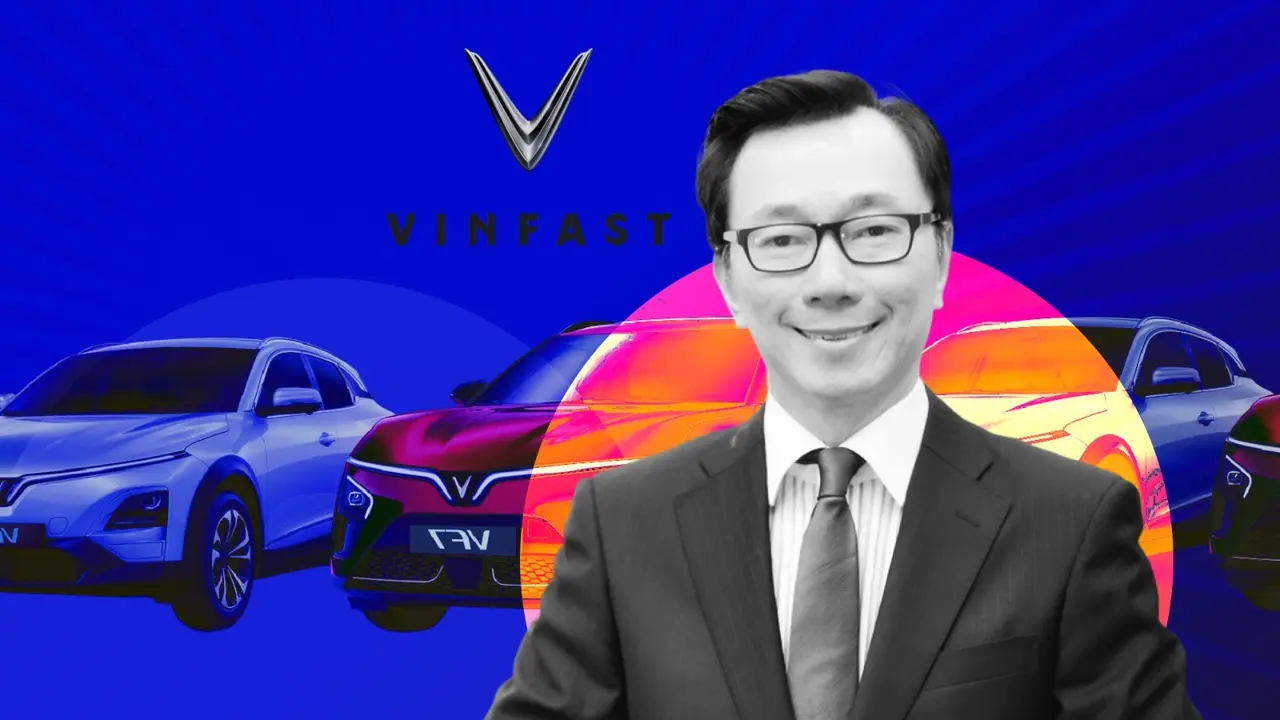
Vietnamese electric vehiclemaker VinFast Auto Limited enters India with VF 6 and VF 7 SUVs, a Rs 2,000 crore investment, and a roadmap spanning EVs, smart cities, and green energy — even as it misses out on policy incentives.
Vision for a Pan-India ecosystem
The Haiphong-based firm has formally debuted in India, but its ambitions stretch far beyond just selling cars. Backed by parent company Vingroup JSC, the country’s largest conglomerate, VinFast is eyeing an integrated ecosystem here — spanning electric mobility, renewable energy, smart cities, healthcare, and hospitality.
“Our chairman wants to bring the whole ecosystem of Vingroup into India. Even if we don’t sell 50,000 cars, it’s no issue. We want to be here for the long run,” said Pham Sanh Chau, CEO of VinFast Asia, in a round table interaction.
EV manufacturing plans
At the centre of this expansion is VinFast’s new manufacturing facility at Thoothukudi, Tamil Nadu, which began operations this year. The plant has an annual capacity of 50,000 EVs, already backed by an investment of Rs 2,000 crore out of a larger $2 billion commitment.
Advertisement
The company's long-term plans are to scale up the output to 1.5 lakh units in the second phase and 300,000 eventually, alongside a network of 35 showrooms in 27 cities and 15,000 charging stations nationwide.
However, the company maintained that the journey has not been without hurdles. Chau expressed disappointment that VinFast does not qualify for the government’s newly announced Scheme to Promote Manufacturing of Electric Passenger Cars in India (SPMEPCI).
Advertisement
“This scheme was drafted when we were considering entering India. But now our car has rolled out from the Indian factory and the policy is complete. We no longer qualify. It should have included VinFast’s investment,” he noted. Calling for greater alignment, he added: “The process of policymaking does not match the speed with which companies are investing. Companies move much faster.”
Unlike many global rivals that test the waters with imported units, VinFast opted to invest directly in Indian manufacturing. “We came straight and built our factory. Others import CBUs to test the market. Yet we are not recognised under the EV scheme. That is the irony,” Chau remarked.
Product rollout and sales strategy
The company’s strategy is also built on customer trust rather than short-term sales targets, according to the company. For its first 1,500 cars, VinFast is offering three years of free charging, three years of free maintenance, and a 10-year warranty on both vehicle and battery. “We don’t put volumes as the key performance indicator,” Chau emphasized.
Beyond cars, VinFast plans to launch a new EV model every six months, including electric two-wheelers and buses. Work is underway to adapt its e-buses for India’s right-hand-drive market, with trials and state-level discussions already in progress. The company is also evaluating the VinFast VF 3, an affordable mini-SUV expected to launch in India in late 2025, likely priced in the Rs 7–10 lakh range.
Smart cities and beyond
Chau underlined Vingroup’s broader ambition to replicate its Vietnamese model of smart cities, luxury resorts, schools, and hospitals in India. “We want to build Smart Cities bigger than 2,000 acres where everything is green: e-buses, charging points, e-taxis, and electric two-wheelers,” he said.
Product Specifications and Pricing
Meanwhile, the debut products — the VF 6 and VF 7 SUVs — are locally assembled in Tamil Nadu. The VF 6, powered by a 59.6 kWh battery, offers a certified range of up to 468 km and supports rapid charging from 10% to 70% in 25 minutes. The larger VF 7, available in multiple variants with batteries up to 70.8 kWh, delivers 438–532 km ranges, with the dual-motor Sky variant sprinting 0–100 km/h in 5.8 seconds. Prices start at Rs 16.49 lakh for the VF 6 Earth and Rs 20.89 lakh for the VF 7 Earth (ex-showroom, introductory).
For Chau, however, the bigger picture is clear: “With its scale, India can lead the global electric revolution.”