
India Energy Week 2026: UAE Minister Al Jaber Highlights Enduring Oil Demand and India’s Strategic Role
At India Energy Week 2026, ADNOC CEO Sultan Ahmed Al Jaber, UAE Minister of Industry and Advanced Technology, said global oil demand is expected to remain above 100 million barrels per day beyond 2040, underscoring the resilience of energy markets. Analysts forecast that India will be the largest driver of energy demand growth through 2035, supported by rising electricity consumption, industrial expansion, and renewable energy adoption.
- Republic Business
- 2 min read

;'%3e%3cpath%20d='m8,15.99c4.41,0,7.99-3.58,7.99-7.99S12.41,0,8,0,0,3.59,0,8s3.58,7.99,7.99,7.99Z'%20style='stroke:%23fff;%20stroke-miterlimit:10;%20stroke-width:.02px;'/%3e%3cpath%20d='m3.08,3.37l3.82,5.11-3.84,4.15h.87l3.37-3.64,2.72,3.64h2.94l-4.04-5.39,3.58-3.87h-.86l-3.1,3.35-2.5-3.35h-2.94Zm1.27.64h1.35l5.97,7.99h-1.35l-5.97-7.99Z'%20style='fill:%23fff;'/%3e%3c/g%3e%3c/svg%3e)


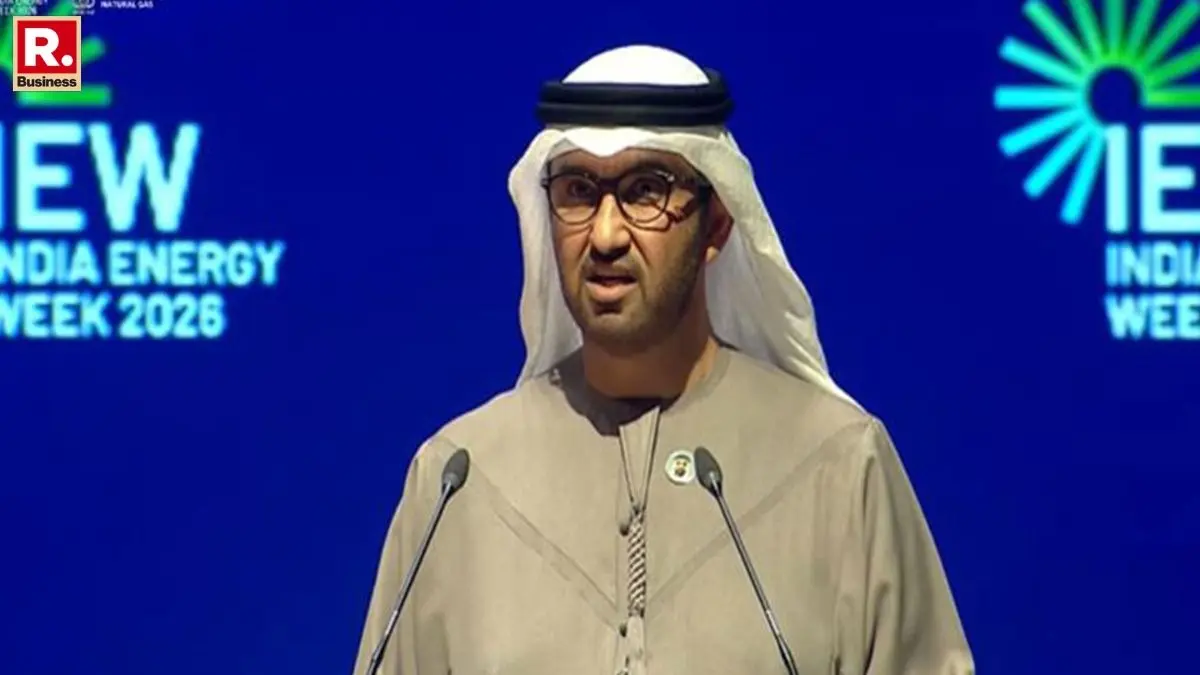
At India Energy Week 2026 in Goa, Dr Sultan Ahmed Al Jaber, UAE Minister of Industry and Advanced Technology and Group CEO of ADNOC, highlighted the strengthening energy partnership between India and the UAE. He emphasised India’s central role in global energy demand and the long-term collaboration shaping regional and international energy markets.
“As the world’s third‑largest energy consumer, India has become a key driver of global crude demand,” Al Jaber said, underlining India’s growing influence in both crude oil and gas sectors.
Al Jaber described the India–UAE energy relationship as a strategic, enduring partnership built on reliability and mutual trust. He stressed that the UAE will continue to be a “trusted and dependable supplier” as India’s energy consumption rises, reflecting the long-term vision shared by both nations.
He further pointed out that India ranks as ADNOC’s top market for liquefied natural gas (LNG), an essential fuel for power generation, chemicals, and industrial sectors. ADNOC also serves as India’s largest supplier of liquefied petroleum gas (LPG), supporting both domestic consumption and industrial applications.
Advertisement
Al Jaber highlighted that the partnership goes beyond conventional hydrocarbons, extending into feedstocks and chemicals for India’s refining and petrochemical industries, strengthening a long-term collaborative energy value chain.
Advertisement
India’s Growing Energy Role
Independent projections from the International Energy Agency (IEA) indicate that India will account for the largest share of incremental global energy demand through 2035, driven by urbanisation, industrial expansion, and increased household energy consumption. India’s installed electricity capacity has expanded to around 476 GW, with renewable sources contributing nearly half. The country aims to reach 500 GW of non-fossil energy capacity by 2030, highlighting its pivotal role in global energy transformation.
Investment and Infrastructure as Key Drivers
Al Jaber emphasised that underinvestment poses a greater risk to energy security than oversupply, reflecting a need for strategic planning in generation, grids, storage, and emerging technologies. India’s growing digital economy, including data centres and AI-driven infrastructure, will add further pressure on energy systems, requiring a balance of conventional and clean energy solutions.
Beyond consumption, India is increasingly a hub for international energy investment. Its expanding natural gas imports, renewable energy adoption, and growing refining capacity make it a focal point for international stakeholders seeking to secure long-term energy partnerships.