
India-EU FTA: 'The Mother Of All Deals' - What's In It For World's Fastest Growing Economy?
Ahead of her India Visit, EU Chief Ursula von der Leyen said, “We are on the cusp of a historic trade agreement some call it the “mother of all deals.” Let's look at the contours of the historic trade pact - India-EU FTA set to take centre stage in January 2026".
- Republic Business
- 3 min read

;'%3e%3cpath%20d='m8,15.99c4.41,0,7.99-3.58,7.99-7.99S12.41,0,8,0,0,3.59,0,8s3.58,7.99,7.99,7.99Z'%20style='stroke:%23fff;%20stroke-miterlimit:10;%20stroke-width:.02px;'/%3e%3cpath%20d='m3.08,3.37l3.82,5.11-3.84,4.15h.87l3.37-3.64,2.72,3.64h2.94l-4.04-5.39,3.58-3.87h-.86l-3.1,3.35-2.5-3.35h-2.94Zm1.27.64h1.35l5.97,7.99h-1.35l-5.97-7.99Z'%20style='fill:%23fff;'/%3e%3c/g%3e%3c/svg%3e)


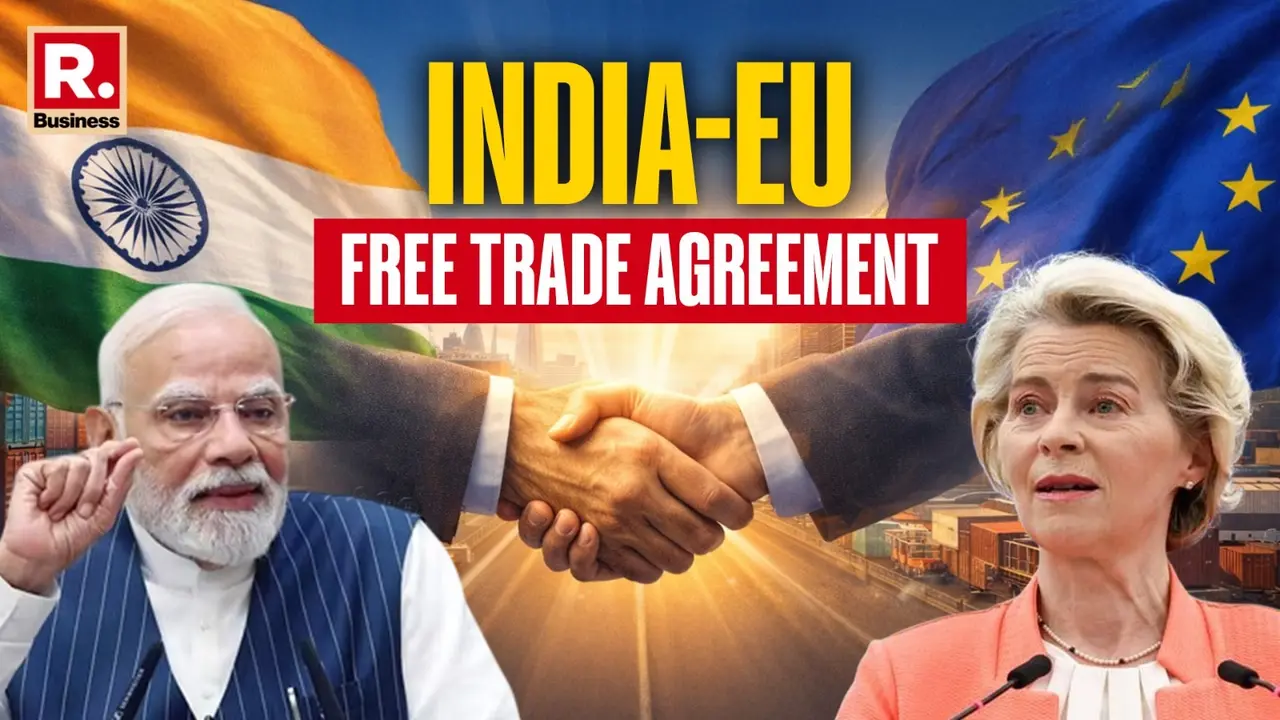
After having inked 7 free trade agreements (FTAs) with economies surpassing a combined GDP of $20 trillion since 2021, India's growth story is all set to be bolstered through a historic trade pact with European Union (EU), expected this January.
On the highly-anticipated India-EU FTA, EU Chief Ursula von der Leyen said, “There is still work to do. But we are on the cusp of a historic trade agreement. Some call it the mother of all deals. One that would create a market of 2 billion people, accounting for almost a quarter of global GDP,” addressing the WEF at Davos 2026.
The European Union is on the verge of concluding a free trade agreement with India, although work remains to get it over the line, European Commission President Ursula von der Leyen said in a speech at the World Economic Forum in Davos on Tuesday.
This comes after earlier this year Union Commerce Minister Piyush Goyal and EU Commissioner for Trade and Economic Security Maros Sefcovic met in Brussels and took stock of progress of negotiations. The
Advertisement
"Both leaders provided guidance to negotiating teams to resolve pending issues and expedite the agreement," the Ministry of Commerce said.
The officials worked to "narrow divergences" and ensure clarity on outstanding issues, clearing the path for the ministerial dialogue, it said.
Advertisement
From Mauritius Trade Pact To India-EU FTA
India signed the Comprehensive Economic Cooperation and Partnership Agreement (CECPA) with Mauritius in 2021, marking its first trade agreement with an African country. India–Mauritius bilateral trade stood at around $690 million in FY21 and has since recorded steady growth, supported by tariff concessions and expanded services access under the agreement.
At present, the south Asian nation stands at the heels of inking the India–EU FTA after 16 rounds, with “open issues narrowing.” At stake, lies $136.5 billion in annual goods, trade and market access across 23 chapters, including autos and IPR to textiles and services—one of India’s most consequential trade deals.
The Contours Of India-EU Bilateral Trade
In FY25, India exported goods totalling $76 billion to the EU and imported nearly $61 billion, signalling a trade surplus.
During the same fiscal period, the fastest growing world economy exported Petroleum products worth $15.0 billion, electronics totalling 11.3 billion, $4.5 billion worth of textiles, and garments to the EU. Coming to Pharma, India sold good worth $3.0 billion, $1.6 billion in auto parts, and $775 million in coffee, and $809 million worth footwear.
On the other hand, the removal of the EU’s Generalised System of Preferences in 2023 impacted global competitiveness of several Indian exports.
The average EU tariffs on Indian goods hovered around 3.8 percent on exports of $75.9 billion in FY2025. Meanwhile, the labour-intensive sectors like textiles and apparel continue to face duties of close to 10 percent. A removal in such tariffs is expected to deliver clear export gains.
Once formally announced, this trade pact will be considered as India’s largest free trade agreement both scale-wise and regulatory coverage.
The proposed agreement will broaden India's export market via the European Union, whose GDP is estimated nearly between $20.9–25.6 trillion with a market spanning 450 million high-income consumers.