
India & Finland Ink Mobility Pact; 2030 Vision To Double Trade Via New Strategic Partnership
India and Finland signed the Migration and Mobility Partnership Agreement to link their innovation ecosystems. The countries have reported a 19% surge in bilateral trade for the current fiscal year. With the trade deficit narrowing, both leaders have committed to doubling trade volumes by 2030.
- Republic Business
- 2 min read

;'%3e%3cpath%20d='m8,15.99c4.41,0,7.99-3.58,7.99-7.99S12.41,0,8,0,0,3.59,0,8s3.58,7.99,7.99,7.99Z'%20style='stroke:%23fff;%20stroke-miterlimit:10;%20stroke-width:.02px;'/%3e%3cpath%20d='m3.08,3.37l3.82,5.11-3.84,4.15h.87l3.37-3.64,2.72,3.64h2.94l-4.04-5.39,3.58-3.87h-.86l-3.1,3.35-2.5-3.35h-2.94Zm1.27.64h1.35l5.97,7.99h-1.35l-5.97-7.99Z'%20style='fill:%23fff;'/%3e%3c/g%3e%3c/svg%3e)


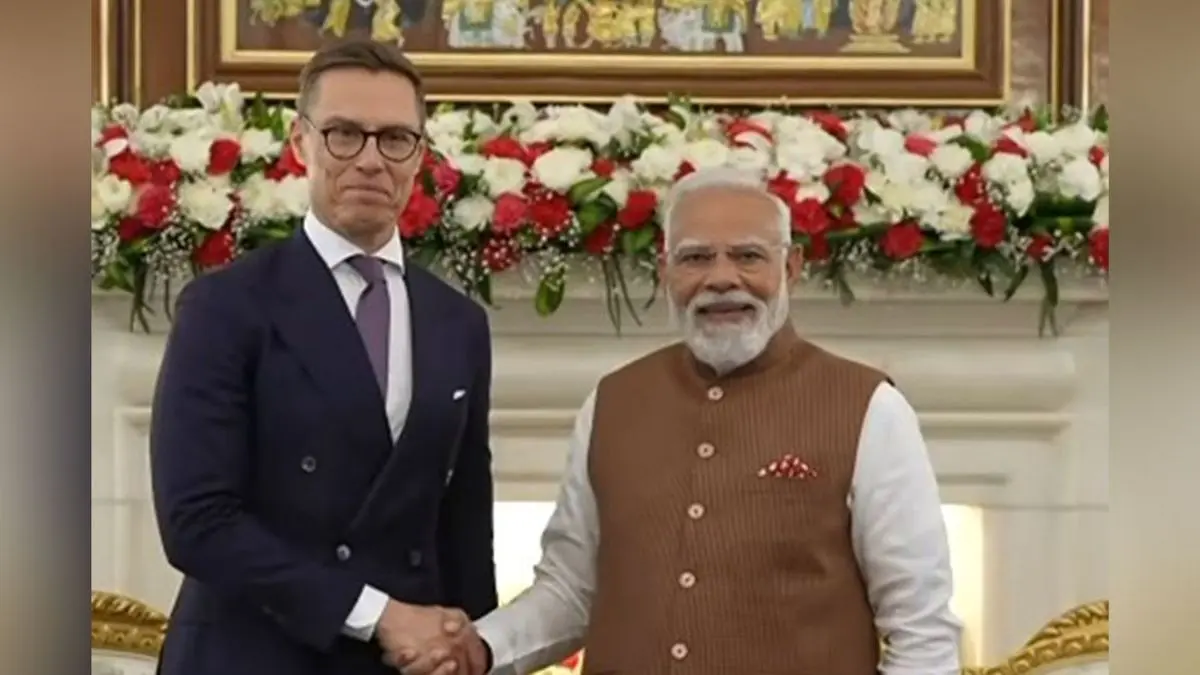
To streamline the movement of students, professionals, and researchers, Prime Minister Narendra Modi and President Alexander Stubb formalized a Migration and Mobility Partnership Agreement. PM Modi described Finland as a "preferred destination" for Indian talent. He noted that the pact would bridge the gap between "school and industry." The agreement specifically targets the entrepreneurial space, thus fostering joint research and startup collaborations in high-tech sectors such as AI, 6G, and quantum computing.
Bilateral trade grew by 19% in the April–December (FY26) period, reaching approximately $1.52 billion.
Crucially, India’s export competitiveness has led to a significant structural realignment. India’s outbound shipments to Finland jumped 11% year-on-year, helping the trade deficit narrow to $300–$400 million. This change is driven by a diversified export basket:
- High-Tech Exports: Heterocyclic compounds now account for 28% of India's exports to Finland.
- Maritime & Pharma: Passenger and cargo vessels comprise 10%, while pharmaceuticals maintain a steady 12%share.
- Finnish Inputs: India's imports of Finnish industrial technology and electronic components grew by 24%, reflecting India's scaling manufacturing needs.
Doubling Bilateral Trade
President Stubb, accompanied by a delegation of 20 Finnish companies, said that the goal is to at least double bilateral trade in the coming years. This ambition is underpinned by the historic India-EU Free Trade Agreement signed in early 2026, which has already begun reducing tariff barriers and stabilizing supply chains.
Advertisement
The partnership also extends to environmental frontiers, with new agreements on Arctic and polar research and the expansion of the "Green Growth" corridor. As PM Modi noted, the relationship between these two "diplomatic powers" is entering a “golden era.” This will provide a stable anchor for global growth and innovation.