
India-Russia Summit: PM Modi-Putin’s Strong ‘Tariff’ Signal Amid Trump’s Trade War
PM Modi and President Putin finalised a 2030 economic roadmap at the India-Russia Summit, signalling deeper trade cooperation amid Trump’s 50% tariffs. Both leaders pushed to cut tariff barriers, expand defence and energy ties, and target USD 100 billion in trade while shifting payments to rupees and rubles.
- Republic Business
- 3 min read

;'%3e%3cpath%20d='m8,15.99c4.41,0,7.99-3.58,7.99-7.99S12.41,0,8,0,0,3.59,0,8s3.58,7.99,7.99,7.99Z'%20style='stroke:%23fff;%20stroke-miterlimit:10;%20stroke-width:.02px;'/%3e%3cpath%20d='m3.08,3.37l3.82,5.11-3.84,4.15h.87l3.37-3.64,2.72,3.64h2.94l-4.04-5.39,3.58-3.87h-.86l-3.1,3.35-2.5-3.35h-2.94Zm1.27.64h1.35l5.97,7.99h-1.35l-5.97-7.99Z'%20style='fill:%23fff;'/%3e%3c/g%3e%3c/svg%3e)


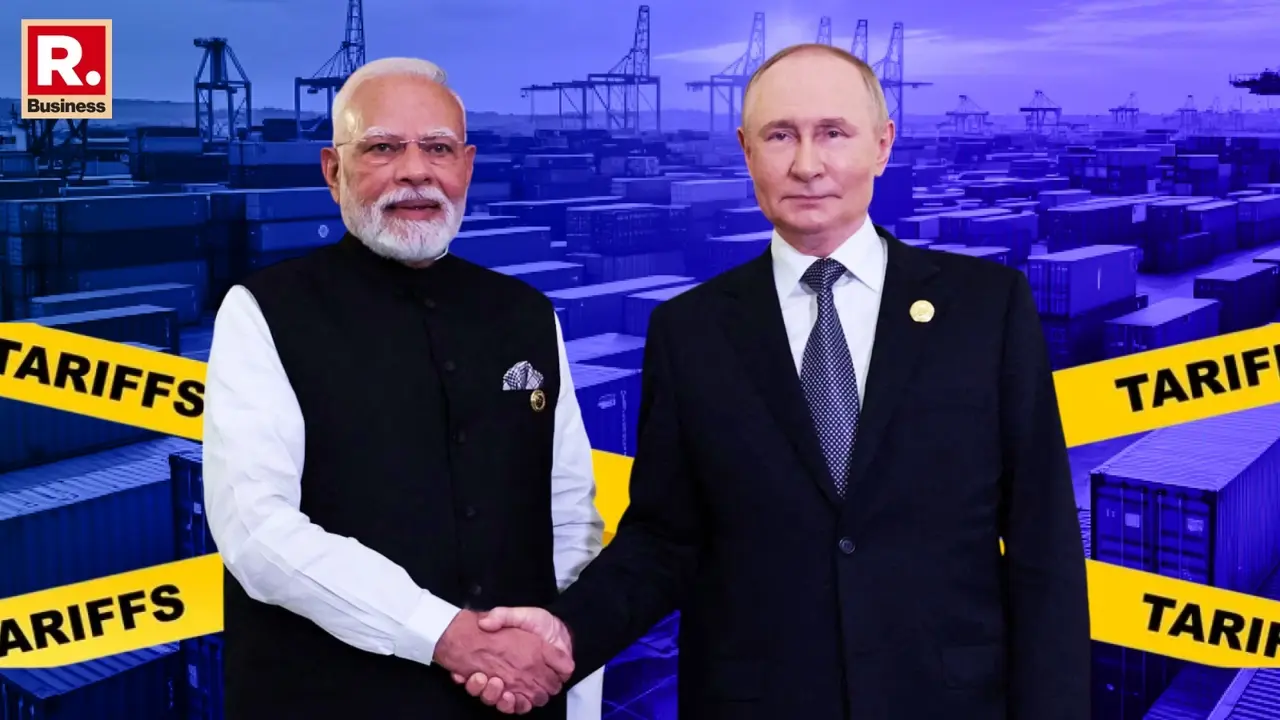
Prime Minister Narendra Modi on Friday described India–Russia ties as a “North Star” in a turbulent global landscape, using the 23rd Annual Summit in New Delhi to send a calibrated but unmistakable signal amid US President Donald Trump’s escalating tariff war. Addressing a joint press conference with Russian President Vladimir Putin at Bharat Mandapam, Modi announced that both countries had finalised an economic cooperation programme till 2030, designed to reduce tariff and non-tariff barriers and widen bilateral trade.
At the India–Russia Business Forum, Modi recalled that the two leaders had set a target of achieving USD 100 billion in bilateral trade by 2030. “But after my discussions with President Putin yesterday, I feel we will not have to wait until 2030—we will achieve it earlier. Work is also underway to reduce tariff and non-tariff barriers,” he said. He added that despite global disruptions, the India–Russia partnership had remained “steadfast like a pole star” across eight decades of geopolitical upheavals.
Advertisement
Also Read: Modi, Putin Announce Major Accords: Europe War, Anti-Terror Cooperation, Make-in-India, E-Visa For Russians Drive Top Agenda | Republic World
The summit, held against the backdrop of Washington’s punitive 50% tariff regime on Indian imports—triggered in part by India’s continued purchase of discounted Russian oil—saw both leaders double down on insulating economic ties from external pressure. Modi reiterated that the conflict in Ukraine “must be brought to an end through dialogue,” even as the two sides advanced a robust five-year plan focusing on trade, defence, energy, and technology.
Putin highlighted that bilateral trade had already touched USD 64–65 billion, rising 12% last year, and was forecast to stay at similar levels before accelerating toward the USD 100-billion milestone. Moscow and New Delhi, he said, were reducing tariff and non-tariff barriers, coordinating a 2030 roadmap, and progressing on a proposed free trade zone between India and the Eurasian Economic Union. He also emphasised that 96% of bilateral payments were now conducted in rupees and rubles, helping both countries bypass the dollar as a “political tool.”
Putin, who received a ceremonial welcome at Rashtrapati Bhavan on 4 December, praised Modi as a “very wise leader” for resisting US pressure on Russian oil imports, which continue to account for roughly 35% of India’s intake despite sanctions affecting companies like Rosneft. Key discussions centred on boosting Indian exports—especially agricultural and medical products—to counter tariff-driven losses, alongside progress on defence deals for Su-57 jets and S-400 systems, civil nuclear cooperation, and labour mobility agreements.
Overall, the two-day visit reaffirmed that New Delhi and Moscow are positioning their partnership to withstand global economic realignments while signalling that tariff pressure will only accelerate their strategic and trade convergence.