
‘Don’t Hitch Your Ride To US’: Jeffrey Sachs At Republic Summit, Says India Will Be World’s Growth Story
At Republic Summit 2026, economist Jeffrey Sachs discusses the US market bubble, global capital, India-China ties and why he believes India will be the world growth story.
- Republic Business
- 7 min read

;'%3e%3cpath%20d='m8,15.99c4.41,0,7.99-3.58,7.99-7.99S12.41,0,8,0,0,3.59,0,8s3.58,7.99,7.99,7.99Z'%20style='stroke:%23fff;%20stroke-miterlimit:10;%20stroke-width:.02px;'/%3e%3cpath%20d='m3.08,3.37l3.82,5.11-3.84,4.15h.87l3.37-3.64,2.72,3.64h2.94l-4.04-5.39,3.58-3.87h-.86l-3.1,3.35-2.5-3.35h-2.94Zm1.27.64h1.35l5.97,7.99h-1.35l-5.97-7.99Z'%20style='fill:%23fff;'/%3e%3c/g%3e%3c/svg%3e)


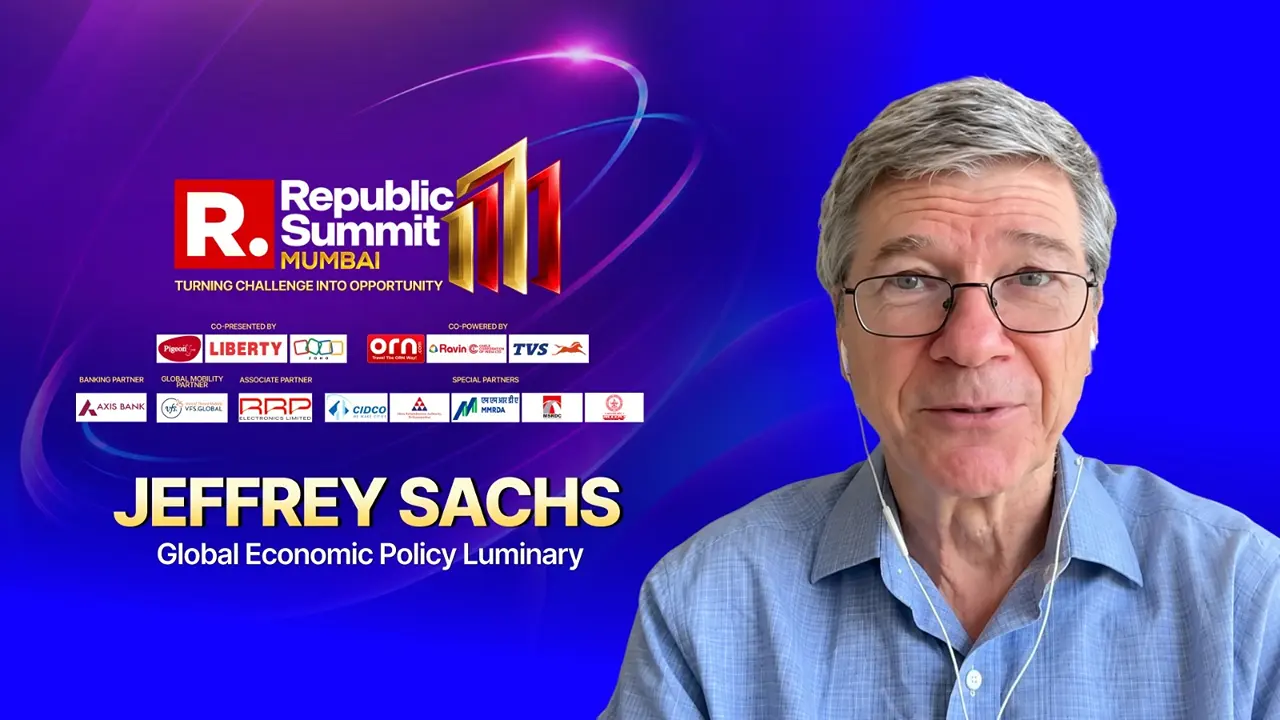
Mumbai: Jeffrey D. Sachs, one of the world’s most prominent economists and a leading voice on global development, brought a sweeping assessment of the world economy, US-China relations and India’s place in a rapidly shifting geopolitical order to the Republic Summit 2026 in Mumbai.
At the Republic summit, Sachs moved across some of the biggest questions confronting the global economy, from the complicated India-China relationship and the latest Trump-Xi engagement to the attraction of Indian markets, the flow of global capital and what he sees as an increasingly important role for BRICS and the Shanghai Cooperation Organization.
India And China: Business On One Side, Geopolitics On The Other
Sachs began by addressing the contradictions in the India-China relationship, where economic interests and geopolitical tensions often pull in different directions. “There’s been a contradictory relationship where China wants to do a lot of business with India,” Sachs said, while pointing to the complications that arise over issues such as US expansion, China’s support to Pakistan and wider geopolitical tensions.
He argued that the “geoeconomic” aspect of the relationship is an area that still needs to be worked through.
Advertisement
“I know, but don’t fear that, and then it’ll be easier. This is a part of the bilateral relationship that needs to be sorted out,” he said. For Sachs, the India-China relationship therefore cannot be viewed simply through the lens of either trade or geopolitics. The two dimensions exist alongside each other, creating both opportunities and difficulties.
Trump-Xi Summit: ‘Happier When There Is No Content Than When There Is Conflict’
Turning to the recent Trump-Xi engagement, Sachs offered a striking assessment of the summit and the optics surrounding it. “I was happy with the outcome of the summit. It seemed to have no content at all. You know, I’m not happy when there’s no content, but I’m happier when there is no content than when there is conflict,” he said.
Advertisement
Sachs argued that the US had effectively backed down from some of the threats that had marked its earlier approach towards China. “I think basically the U.S. backed down. It didn’t say to China, ‘You can’t buy Russian oil.’ It didn’t say to China, ‘You can’t buy Iranian oil.’ It didn’t make threats to China.”
He also pointed to the highly public nature of the meeting, describing Trump’s interactions with Xi and the surrounding events as part of a very different tone from the trade confrontations of the previous year.
“Trump wanted to put on a good show. He brought his 19 billionaire friends to dinner that night. He took Xi Jinping and his wife around a tour of Washington. It was all very pleasant,” Sachs said.
But for him, the larger takeaway lay beyond the ceremony. “I think what that shows is that last year when Trump came back into office and put on tariffs and trade and made all sorts of threats, it didn’t work. So I was satisfied with this.”
‘Don’t Hitch Your Ride To The United States’
Sachs then turned his attention to what he believes India should be watching as the global economic order shifts. His message was direct. “Don’t hitch your ride to the United States. This is not the way to go,” he said.
Instead, Sachs pointed towards a wider network of emerging economic and geopolitical groupings. “Hitch your ride to BRICS, to the Shanghai Cooperation Organization, to India’s leadership with Africa.”
He also highlighted Africa’s potential, describing it as “another giant” and pointing towards the continent’s development needs and expected growth. “They need what India has, the whole big development,” Sachs said. The argument placed India not simply as an economy responding to global changes, but as a country that could itself become an important part of the development story across the Global South.
Sachs also underlined India’s position among the world’s major emerging economies, arguing that the country’s future lies in deeper engagement with emerging and developing markets.
“India is the fastest-growing large economy. India’s future is in trade with emerging and developing countries – this is where the world’s fast growth is going to take place, not in the old world,” Sachs said.
If Indian Markets Are So Attractive, Where Is The Money?
Sachs was then confronted with a different question: if India’s market valuations and growth prospects are so attractive, why is global investment not flowing into the country at the scale one might expect?
His answer, he does not see a fundamental obstacle. “I don’t see any fundamental obstacles,” Sachs said. Instead, he pointed towards what he described as a bubble in the United States that is currently drawing capital towards American markets.
“I think the world is pretty oriented right now towards a bubble in the United States,” he said, before turning specifically to the role of artificial intelligence in attracting capital. “AI holds in a lot of money.”
Sachs then made a pointed observation about the state of American capitalism, referring to an AI company preparing for an IPO while acknowledging that its technology could potentially destroy humanity.
“This is the quality of American capitalism right now,” he said. “We’re about to have an IPO for a company that admits it could destroy humanity. I wish they’d slow down a little bit and get this right before they destroy us.”
‘There Really Is A Bubble’: Why Sachs Thinks Capital Could Move
For Sachs, the attraction of the US market may not last indefinitely. He said he sees sophisticated investors beginning to move away because they believe the US market is overvalued. “But I think, and I see a lot of sophisticated investors that are moving away because they understand the U.S. market is overvalued,” Sachs said.
“They understand there really is a bubble. They understand we’re led by the likes of Donald Trump. That makes a difference.”
He reiterated that he did not see a fundamental barrier preventing more capital from moving towards India. His argument also rests on the changing cost of capital in the United States.
“U.S. interest rates are rising. They’re reaching levels not seen in the last 20 years,” Sachs said. “Our long-term debt is now at about five-and-a-half percent yield, which is—we haven’t seen that in decades.”
For Sachs, that creates another reason for investors to question whether the current US market surge can continue indefinitely.
“And so there is a lot of sense right now among people that are investing. Yes, the bubble’s going on a bit, but don’t assume that it’s going to go on for that much longer.”
And Then Came His Five-Year India Forecast
The conversation ultimately returned to India. Asked what he sees as the biggest story emerging from India over the next five years, Sachs gave a short and sweeping answer, “India will be the world growth story.”
That statement came after a discussion that had ranged from India-China tensions and the Trump-Xi summit to US markets, global capital flows, BRICS, the SCO and India’s role in Africa. For Sachs, the larger picture is therefore not simply about India navigating global headwinds. It is about where the centre of global growth could be heading next.