
India–UK FTA: Your Car To Go Cheap Or Expensive? Here's How It Will Affect Auto Sector
The India–UK FTA slashes tariffs, opening new opportunities for Indian automakers, EV firms, and auto part exporters in the UK. Luxury British cars get cheaper in India, while Indian brands like Tata, Mahindra, and Royal Enfield gain easier access to UK markets.
- Republic Business
- 3 min read

;'%3e%3cpath%20d='m8,15.99c4.41,0,7.99-3.58,7.99-7.99S12.41,0,8,0,0,3.59,0,8s3.58,7.99,7.99,7.99Z'%20style='stroke:%23fff;%20stroke-miterlimit:10;%20stroke-width:.02px;'/%3e%3cpath%20d='m3.08,3.37l3.82,5.11-3.84,4.15h.87l3.37-3.64,2.72,3.64h2.94l-4.04-5.39,3.58-3.87h-.86l-3.1,3.35-2.5-3.35h-2.94Zm1.27.64h1.35l5.97,7.99h-1.35l-5.97-7.99Z'%20style='fill:%23fff;'/%3e%3c/g%3e%3c/svg%3e)


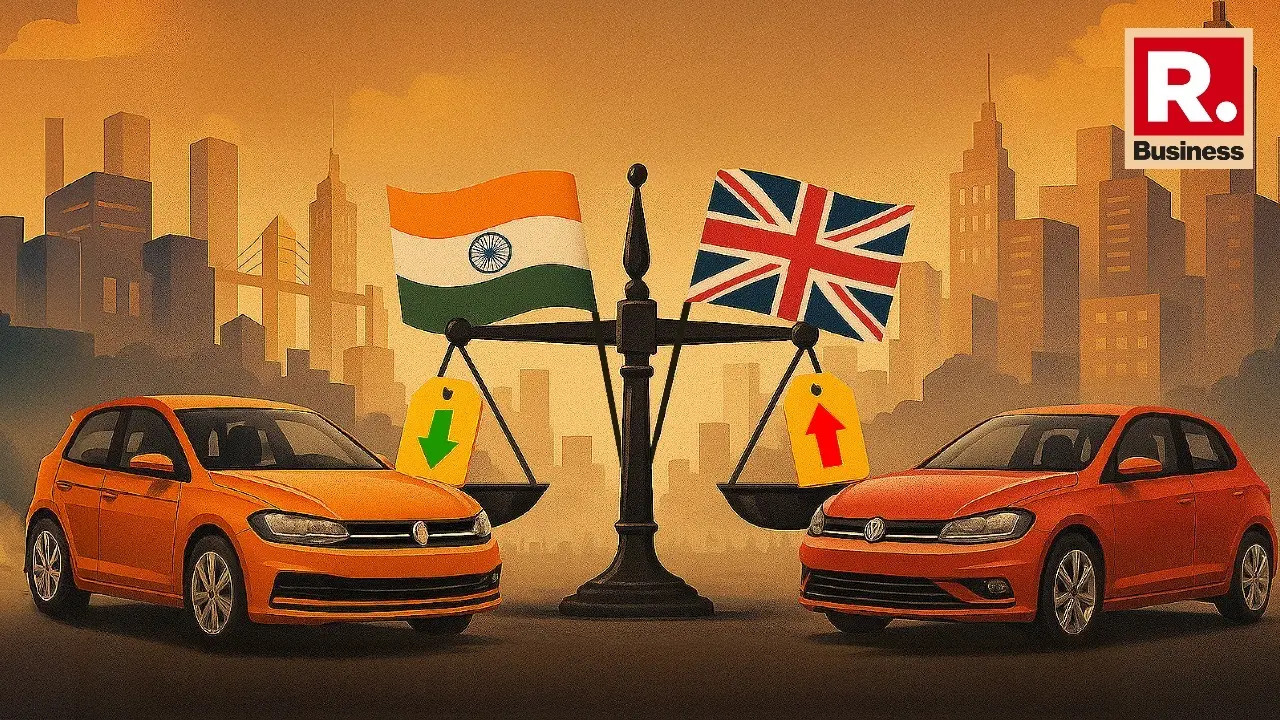
In a landmark move for global trade, the recently signed India–UK Free Trade Agreement (FTA) is expected to open significant growth avenues for India’s automobile and allied industries. By eliminating tariffs on nearly 99% of traded goods, the deal strengthens India’s ties with a major developed market and gives domestic manufacturers a competitive edge globally.
The FTA is a breakthrough for both countries, particularly in the premium vehicle, EV, and auto component segments. It slashes steep import duties and opens fresh export corridors.
Tariff Relief for premium British cars
Luxury car buyers in India stand to benefit the most. Import duties on fully built British cars—currently over 100%—could drop to around 10% under a quota-based system. This benefits brands like Jaguar Land Rover (JLR), Rolls-Royce, Bentley, McLaren, and Aston Martin, making their models far more competitively priced.
JLR, owned by Tata Motors, is seen as a major beneficiary. With UK-based production, it can scale up in India’s luxury market and possibly export India-assembled EVs back to the UK duty-free, according to industry analysts.
Shailesh Chandra, President of SIAM and MD of Tata Passenger Vehicles and Tata Electric, praised the government’s balanced tariff approach. He said the automobile sector tariffs thoughtfully balance consumer interests with India’s industrial goals. Chandra also highlighted that the FTA opens new opportunities for collaboration with the UK and showcases India’s leadership in modern trade frameworks.
Advertisement
India’s EV makers eye UK
Indian automakers such as Mahindra & Mahindra and Maruti Suzuki are set to benefit as the agreement provides zero-duty access for Indian-made vehicles to the UK. This is a big incentive for companies planning global expansions.
According to industry observers, Tata Motors, Hyundai India, and Toyota Kirloskar may also ramp up exports of right-hand-drive models suited for British roads. The FTA is seen as a gateway for Indian EVs to compete internationally.
Boost for two-wheelers and startups
Two-wheeler giants like Royal Enfield, TVS Motor, and Bajaj Auto—all running their operations in the UK—can leverage lower tariffs to expand. Royal Enfield’s strong UK following could translate to higher sales. TVS, which owns the British brand Norton, plans to export more from India.
TVS MD Sudarshan Venu said the deal helps Indian firms scale globally by leveraging common supply chains and supporting their growth toward “Viksit Bharat.”
Advertisement
Auto component sector gets a lift
The FTA also benefits India’s vast auto component sector. Companies such as Bharat Forge, Sona Comstar, and Motherson Sumi can now supply UK-based automakers more competitively.
ACMA, India’s top auto component body, hailed the deal as a milestone in clean mobility collaboration. President Shradha Suri Marwah said the pact would improve access for MSMEs, especially in electric and lightweight components, and boost partnerships in R&D and green tech.
Strategic shift in global auto trade
Industry observers reckon that this agreement is more than a tariff cut—it marks a strategic shift. It promotes localized manufacturing, tech collaboration, and aligns with India’s ambitions of becoming a global auto hub. For the UK, it diversifies supply chains post-Brexit and supports decarbonisation goals.
Experts say bilateral auto trade could multiply over the next five years. Indian manufacturers, once seen mainly as outsourcing partners, are now poised to become global exporters and innovation leaders, as per experts.