
After salary delays, FIITJEE ad draws flak for targeting student
This comes after company CFO Rajeev Babbar blamed the ‘butchers of Kota’ for defaming them on employee salary delays
- Republic Business
- 4 min read

;'%3e%3cpath%20d='m8,15.99c4.41,0,7.99-3.58,7.99-7.99S12.41,0,8,0,0,3.59,0,8s3.58,7.99,7.99,7.99Z'%20style='stroke:%23fff;%20stroke-miterlimit:10;%20stroke-width:.02px;'/%3e%3cpath%20d='m3.08,3.37l3.82,5.11-3.84,4.15h.87l3.37-3.64,2.72,3.64h2.94l-4.04-5.39,3.58-3.87h-.86l-3.1,3.35-2.5-3.35h-2.94Zm1.27.64h1.35l5.97,7.99h-1.35l-5.97-7.99Z'%20style='fill:%23fff;'/%3e%3c/g%3e%3c/svg%3e)


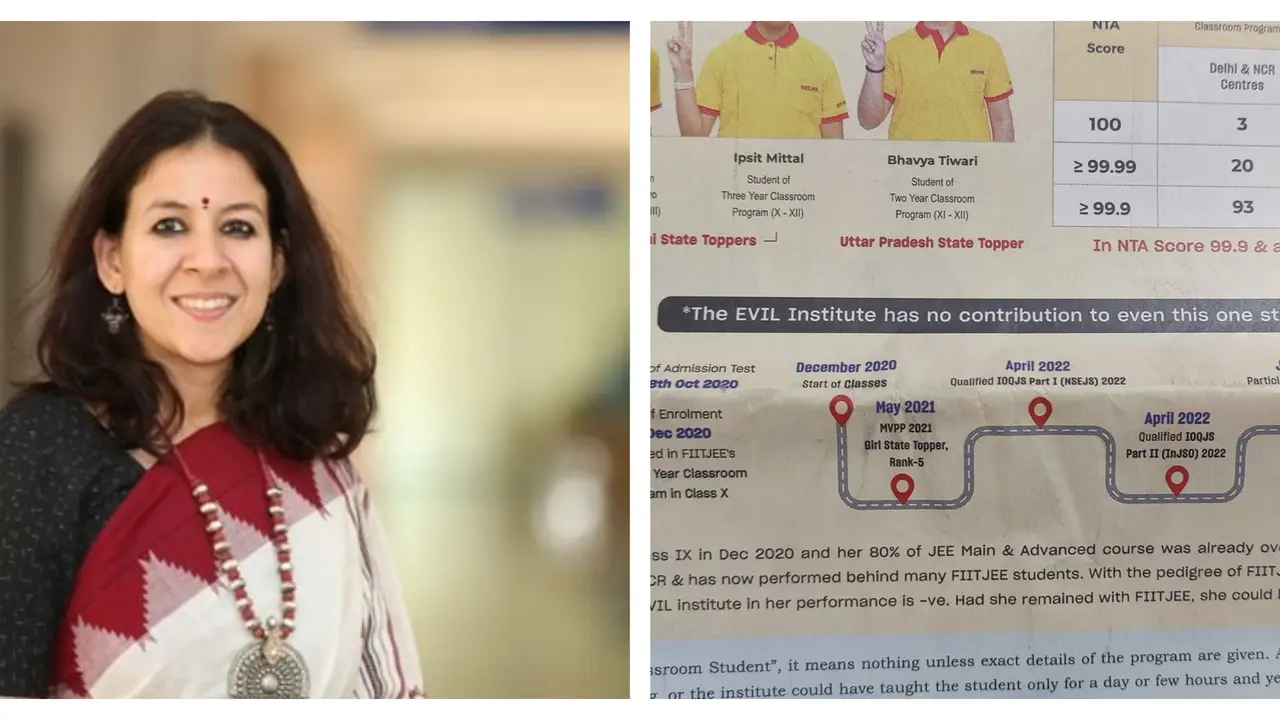
In another trouble for Delhi-based coaching institute FIITJEE, an advertisement has invited ire for violating a student’s privacy and further deepening the pressure for the IIT-JEE race.
The front-page advertisement contains the images of toppers, and a former student’s name and image with FIITJEE saying their performance declined after leaving the institute fpr ‘an EVIL institute of Kota’.
The matter drew remarks from Indian Revenue Service officer, Katyayani Sanjay Bhatia who posted a strong-worded thread on X against the advertisement.
“We talk about parents putting pressure on kids for IIT JEE, but what about this manner of advertising where you shame a student for not performing? And claiming she would have performed had she been in your institute? Shameful,” she said.
The advertisement also described the unnamed Kota institute as one ‘with history of suicides.’
This comes after FIITJEE CFO Rajeev Babbar blamed the ‘butchers of Kota’ for defaming them on employee salary delays, in an internal mail to Republic Business.
Advertisement
“These are the butchers of KOTA that we are trying to expose in the interest of the society,” he said in the second paragraph of the response which was on an issue of corporate compliance and revenue concerns for the institute.
Republic Business sought legal purview in the matter from Satya Muley and Co’s founder Satya Muley, who said publishing the information and photograph of the child in the advertisement constitutes a violation of their Right to Privacy under Article 21 of the Indian Constitution.
“The child has a Right to Privacy, since there are also implications of the advertisement for affecting their psychology,” he said.
Muley added that publishing targeted information on the minor and saying they did not do well is a civil as well as a criminal act.
From the civil aspect, he said the code of conduct by the Advertising Standards Council of India’s section 4.1 (e) states that advertisers cannot unfairly denigrate, attack or discredit other products, advertisers or advertisements directly or by implication.
This is a blatant violation of self-regulation, Muley emphasised.
Advertisement
He also cited the Supreme Court ruling where it took cognisance of Patanjali degrading competition as part of its advertising campaigns.
The case is also sensitive pertaining to statutory laws under Section 43 A of the Information Technology (IT) Act, which states action on a corporate body which possesses sensitive personal data or information in a computer device and is negligent in security practices, causing wrongful loss to any person.
The complete version of the story has also not been published in the advertisement, he stated.
This makes it a punishable offence, and the parents can also claim Section 499 of the Indian Penal Code (IPC), or defamation.
“The Right to Privacy is prosecutable in the criminal court,” he said, pertaining to the rights of the student and wards in this case.
“Since FIITJEE has implemented unfair trade practices, it can also be persecuted for violation of the consumer protection act, under which the parents can seek damages under the law," he added
When asked how much the national publication is responsible for running the advertisement, Muley said editorial is responsible to some extent “since ignorance is not an excuse under the law.”
On the wider ramifications of the case, he said FIITJEE should be prosecuted for the advertisment, since if this is allowed to pass by - it will legitimise the practice.
“Anyone who comes across this advertisement can lodge a complaint,” Muley said, since this is a violation of human rights and should call for heavy penalty on the institute.
The publication should also receive a strict warning, setting a precedent to verify what is being published, he added.
Recently, the Indian government passed a law against coaching institutes giving admission to minors, or those below 16 years of age. The regulations passed this year also crack down on misleading advertisement, false guarantees and provision of counselling for students.
The advertisement also drew focus from social media users and entrepreneurs, who questioned the bigger concern of stress induced by the race for clearing competitive exams.
Zoho CEO Sridhar Vembu also put his perspective on the case, saying India has to get out of this ultra-competitive exam pressure on children and young adults.
“Intense pressure at a young age all too often destroys talent and creates zombified adults. It is the rat race to extinction.”
Drawing reference from Finland, he said the country has “a superb state-funded educational system, serving every child without such competitive insanity.”
Intense competition is for companies serving a market and for sports, not for children in education, he added.
Vembu, like Elon Musk in the past, drew focus away from academic credentials while employing.
Musk had said no college degree is required to work in Tesla, and rather an “evidence pf exceptional ability” is seen in candidates.