
Updated 7 October 2023 at 14:37 IST
US grapples with IMF quota expansion without shareholding changes
The quotas have not been increased since 2010, a move that gave a bigger voice to China, Brazil and other fast-growing emerging market economies.
- Republic Business
- 4 min read

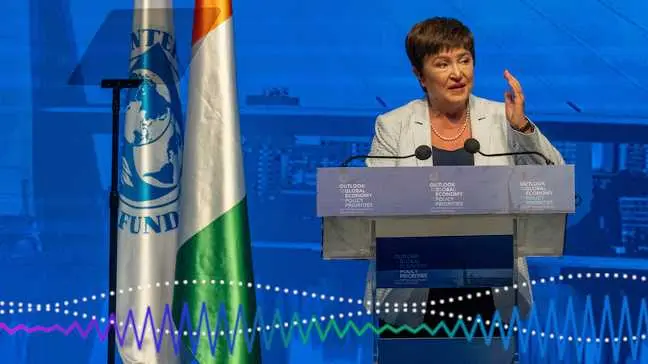
US's IMF quota: The US faces an uphill battle to persuade other International Monetary Fund member countries to expand the IMF's lending war chest without boosting the shareholdings of China, India and Brazil, government officials and development experts say.
As global finance officials prepare to gather in Marrakech, Morocco, for next week's IMF and World Bank annual meetings, where a review of IMF quota resources is expected to be a contentious topic, some are already anticipating another delay in making decisions.
"Quota increases without realignment would politically weaken the Fund," a Brazilian official told Reuters, adding that Brazil, China and India deserved a bigger role in the IMF commensurate with their growing stature in the global economy.
Quotas contributed by member countries in proportion to their voting power now account for more than 40 per cent of the Fund's $1 trillion in lending firepower, which has been taxed by years of COVID-19, inflation, climate shocks and spillovers from Russia's war in Ukraine.
Advertisement
The rest of the funding is made up of emergency capital pledges and bilateral lending, sources seen as less reliable. Boosting the quotas would allow developing countries to access bigger loans and provide more certainty than current arrangements. The
IMF argues that the increased resources are "vital" to safeguard the global economy against future shocks. The quotas have not been increased since 2010, a move that gave a bigger voice to China, Brazil and other fast-growing emerging market economies at the expense of European countries.
Advertisement
If such an exercise were to be repeated, China would be likely to see the biggest increase, as it controls just 6.08 per cent of the IMF's voting power but makes up 18 per cent of global gross domestic product based on IMF estimates. The US is by far the IMF's largest shareholder with 16.5 per cent of voting power.
But with anti-China sentiment firmly entrenched in the US Congress, any move to increase China's share would cause a political backlash for US President Joe Biden as he seeks re-election next year.
The plan that US Treasury Secretary Janet Yellen is pushing at the Morocco meetings would have countries contribute new money in proportion to their current shares, with changes to the formula to come later.
New Representation
As a sweetener for emerging markets, the US is proposing to add a fifth deputy managing director to represent the interests of middle-income countries and another Executive Board member to represent more countries from sub-Saharan Africa.
Doing so, Ivory Coast President Alassane Ouattara said on Thursday, would "increase the voice and agency of member countries who are the most vulnerable" at the Fund.
Mark Sobel, a former US Treasury and IMF official now with the OMFIF financial think tank, described the proposed new positions as "sugarcoating" for the US plan but was sceptical that they would bring enough large economies on board to secure China's support. He said members could postpone a decision for many months, as they have in the past.
A spokesperson for China's embassy in Washington declined to comment on the US quota proposal.
Martin Muhleisen, a former IMF strategy chief, said the plan "puts the Chinese on the spot to agree". Otherwise, Beijing would be in the position of opposing new resources for distressed developing countries for its own political gain, he added.
Delays possible
The Brazilian official, who spoke on condition of anonymity because the IMF quota discussions are private, said negotiations in Marrakech would be "intense" but the US proposal was not the only solution.
"You could extend the discussion for another year," the official said, or combine the current, 16th review of quotas due by Dec. 15 with the 17th review and accelerate the timetable.
A delay would be a major disappointment for the IMF after contentious 2019 negotiations left quota resources and shareholding untouched.
But some development experts say that a delay, perhaps until after the US elections in 2024, may be an easier path forward, partly because the IMF is not in danger of running short of resources. Its total loans outstanding now stand at about $150 billion, less than half its quota-based lending capacity.
"The Fund's not tight," said Mark Plant, a former IMF official now with the Center for Global Development. "If we hit another crisis, it could get tight."
Published By : Anirudh Trivedi
Published On: 7 October 2023 at 14:37 IST