
Inside the India–EU Trade Pact with 27 EU States
India and the European Union have concluded a Free Trade Agreement covering goods, services and investment across 27 EU member states. With bilateral trade at $180 billion annually, the pact provides for tariff reductions on over 90% of traded goods and is expected to come into force from 2027 after ratification.
- Republic Business
- 4 min read

;'%3e%3cpath%20d='m8,15.99c4.41,0,7.99-3.58,7.99-7.99S12.41,0,8,0,0,3.59,0,8s3.58,7.99,7.99,7.99Z'%20style='stroke:%23fff;%20stroke-miterlimit:10;%20stroke-width:.02px;'/%3e%3cpath%20d='m3.08,3.37l3.82,5.11-3.84,4.15h.87l3.37-3.64,2.72,3.64h2.94l-4.04-5.39,3.58-3.87h-.86l-3.1,3.35-2.5-3.35h-2.94Zm1.27.64h1.35l5.97,7.99h-1.35l-5.97-7.99Z'%20style='fill:%23fff;'/%3e%3c/g%3e%3c/svg%3e)


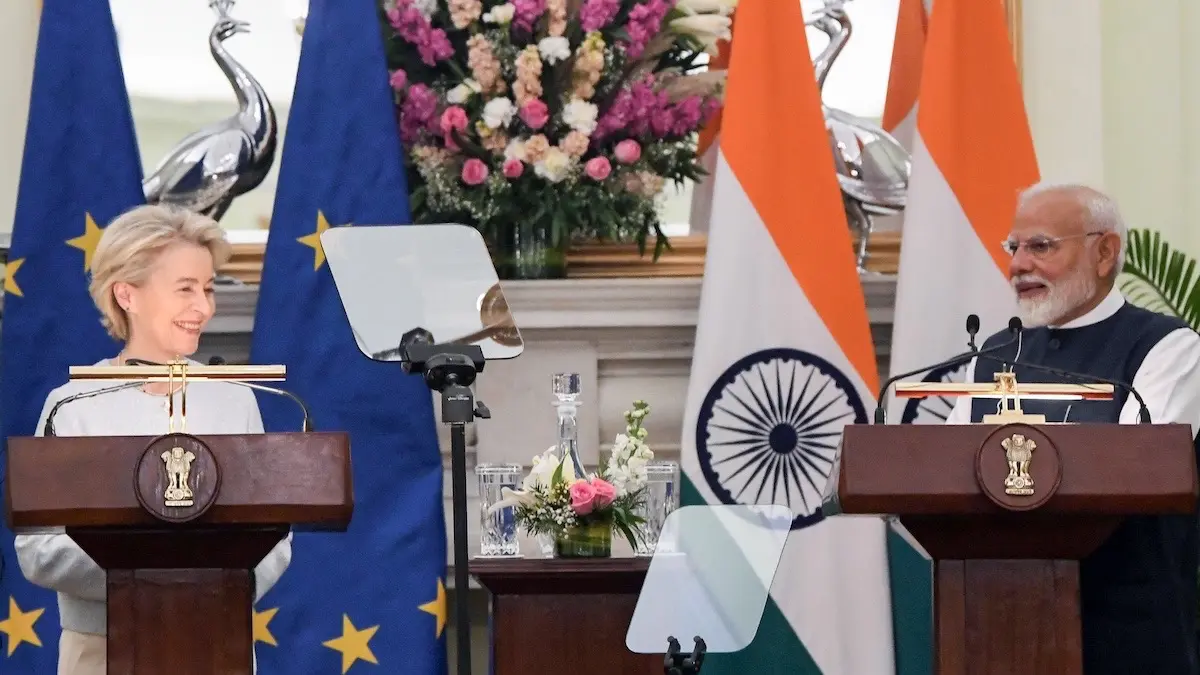
India and the European Union on January 27 concluded negotiations on a comprehensive Free Trade Agreement (FTA), marking the end of talks that began in 2007 and were relaunched in 2022. The agreement covers trade in goods and services, investment facilitation and regulatory cooperation between India and all 27 EU member states, creating one of the largest free-trade zones negotiated by India.
The pact connects two major economies representing a combined population of nearly 2 billion people and roughly 25% of global GDP. The European Union is currently India’s largest trading partner in goods.
Current India–EU Trade
Bilateral trade between India and the EU stood at around $180 billion annually, according to official figures referenced during the summit. Goods trade accounts for over $135 billion, while services trade is estimated at more than $80 billion.
The EU accounts for about 17% of India’s total exports, while India ranks among the EU’s top ten trading partners globally. India has maintained a goods trade surplus with the EU in recent years.
Advertisement
Nearly eight lakh Indians currently live and work across EU member states, forming a significant people-to-people link alongside economic engagement.
• Goods trade: ~$136 billion
Advertisement
• Services trade: ~$88 billion
• EU share of India’s exports: ~17%
• India’s rank among EU trading partners: 9th
India recorded a trade surplus of approximately $16 billion with the EU in goods in 2024.
Tariff Reductions and Market Access
The FTA provides for the reduction or elimination of tariffs on over 90% of goods traded between the two sides, with sensitive sectors subject to phased reductions or exclusions.
Indian export sectors are expected to gain from tariff reductions include textiles and apparel, leather products, engineering goods, chemicals and pharmaceuticals, many of which currently face higher duties in EU markets.
European exports to India are expected to benefit from industrial machinery, automobiles and auto components, medical devices, electrical equipment, wines and spirits, with tariff cuts to be implemented over a defined transition period.
In certain categories, such as automobiles, existing import duties that exceed 100% will be reduced gradually under agreed schedules.
India’s Export Gains:
EU tariffs currently range from 8–12% on many Indian exports. These will be eliminated or reduced on:
• Textiles and apparel (current duty: up to 12%)
• Leather and footwear (8–10%)
• Engineering goods
• Chemicals and pharmaceuticals
• Processed food and agri-value products
India exported $22 billion worth of textiles and garments to the EU in 2024, making it one of the largest beneficiaries of tariff removal.
Services and Investment Provisions
Services form a key part of the agreement. India’s services exports to the EU, including IT and IT-enabled services, professional services, telecom and business consulting, are valued at over $80 billion annually. The agreement includes commitments to improve market access and regulatory clarity for service providers on both sides, while retaining domestic policy space.
On investment, the EU remains one of India’s largest sources of foreign direct investment, with cumulative EU-origin FDI running into tens of billions of dollars across sectors such as manufacturing, renewables, pharmaceuticals, finance and infrastructure.\
The EU is India’s largest source of cumulative FDI, accounting for over €100 billion in investments.
Major investment sectors include:
• Manufacturing
• Renewable energy
• Pharmaceuticals
• Chemicals
• Infrastructure
The agreement includes provisions on investment facilitation, not investor-state dispute settlement (ISDS).
Manufacturing, MSMEs, and Agriculture
The agreement is expected to improve access for Indian manufacturers to EU supply chains through tariff reductions and regulatory cooperation.
Micro, small, and medium enterprises (MSMEs), which account for a significant share of India’s exports, are expected to benefit from simplified procedures and lower export costs under the FTA framework.
In agriculture, market access has been calibrated to protect sensitive crops while allowing expanded exports of processed foods, specialty agricultural products, and value-added items.
Strategic and Connectivity Elements
Alongside the FTA, India and the EU announced cooperation on trade corridors, including the India–Middle East–Europe Economic Corridor (IMEC), aimed at improving connectivity between Asia, the Middle East, and Europe.
The agreement also aligns with broader cooperation on supply chain resilience, standards, and regulatory coordination.
Implementation Timeline
Following the conclusion of negotiations, the agreement will undergo legal scrubbing and translation, followed by formal signing. Ratification will be required by the European Parliament and EU member states, as well as through India’s domestic processes.
The FTA is expected to enter into force from 2027, with tariff reductions and commitments implemented in phases over several years.
What the Agreement Does Not Do?
The FTA does not mandate immediate tariff elimination across all sectors and does not override domestic laws. Sensitive sectors retain safeguards, and implementation is subject to review mechanisms.