
Maruti Suzuki Scales Up India Strategy: 4–5 EVs by FY2030, Rs 70,000 Crore Investment and Big Push for Market Leadership
Maruti Suzuki is pushing ahead with plans to launch 4–5 EVs by FY2030, led by the e-Vitara in 2025. Despite trimming volume targets, it is investing Rs 70,000 crore to expand capacity to 4 million units and pursuing a multi-fuel strategy while exploring an affordable sub-Rs 10 lakh EV.
- Republic Business
- 3 min read

;'%3e%3cpath%20d='m8,15.99c4.41,0,7.99-3.58,7.99-7.99S12.41,0,8,0,0,3.59,0,8s3.58,7.99,7.99,7.99Z'%20style='stroke:%23fff;%20stroke-miterlimit:10;%20stroke-width:.02px;'/%3e%3cpath%20d='m3.08,3.37l3.82,5.11-3.84,4.15h.87l3.37-3.64,2.72,3.64h2.94l-4.04-5.39,3.58-3.87h-.86l-3.1,3.35-2.5-3.35h-2.94Zm1.27.64h1.35l5.97,7.99h-1.35l-5.97-7.99Z'%20style='fill:%23fff;'/%3e%3c/g%3e%3c/svg%3e)


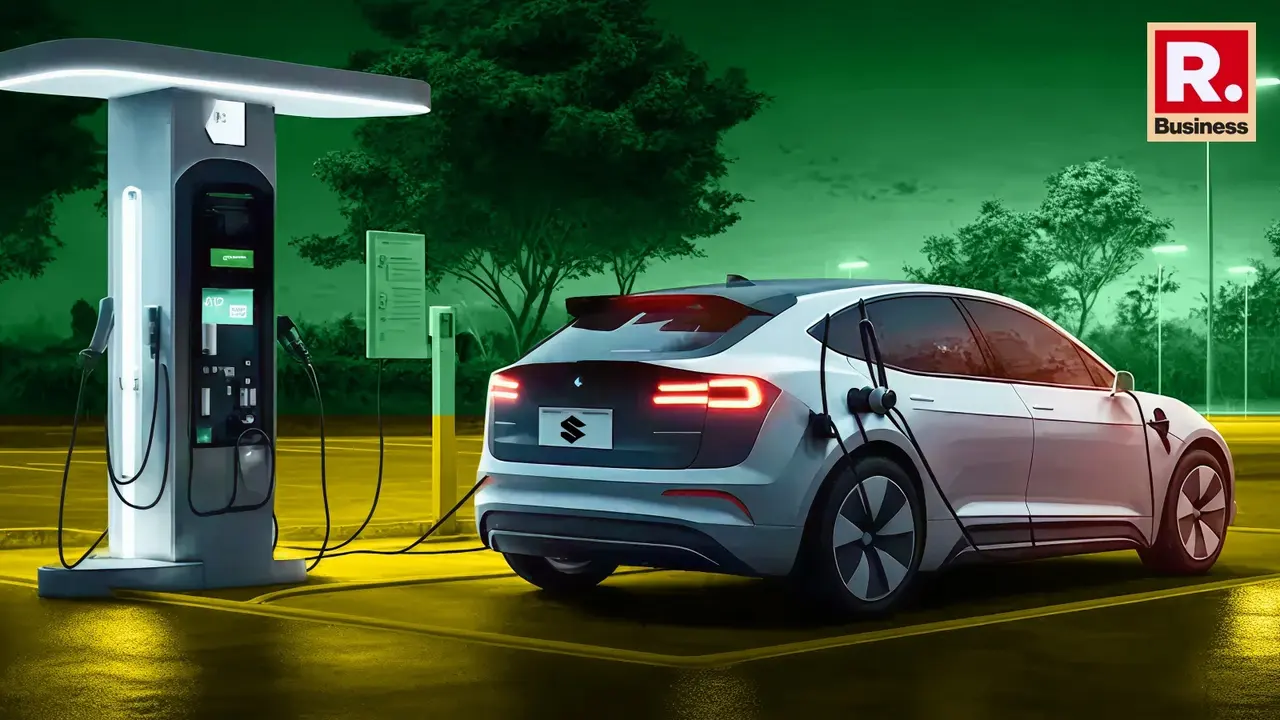
Maruti Suzuki is sharpening its long-term electric and multi-powertrain strategy for India, even as global EV demand faces headwinds. The company has now reaffirmed plans to introduce 4–5 battery electric models in the country by FY2030, beginning with the e-Vitara in 2025. The roadmap aligns closely with parent Suzuki Motor Corporation’s new mid-term plan, which positions India as its most critical global growth engine over the next decade.
Volume targets trimmed, but EV commitment stands
Maruti Suzuki has revised its overall India volume forecast for FY31 to 2.54 million units, down from the earlier projection of 3 million. With EVs expected to contribute around 15% of its sales mix, projected electric volumes stand at roughly 400,000 units, compared with the previous estimate of 450,000 units.
Despite this recalibration, the company reiterated its continued EV commitment.
Late entry, but aggressive EV ambitions
While rivals Tata Motors and Mahindra enjoy a head start, Maruti Suzuki aims to emerge as a strong EV contender once its portfolio hits the market. The e-Vitara, scheduled for launch on 2 December 2025, will feature 49 kWh and 61 kWh battery options and is expected to deliver a range of over 500 km. An electric Fronx and other mass-market EVs are under development, including a compact entry-level option positioned below the e-Vitara.
Advertisement
Industry sources indicate Maruti is studying a sub-Rs 10 lakh EV for city-centric buyers, designed around “reliability, ease of maintenance, and strong charging support,” although the company has denied any immediate launch timeline.
Advertisement
India at the centre of Suzuki’s global blueprint
According to Suzuki’s FY2025–2030 mid-term plan, India is explicitly identified as the company’s “most important market”. The automaker is targeting a 50% market share in India by FY2030—viewed internally as a strategic reclaiming of leadership amid rising competition.
Suzuki plans to scale its manufacturing capacity to 4 million units annually, supported by major expansions at Kharkhoda (Haryana) and its Gujarat facilities. India will also serve as a global export hub, with a sharply localised supply chain to support both domestic and overseas volumes.
Multi-powertrain approach for a diverse market
Suzuki’s electrification roadmap for India is balanced with a multi-fuel strategy. By FY31, CNG/CBG vehicles are projected to contribute 35%, while ICE and hybrid models are expected to account for 25% each. BEVs will round out the mix with nearly 15%.
The company is also deepening its work in biogas, exploring rural partnerships to produce renewable fuel from cow dung—an initiative that could complement its CNG portfolio.
Massive capacity expansion to support growth
Suzuki Motor has committed 1,200 billion yen (about Rs 70,000 crore) for India through FY2030–31 to build capacity, strengthen EV development and expand exports.
Industry experts say Maruti Suzuki’s stepped-up India strategy—especially if it succeeds in developing an affordable EV—could reshape the competitive landscape and reinforce its long-standing dominance in the domestic passenger vehicle market.