
New Trump Tariffs To Kick In From August 7: Canada, India Among 70 Countries Facing Duties| Full Country‑Wise Breakdown
US President Donald Trump has imposed steep tariffs on exports from 69 countries, including India, Brazil, and Canada, ahead of a Friday trade deadline. The move escalates global trade tensions as Trump pushes to rebalance deficits, citing national security. India's Russian oil imports and farm policies triggered Washington’s ire.
- Republic Business
- 6 min read

;'%3e%3cpath%20d='m8,15.99c4.41,0,7.99-3.58,7.99-7.99S12.41,0,8,0,0,3.59,0,8s3.58,7.99,7.99,7.99Z'%20style='stroke:%23fff;%20stroke-miterlimit:10;%20stroke-width:.02px;'/%3e%3cpath%20d='m3.08,3.37l3.82,5.11-3.84,4.15h.87l3.37-3.64,2.72,3.64h2.94l-4.04-5.39,3.58-3.87h-.86l-3.1,3.35-2.5-3.35h-2.94Zm1.27.64h1.35l5.97,7.99h-1.35l-5.97-7.99Z'%20style='fill:%23fff;'/%3e%3c/g%3e%3c/svg%3e)


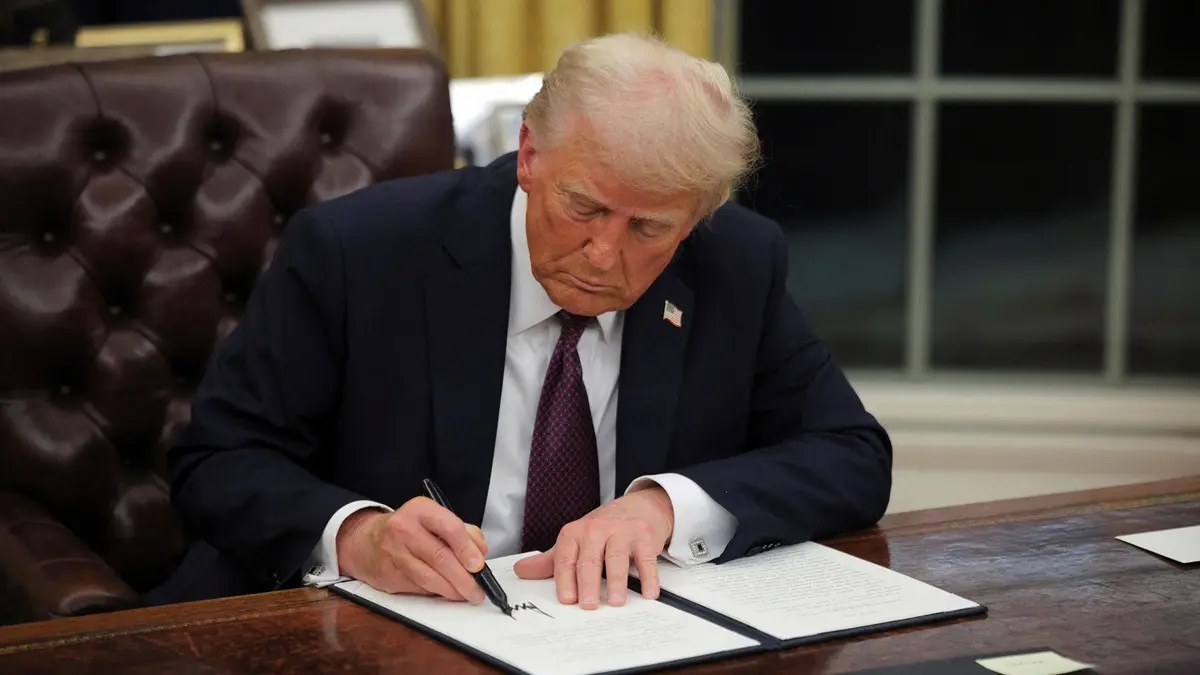
US President Donald Trump has unleashed a sweeping wave of tariffs affecting nearly 70 countries in a bid to reorder global trade ties and protect American manufacturing. The executive order, issued just days before a self-imposed Friday trade deadline, imposes duties ranging from 10% to 50% on a vast array of goods from 69 nations.
This latest move targets countries like Canada, India, Brazil, and Taiwan with some of the heaviest levies. “Despite having engaged in negotiations, some partners offered terms that do not sufficiently address imbalances or align with the United States on economic and national-security matters,” Trump’s order stated.
The move has already triggered diplomatic tensions, market jitters, and threats of retaliation. Stocks and equity futures dipped modestly in Asia following the announcement, though the reaction was more muted than the sharp sell-offs that followed earlier tariff announcements in April.
What the Order Says: New Rates, Timeline, and Exemptions
According to the executive order, new import duty rates of 10% to 41% will begin taking effect at 12:01 a.m. EDT on August 7, impacting a total of 69 trading partners. Countries not on the list will face a flat 10% import tax—though Trump has hinted that could rise further.
Countries like India will face a 25% tariff, while Brazil faces a 50% levy. Taiwan is hit with 20%, and Canada sees a new 35% rate on fentanyl-linked goods, up from the previous 25%.
Some countries had negotiated partial reprieves, but others were blindsided without a chance to negotiate. The order includes a one-week grace period for goods already in transit.
A US official hinted at more developments, stating, “We have made a few deals today that are excellent for the country,” though details are still pending, as mentioned in the report by reuters.
India in the Crosshairs: Tariffs and a Russian Oil Penalty
India emerged as one of the key flashpoints in Trump’s tariff crackdown. The White House cited delays in finalising a trade deal and India’s agricultural protectionism as causes for concern. But a deeper grievance appeared to be New Delhi’s continued oil purchases from Russia.
“India's purchases of Russian oil are helping to sustain Moscow's war efforts in Ukraine, and it is ‘most certainly a point of irritation’ in New Delhi’s relationship with Washington,” said U.S. Secretary of State Marco Rubio.
Although Trump had earlier announced that India’s tariffs would take effect on August 1, the signed executive order now sets the new effective date as August 7. The 25% tariff comes alongside an unspecified penalty related to India’s Russia trade, mainly defence and energy imports.
Meanwhile, the Indian opposition seized on the announcement to criticise Prime Minister Modi’s foreign policy handling, calling it a failure in diplomacy. The rupee slid against the dollar following the news, as mentioned in the report by Reuters.
Canada and Mexico: Same Region, Different Treatment
Canada and Mexico, two of the US’s biggest trading partners, received starkly different treatment under the executive orders.
Trump raised tariffs on Canadian goods tied to fentanyl to 35%, citing Ottawa’s alleged failure to help stem illicit drug flows into the U.S. “Canada has been very poorly led,” Trump told reporters. The Canadian government did not immediately respond, but has previously contested US claims.
By contrast, Mexico was granted a 90-day reprieve from a scheduled 30% hike, giving time for further negotiations on a broader trade pact.
“We avoided the tariff increase announced for tomorrow,” said Mexican President Claudia Sheinbaum in a post on X after a call with Trump. “The conversation was very good.”
Roughly 85% of U.S. imports from Mexico comply with USMCA rules of origin, which shield them from fentanyl-related tariffs. However, Trump is maintaining a 50% tariff on Mexican metals (steel, aluminium, copper) and a 25% levy on autos and non-compliant goods.
“Mexico has agreed to immediately terminate its non-tariff trade barriers, of which there were many,” Trump wrote on Truth Social, without detailing what those were.
Brazil Gets Hit Over Bolsonaro, But Some Relief Granted
Brazil, Latin America’s largest economy, was hit with a massive 50% tariff, partly in retaliation for its prosecution of Trump ally Jair Bolsonaro. However, the White House excluded key sectors such as aircraft, energy, and orange juice from the higher tariffs to avoid a complete rupture in ties.
This targeted move showcases the administration’s intent to wield tariffs not just as economic tools, but also as instruments of political influence.
Judicial Pushback: Legal Challenges Over Trump’s Powers
Trump’s sweeping use of the 1977 International Emergency Economic Powers Act (IEEPA) to justify the tariffs is now facing stiff judicial scrutiny. A lower court in May ruled that Trump’s actions exceeded his executive authority, and federal appeals court judges have voiced scepticism over whether declaring a trade deficit an "emergency" is legally valid.
Oral arguments before the US Appeals Court for the Federal Circuit suggested that the bench could impose constraints on future tariff impositions.
The China Question: Deal or More Duties by August 12
Amid the flurry of tariffs, China is facing an August 12 deadline to finalise a durable trade agreement. Beijing and Washington had reached preliminary understandings in May and June to ease tit-for-tat tariff escalations and address the rare earths dispute.
What’s Next: Potential Economic Fallout
Commerce Department data shows the tariffs are already beginning to push up prices on consumer goods. In June alone:
Home furnishings and household equipment prices jumped 1.3%
Recreational goods rose by 0.9%
Clothing and footwear costs were up 0.4%
Economists warn that if the tariffs remain in place—or escalate further—they could fuel inflation, disrupt supply chains, and even impact the upcoming U.S. election cycle by increasing the cost of living.
The Full Tariff List: Some Countries Worse Off Than Others
Countries and Territories Reciprocal Tariff, Adjusted
Afghanistan 15%
Algeria 30%
Angola 15%
Bangladesh 20%
Bolivia 15%
Bosnia and Herzegovina 30%
Botswana 15%
Brazil 10%
Brunei 25%
Cambodia 19%
Cameroon 15%
Chad 15%
Costa Rica 15%
Côte d`Ivoire 15%
Democratic Republic of the Congo 15%
Ecuador 15%
Equatorial Guinea 15%
European Union: Goods with Column 1 Duty Rate > 15% 0%
European Union: Goods with Column 1 Duty Rate < 15% 15% minus Column 1 Duty Rate
Falkland Islands 10%
Fiji 15%
Ghana 15%
Guyana 15%
Iceland 15%
India 25%
Indonesia 19%
Iraq 35%
Israel 15%
Japan 15%
Jordan 15%
Kazakhstan 25%
Laos 40%
Lesotho 15%
Libya 30%
Liechtenstein 15%
Madagascar 15%
Malawi 15%
Malaysia 19%
Mauritius 15%
Moldova 25%
Myanmar (Burma) 40%
Mozambique 15%
Namibia 15%
Nauru 15%
New Zealand 15%
Nicaragua 18%
Nigeria 15%
North Macedonia 15%
Norway 15%
Pakistan 19%
Papua New Guinea 15%
Philippines 19%
Serbia 35%
South Africa 30%
South Korea 15%
Sri Lanka 20%
Switzerland 39%
Syria 41%
Taiwan 20%
Thailand 19%
Trinidad and Tobago 15%
Tunisia 25%
Turkey 15%
Uganda 15%
United Kingdom 10%
Vanuatu 15%
Venezuela 15%
Vietnam 20%
Zambia 15%
Zimbabwe 15%
Advertisement
America First, Again
This sweeping tariff initiative reinforces Trump’s core economic message: America First. While it might offer some relief to domestic manufacturers, it risks triggering new trade wars, weakening multilateral ties, and harming global trade flows.
With more trade deals “in the pipeline” and retaliatory threats looming, the coming weeks could reshape global trade diplomacy all over again.
Advertisement
(With Inputs From Reuters)