
PM Modi & Mark Carney End Diplomatic Freeze With Landmark $2.6B Uranium and Minerals Deal
Prime Minister Narendra Modi and Canadian PM Mark Carney have signed a landmark 10-year Uranium Supply Agreement and a Critical Minerals MoU, effectively ending years of diplomatic "freeze." The deals secure long-term nuclear fuel for India and establish a "lithium-to-battery" supply chain to power India's EV and semiconductor sectors. Both nations aim to double bilateral trade to $50 billion by 2030 through a renewed Comprehensive Economic Partnership Agreement (CEPA).
- Republic Business
- 3 min read

;'%3e%3cpath%20d='m8,15.99c4.41,0,7.99-3.58,7.99-7.99S12.41,0,8,0,0,3.59,0,8s3.58,7.99,7.99,7.99Z'%20style='stroke:%23fff;%20stroke-miterlimit:10;%20stroke-width:.02px;'/%3e%3cpath%20d='m3.08,3.37l3.82,5.11-3.84,4.15h.87l3.37-3.64,2.72,3.64h2.94l-4.04-5.39,3.58-3.87h-.86l-3.1,3.35-2.5-3.35h-2.94Zm1.27.64h1.35l5.97,7.99h-1.35l-5.97-7.99Z'%20style='fill:%23fff;'/%3e%3c/g%3e%3c/svg%3e)


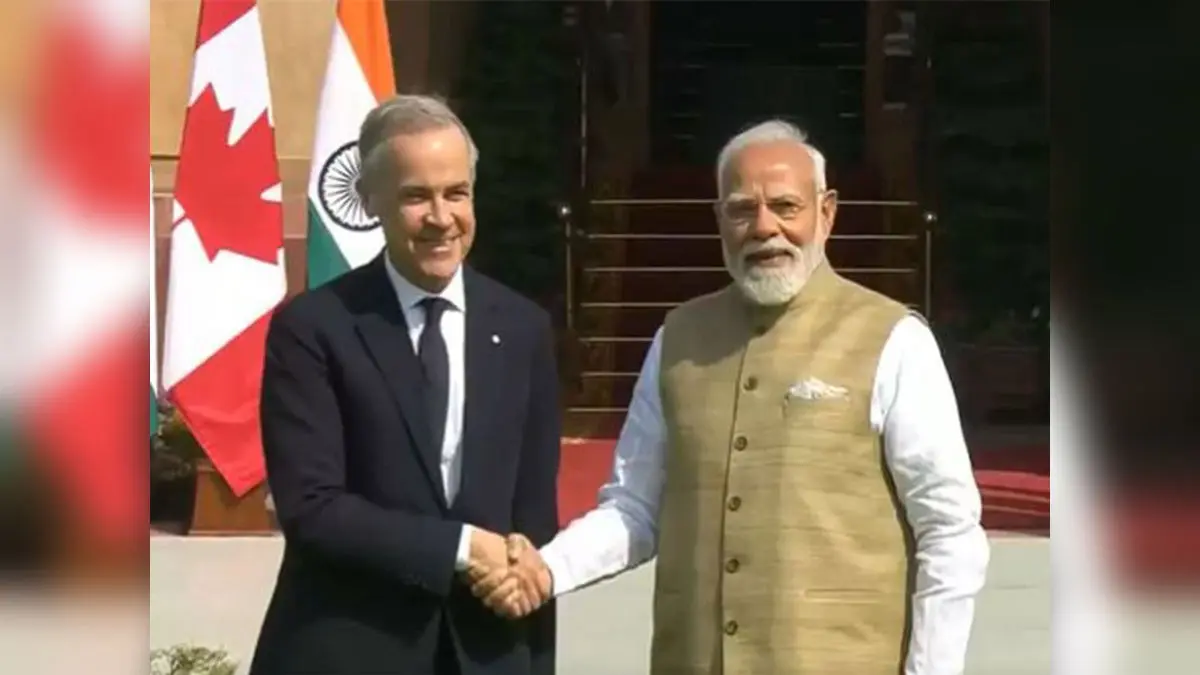
Marking what both sides described as a decisive end to years of diplomatic “deep freeze,” Prime Minister Narendra Modi and Canadian Prime Minister Mark Carney on Monday signed a series of high-stakes agreements at Hyderabad House, centred on energy security and the global green transition.
The centrepiece of the summit is a 10-year Uranium Supply Agreement along with a comprehensive Memorandum of Understanding (MoU) on Critical Minerals.
The 10-Year Uranium Deal
After the previous supply arrangement lapsed in 2020, the newly signed agreement establishes a stable, decade-long pipeline of uranium ore concentrate from Canadian miners, notably Cameco, to India’s Department of Atomic Energy.
The agreement is critical for India’s stated goal of tripling its nuclear capacity by 2031–32, as the country positions atomic energy as a cornerstone of its clean power mix.
Advertisement
Speaking at the joint press interaction, Prime Minister Modi said:
“The procurement of uranium from Canada for our civilian nuclear plants launches a renewed era of mutual trust. It is not just a commodity trade; it is a partnership for a cleaner planet.”
Advertisement
Officials indicated that the long-term supply visibility will help India stabilise fuel procurement costs while accelerating reactor expansion projects already in the pipeline.
Critical Minerals MoU
The leaders signed a wide-ranging MoU focused on the “lithium-to-battery” value chain. Canada, which holds substantial reserves of lithium, cobalt, and nickel, will collaborate with India to support its fast-growing electric vehicle (EV) and semiconductor industries.
Key elements of the agreement include:
- Collaborative mining initiatives in mineral-rich provinces such as Saskatchewan and Quebec.
- Sharing Canadian mining expertise and sustainable extraction technologies.
- Establishment of a Canada–India Critical Minerals Annual Dialogue, with the inaugural session scheduled in Toronto later this month.
The framework aims to integrate Canadian upstream mineral capacity with India’s expanding downstream manufacturing base, particularly in EV batteries and advanced electronics.
“A Partnership for Resilience”
In a joint statement titled “Renewing Momentum: A Strategic Roadmap 2026,” both leaders emphasised that “trade and energy are the cornerstones of bilateral resilience.”
The statement outlined:
- An intent to conclude negotiations on a Comprehensive Economic Partnership Agreement (CEPA), with a target to double bilateral trade to $50 billion by 2030.
- A reaffirmed commitment to respect “sovereignty and territorial integrity,” widely viewed as a reference to diplomatic tensions during 2023–24.
- Expanded cooperation in green hydrogen development and Small Modular Reactors (SMRs).
Prime Minister Carney framed the renewed partnership in economic and strategic terms, stating, “Canada is an energy superpower, and India is the world’s fastest-growing major economy. We are forging a partnership that leverages Canada’s resources and India’s scale to lead the global energy transition.”
A Diplomatic and Economic Reset
The 2026 summit is being seen as a pivotal reset in India–Canada relations. By securing a decade-long uranium supply arrangement and institutionalising cooperation on critical minerals, both countries are shifting the bilateral equation toward long-term industrial and energy alignment.
For India, the agreements strengthen access to strategic raw materials needed for nuclear expansion and net-zero ambitions. For Canada, they secure a high-growth market for energy and mining exports.
The 2026 summit is seen as a pivotal reset in India- Canada relations. By securing a decade long supply of uranium ore, the agreement strengthens access to crucial raw materials.