
Ratan Tata’s First Death Anniversary: From Jamsetji To Noel, The Tata Legacy Explained
October 9, 2025, marks the first death anniversary of Ratan Tata, the visionary industrialist, philanthropist, and leader who transformed the Tata Group into a global powerhouse. As India remembers him, we trace the Tata family tree that shaped one of the country’s most influential business dynasties and its enduring legacy.
- Republic Business
- 6 min read

;'%3e%3cpath%20d='m8,15.99c4.41,0,7.99-3.58,7.99-7.99S12.41,0,8,0,0,3.59,0,8s3.58,7.99,7.99,7.99Z'%20style='stroke:%23fff;%20stroke-miterlimit:10;%20stroke-width:.02px;'/%3e%3cpath%20d='m3.08,3.37l3.82,5.11-3.84,4.15h.87l3.37-3.64,2.72,3.64h2.94l-4.04-5.39,3.58-3.87h-.86l-3.1,3.35-2.5-3.35h-2.94Zm1.27.64h1.35l5.97,7.99h-1.35l-5.97-7.99Z'%20style='fill:%23fff;'/%3e%3c/g%3e%3c/svg%3e)


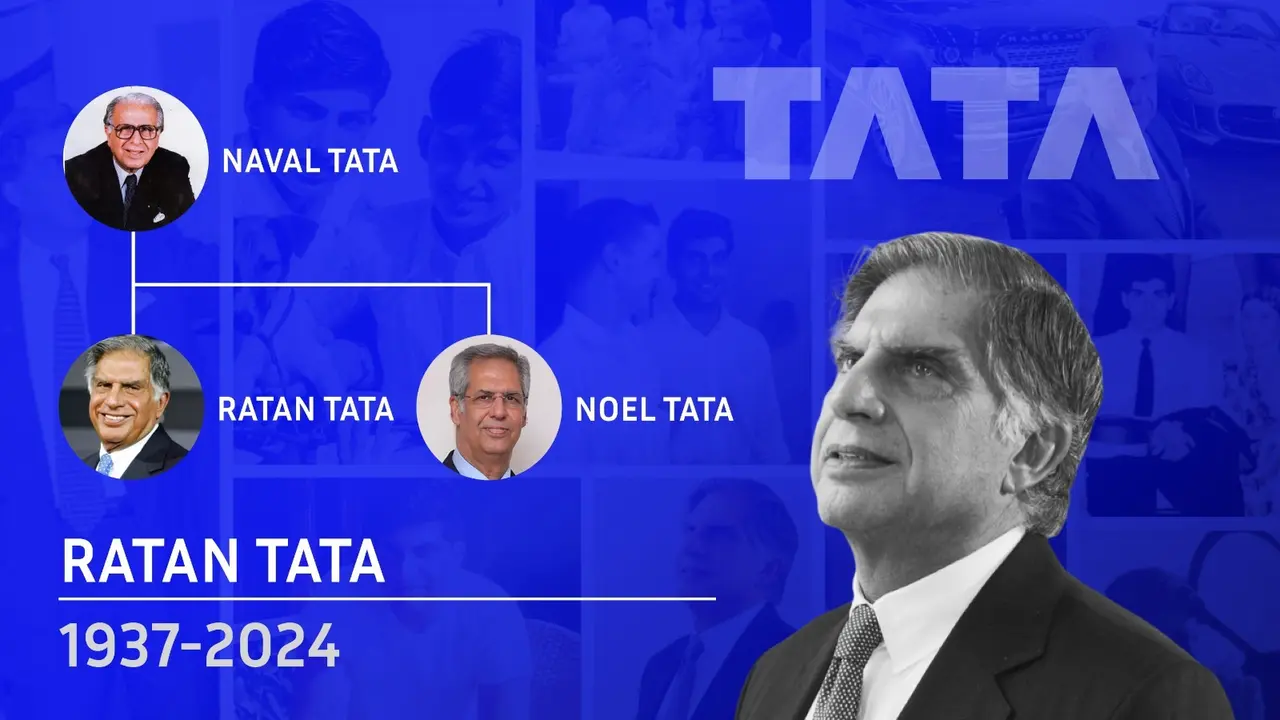
Ratan Tata Death Anniversary: October 9, 2025, marks the first anniversary of the passing of Ratan Tata, a veteran industrialist, philanthropist, and visionary. On this day, people across the nation have shared heartfelt tributes on social media, remembering the legendary personality and his unmatched contributions to the Indian industry and society.
Ratan Tata, who passed away at the age of 86 last year, remains one of India’s most respected and beloved business icons. As the country reflects on his immense legacy, his absence continues to be deeply felt among the countless lives he inspired, not just through his leadership, but through his humility and compassion.
The Tata Family: A Legacy Rooted In Nation-Building
The Tata family is one of India’s most respected and influential business families, known for its deep commitment to both industry and social development. From steel to software and hospitality to automobiles, the Tatas have built one of the world’s largest conglomerates while consistently prioritising philanthropy and nation-building.
The first death anniversary of Ratan Tata marks a significant moment in the Tata family’s history. As the group transitions under new leadership, it’s a time to look back at the family tree that shaped this iconic empire, and the key figures who carried forward Jamsetji Tata’s vision of an industrial India.
Jamsetji Tata: The Visionary Founder Who Dreamed Of A Modern India
Born in 1839, Jamsetji Tata laid the foundation of what would become the Tata Group. Often referred to as the “Father of Indian Industry,” Jamsetji envisioned enterprises that would not only boost India’s economy but also improve the lives of its people.
He began with ventures in textiles and hydroelectric power before establishing Tata Steel, India’s first steel plant, which became the bedrock of the nation’s industrial revolution. His far-sighted ideas on nation-building, education, and economic self-reliance continue to inspire the Tata philosophy even today.
Jamsetji married Hirabai Daboo Tata and had two sons, Sir Dorabji Tata and Sir Ratan Tata, both of whom carried forward his legacy in unique ways.
Sir Dorabji Tata: Expanding The Industrial Empire
Sir Dorabji Tata, Jamsetji’s elder son, succeeded his father and became a driving force behind Tata Steel’s success. Under his guidance, the Tata Group expanded its influence into power generation and other sectors critical to India’s growth.
Beyond his business acumen, Dorabji was also a patron of sports. He personally financed India’s first Olympic team and supported several national sports initiatives. His philanthropy set the tone for the Tata family’s long-standing commitment to public welfare.
Sir Ratan Tata (Jamsetji’s Son): The Philanthropic Torchbearer
Sir Ratan Tata, the younger son of Jamsetji Tata, took a different but equally impactful path. While Dorabji strengthened the group’s industrial foundation, Ratan devoted his life to philanthropy and social causes.
He was a supporter of Mahatma Gandhi’s social movements and contributed generously to education and research initiatives. One of his most enduring contributions was the establishment of the Sir Ratan Tata Trust, as per open source website.
Naval Tata: The Bridge Between Generations
Naval Tata, the adopted son of the Tata family, played a pivotal role in the group’s expansion during the mid-20th century. He was deeply involved in Tata Steel and became known for his progressive approach to labour relations, helping bridge the gap between management and workers.
Naval also had a strong passion for sports, particularly hockey, and worked extensively to promote it in India. His leadership ensured that the Tata Group maintained a balance between business excellence and social responsibility.
Naval Tata married Soonoo Commissariat, and the couple had two sons, Ratan Tata and Jimmy Tata. After their divorce, Naval married Simone Dunoyer, with whom he had another son, Noel Tata.
Following the separation, Ratan and Jimmy were raised by their grandmother, Lady Navajbai Sett, at the family’s iconic Tata Palace in Mumbai, alongside their half-brother Noel.
Ratan Naval Tata: The Global Architect Of The Tata Empire
Ratan Naval Tata, the man who would go on to redefine the Tata Group, took over the reins in 1991. Over two decades of leadership, he transformed the conglomerate into a global powerhouse with operations spanning over 100 countries.
When Ratan Tata assumed leadership, the Tata Group was largely a domestic player. By his retirement in 2012, the group reported revenues of $165 billion (FY 2023-24), cementing its position among the world’s most respected corporate houses.
His bold decisions, including the acquisitions of Corus Group, Jaguar Land Rover, and Tetley Tea, propelled the Tata brand onto the global stage. Yet, beyond boardrooms and billion-dollar deals, Ratan Tata was revered for his humility and compassion.
He was also deeply philanthropic, championing causes in education, healthcare, and rural development. Even after his retirement, he remained a guiding force for India’s entrepreneurs, often mentoring startups and investing in young innovators.
Jimmy Tata: The Reclusive Heir Who Chose Simplicity
Jimmy Tata, Ratan Tata’s younger brother, has largely stayed away from public life. Despite being a shareholder in several Tata companies, including Tata Steel, Tata Motors, and TCS, he leads a quiet, private life.
Known for his humility, Jimmy resides in a modest 2BHK apartment and reportedly does not own a mobile phone. Though he avoids the spotlight, he shares a close bond with his elder brother, Ratan Tata, and remains an integral yet low-profile member of the Tata family.
Noel Tata: The Torchbearer Of A New Chapter
Following Ratan Tata’s passing on October 9 last year, his half-brother Noel Tata took over as Chairman of Tata Trusts, the philanthropic arm that holds a majority stake in Tata Sons.
In his statement following his appointment, Noel said he was “deeply honoured and humbled” by the responsibility entrusted to him after the demise of Ratan Tata. He now oversees the governance of the Rs 30 lakh crore Tata Group empire, continuing the family’s commitment to ethical leadership and social good.
The Next Generation: Tata Legacy Continues
As per media reports, Noel Tata’s three children, Leah, Maya, and Neville Tata, are already contributing to the group’s evolving legacy.
Leah Tata is involved in the group’s hospitality arm, helping expand the Taj Hotels brand globally.
Maya Tata focuses on digital and investment ventures, playing a key role in initiatives like Tata Neu.
Neville Tata leads Star Bazaar, the group’s retail chain, strengthening Tata’s footprint in India’s consumer market.
How J.R.D. Tata Was Related To Ratan Tata
According to open-source information, Ratanji Dadabhoy Tata, an early leader of the Tata Group, was a maternal cousin of Jamsetji Tata. Ratanji’s father, Dadabhoy Tata, was the brother of Jeevanbai, Jamsetji’s mother.
Ratanji Dadabhoy Tata had five children, including Jehangir Ratanji Dadabhoy Tata (J.R.D. Tata), born in 1904, who went on to become the fourth Chairman of the Tata Group. Under J.R.D.’s leadership, the group diversified into aviation, automobiles, and consumer goods, pioneering modern Indian industry long before globalisation took root.
Advertisement
The Legacy Lives On
It has been a year since India lost Ratan Tata, but his presence continues to resonate across industries and communities. His leadership style, a blend of business excellence and human empathy, set a benchmark for generations to come.
As the Tata family steps into a new era under Noel Tata, the spirit of its founder, Jamsetji, and the vision of Ratan Tata remain the guiding light. Their shared belief, that businesses must serve society, continues to define the Tata legacy, even as it evolves in a changing world.
(Read More - Microsoft, Harvard Team Up on Healthcare AI to Reduce OpenAI Dependence)