
How an Asian Nation Placed an Early Bet on 'Future Cities'
Notably, the Asia-Pacific region is projected to add 1.2 billion urban residents by 2050, according to the United Nations Development Programme. This puts pressure on infrastructure, compounded by climate change challenges. As an emerging economy in the region, Vietnam is also part of this trend.
- Republic Business
- 4 min read

;'%3e%3cpath%20d='m8,15.99c4.41,0,7.99-3.58,7.99-7.99S12.41,0,8,0,0,3.59,0,8s3.58,7.99,7.99,7.99Z'%20style='stroke:%23fff;%20stroke-miterlimit:10;%20stroke-width:.02px;'/%3e%3cpath%20d='m3.08,3.37l3.82,5.11-3.84,4.15h.87l3.37-3.64,2.72,3.64h2.94l-4.04-5.39,3.58-3.87h-.86l-3.1,3.35-2.5-3.35h-2.94Zm1.27.64h1.35l5.97,7.99h-1.35l-5.97-7.99Z'%20style='fill:%23fff;'/%3e%3c/g%3e%3c/svg%3e)


While real estate typically follows demand as a rational choice, over a decade ago, when the World Economic Forum (WEF) asked whether cities could be built to anticipate the future, a real estate developer in Vietnam provided the answer through its project portfolio.
In 2015, the WEF's Global Future Councils identified three drivers shaping Future Cities: demographic shifts, environmental change and resource scarcity, and technological and business model breakthroughs. The core of Future Cities, according to this organization, is flexibility and adaptability, achieving more with less space and fewer resources.
Just six years later, Deloitte's "Urban Future With a Purpose" study translated those abstract drivers into a portfolio of 12 elements that will define urban areas by 2030. Key focuses included green public spaces, smart healthcare, smart mobility, intelligent and sustainable buildings, and data-driven urban operations.
Notably, the Asia-Pacific region is projected to add 1.2 billion urban residents by 2050, according to the United Nations Development Programme. This puts pressure on infrastructure, compounded by climate change challenges. As an emerging economy in the region, Vietnam is also part of this trend.
Advertisement
The difference is that this country has placed its urban future into a specific development roadmap. The Politburo's Resolution 06-NQ/TW (January 2022) targets a minimum urbanisation rate of 45% by 2025 and over 50% by 2030, raising the urban economy from about 75% of GDP in 2025 to 85% in 2030, and having three to five cities recognised at the regional and international levels by 2030.
Aligning with this policy, Vinhomes, a subsidiary of Vingroup, has made a significant contribution to transforming Vietnam's urban landscape. The conglomerate entered the real estate sector in 2002 with iconic buildings. The journey of Vinhomes began with a 27,000-square-meter project on Ba Trieu Street, Hanoi, in 2009, pioneering the "city within a city" model with Vinhomes Royal City in 2013, when Hanoi had no precedent for it, and then betting on suburban megacities like Vinhomes Ocean Park in Gia Lam, Hanoi, in 2018, when the area was still attracting little attention. A larger bet took place in 2025 when Vinhomes commenced construction and launched 13 projects with a total area of over 20,000 hectares.
Advertisement
To date, Vinhomes operates 32 urban areas across eight provinces and cities, housing nearly 650,000 residents. The enterprise's mindset framework is ESG++, which is how Vinhomes refers to expanding ESG (environment, society, and governance) to include regeneration and adaptation, specifically responding to the three drivers outlined by the WEF a decade earlier: adapting to climate change, integrated megacities meeting young demographic trends amidst urbanisation, and data-driven operations keeping pace with smart city trends.
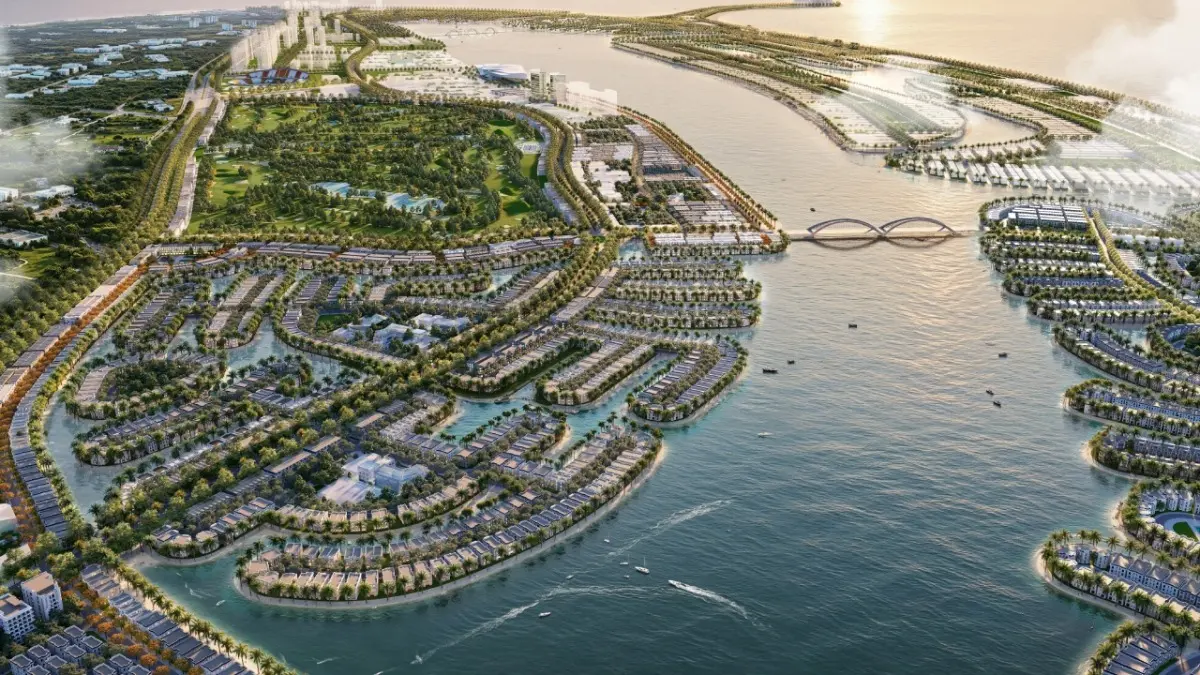
In the portfolio, Vinhomes Green Paradise is considered a model megacity. The urban area is located in Can Gio, Ho Chi Minh City, spanning 2,870 hectares with a master plan that harmonises with the ecosystem, leaning on a UNESCO-recognized biosphere reserve. With the natural ecosystem, the megacity is designed on an all-in-one model featuring a healthcare system (Vinmec), education (Vinschool), sports, public amenities, and commerce, integrating multiple components including renewable energy, water resource management, and biodiversity conservation. Smart city technologies such as artificial intelligence (AI) and the Internet of Things (IoT) are integrated into the infrastructure management system to manage energy consumption, coordinate traffic, and operate urban utilities.
Notably, this is also the first megacity in Vietnam to receive the Provisional ISO 37122 Certification from the World Council on City Data, based on a customised set of indicators. Returning to the WEF's question, it is clear that Vietnam is finding its own path. Given the country’s target of having three to five international-level cities by 2030, the question now needs to be updated with a newer perspective: Which of those cities will become a model for other urbanising areas across Asia?