
Rupee Hits Record Low Near 97 Against US Dollar: How Crucial Import Shock Slams Your Household Budget
The Indian rupee has plunged to an all-time low. It is now inching closer to the psychological ₹97 mark against the US dollar. Triggered by West Asia tensions and Brent crude hovering near $110 a barrel, Asia's weakest-performing currency is shaking India’s economy.
- Republic Business
- 5 min read

;'%3e%3cpath%20d='m8,15.99c4.41,0,7.99-3.58,7.99-7.99S12.41,0,8,0,0,3.59,0,8s3.58,7.99,7.99,7.99Z'%20style='stroke:%23fff;%20stroke-miterlimit:10;%20stroke-width:.02px;'/%3e%3cpath%20d='m3.08,3.37l3.82,5.11-3.84,4.15h.87l3.37-3.64,2.72,3.64h2.94l-4.04-5.39,3.58-3.87h-.86l-3.1,3.35-2.5-3.35h-2.94Zm1.27.64h1.35l5.97,7.99h-1.35l-5.97-7.99Z'%20style='fill:%23fff;'/%3e%3c/g%3e%3c/svg%3e)


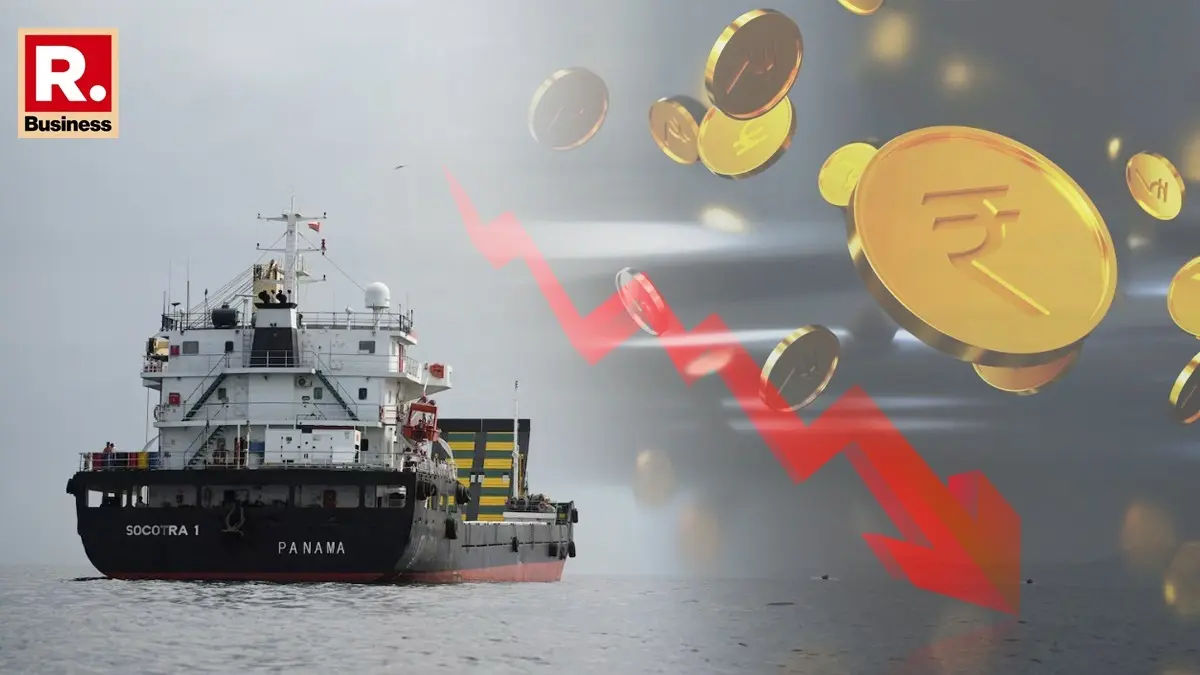
The Indian rupee slipped to an unprecedented lifetime low on Wednesday. It is now drifting dangerously close to the psychological threshold of 97 against the US dollar. The fall is driven by high global crude prices and foreign capital flight, while geopolitical tension in West Asia is adding to the pressure. The currency extended its losing streak today, remaining Asia's weakest-performing currency in 2026.
For the average Indian consumer, this slide is an immediate threat to the household budget. International benchmark Brent crude is hovering near $110 a barrel. Meanwhile, the Strait of Hormuz faces prolonged supply disruptions. These factors have spiked the cost of importing essential commodities. India relies on foreign sources for nearly 85% to 88% of its crude oil. Therefore, a weaker rupee raises the landed cost of every single barrel which triggers an invasive cycle of imported inflation.
The Three Waves
Economic analysts warn that the consequences are already hitting the ground and the pressure is arriving in distinct, compounding cycles. "The pass-through is already underway, though it arrives in waves rather than all at once," said Sachin Jasuja, Head of Equities and Founding Partner at Centricity WealthTech. "The first wave is fuel, and it is the most direct. Wholesale Price Index (WPI) fuel inflation in April 2026 surged to 24.71%, with petrol at 32.4% and diesel at 25.19% year-on-year, even as retail CPI remained at a relatively contained 3.48%."
Jasuja noted that the wide gap between wholesale and retail figures indicates deferred pain. Consumers are not insulated. State-run oil marketing companies absorbed massive losses for nearly 11 weeks before initiating recent fuel price hikes.
Advertisement
"That revision recovers only 7% to 8% of accumulated under-recoveries estimated at ₹1.98 lakh crore over three months. Further revisions are near-certain," Jasuja added. "Even a modest ₹4 to ₹5 per litre hike is estimated to add 0.2 to 0.4 percentage points to headline CPI, modest in isolation, but the indirect effects via freight and logistics multiply this several times over."
The second wave will soon alter the cost of transport logistics. Diesel price hikes embed themselves into farm-to-market transportation, which pushes up the cost of moving daily goods. The final wave represents a broader industrial squeeze. Out of 22 manufacturing groups tracked in the WPI, 21 reported sharp factory-gate price increases in April. This means pressures across metals, chemicals, textiles, and packaged goods will inevitably empty onto retail shelves. Temporary inventory buffers are already drying up.
Advertisement
Where Households Will Feel the Inflationary Squeeze First
The structural nature of this inflation means the pressure will target essential daily consumption first. "The impact of higher crude oil prices and a weaker rupee is expected to reach consumers relatively quickly," explained Pundri Kaksha, Vice President at Alankit Forex India Limited. "Economists estimate that every $10 increase in crude prices can add nearly 40 to 50 basis points to India’s inflation trajectory. The first signs of inflationary pressure are usually visible within a few weeks in fuel-linked categories such as petrol, diesel, LPG, aviation fuel, and transport services."
According to Kaksha, logistics and freight costs are climbing fast. The impact will systematically bleed into daily-use consumer products. "The impact gradually spreads to daily-use consumer products, including milk, packaged foods, edible oils, vegetables, FMCG goods, and online delivery services," Kaksha stated. "Sectors heavily dependent on crude derivatives, such as paints, plastics, tyres, chemicals, and fertilizers, are also likely to witness cost escalation."
The ultimate mapping of India's vulnerability aligns with its heaviest import burdens. In the last fiscal year, crude oil cost India $134.7 billion. Gold stood at $72 billion. Vegetable oils took up $19.5 billion, and fertilizers accounted for $14.5 billion. Together, these sectors command over 31% of the nation's total import bill.
Consequently, consumers can expect an immediate pinch in edible oils. India imports 60% of its domestic supply here. Landed costs for these oils have already risen by 7% to 9% in rupee terms. Packaged fast-moving consumer goods (FMCG) will follow closely. This is due to the rising costs of petrochemical-derived packaging materials.
RBI Intervention
The Reserve Bank of India (RBI) is actively trying to counter the slide. It has intervened in both spot and forward currency markets. It has also imposed strict administrative curbs and tariff hikes on non-essential imports like gold and silver. However, experts view these measures as buffers rather than absolute cures.
"The RBI’s interventions are likely to reduce excessive volatility in the rupee, but they may not be sufficient to fully stabilize the currency in the near term unless global crude prices moderate significantly," Kaksha observed. "The RBI has been actively intervening through dollar sales and liquidity management measures to prevent disorderly depreciation rather than defending a specific exchange rate level."
An unconventional squeeze on secondary capital cushions is adding to the external pressure. Gulf remittances historically pump roughly $51 billion annually into India’s balance of payments. However, these funds face regional pressures. The West Asian conflicts driving energy costs up are also affecting remittance flows. "The import curbs on gold and silver can work again, but realistically this is a 12 to 18 month process, not a quick fix," Jasuja warned. "With the current account deficit likely to widen to 2% to 2.3% of GDP in FY27 at current oil prices, the rupee's pain is not purely a sentiment story, the numbers justify it."
The Finance Ministry has reportedly revised its CPI projection for FY27 upward to between 5.5% and 6%. Financial markets are now bracing for aggressive monetary tightening. The street expects the RBI to hike the repo rate by 50 to 75 basis points by December 2026. This move aims to anchor soaring domestic inflation expectations. However, it will likely come at the cost of temporary economic growth. Global crude prices must drop below $90 to change this path. Alternatively, maritime stability must return to the Strait of Hormuz. Until then, the pressure on the common man's wallet is unlikely to lift.