
S Jaishankar Warns Of ‘Tariff Volatility’ Amid ‘Exceptionally Turbulent’ Global Landscape
At JNU, External Affairs Minister S Jaishankar underscored the need for India to navigate rising geopolitical risks and strategic competition. He said India needs to de-risk exposures and engagements and yet take risks when necessary.
- Republic Business
- 2 min read

;'%3e%3cpath%20d='m8,15.99c4.41,0,7.99-3.58,7.99-7.99S12.41,0,8,0,0,3.59,0,8s3.58,7.99,7.99,7.99Z'%20style='stroke:%23fff;%20stroke-miterlimit:10;%20stroke-width:.02px;'/%3e%3cpath%20d='m3.08,3.37l3.82,5.11-3.84,4.15h.87l3.37-3.64,2.72,3.64h2.94l-4.04-5.39,3.58-3.87h-.86l-3.1,3.35-2.5-3.35h-2.94Zm1.27.64h1.35l5.97,7.99h-1.35l-5.97-7.99Z'%20style='fill:%23fff;'/%3e%3c/g%3e%3c/svg%3e)


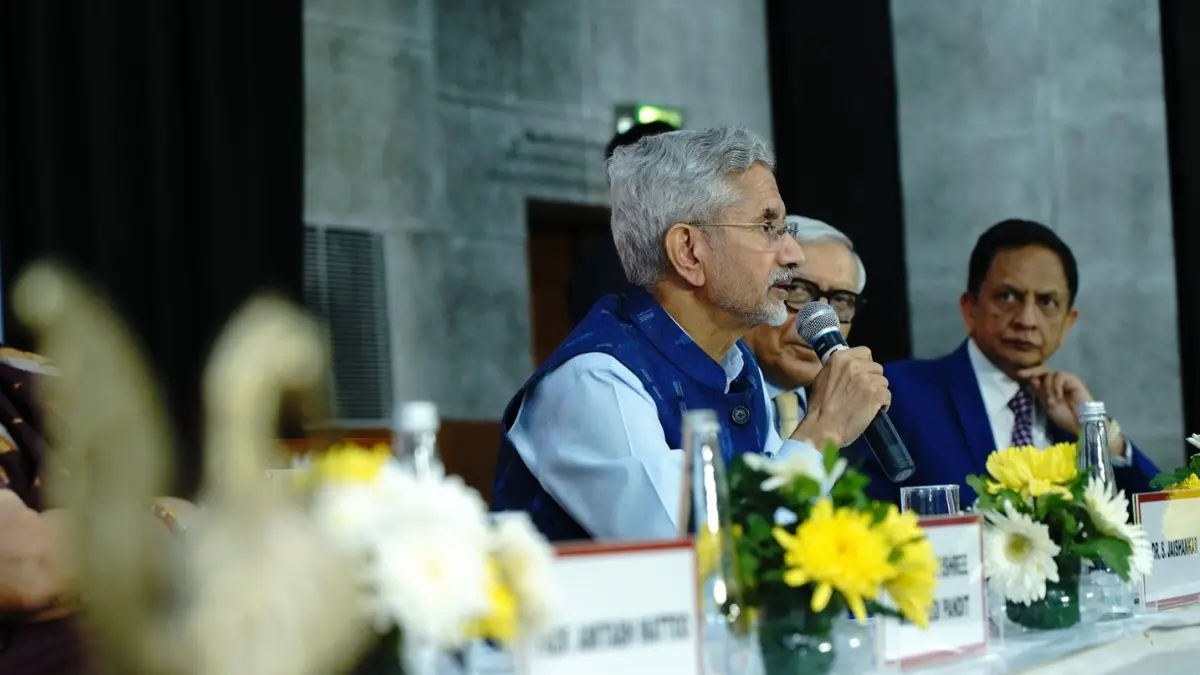
New Delhi: External Affairs Minister S Jaishankar cautioned on Tuesday that global trade faces major disruptions from “tariff volatility” and the concentration of manufacturing in a single geography, underscoring the need for India to navigate rising geopolitical risks and strategic competition.
Speaking at the Jawaharlal Nehru University's School of International Studies (SIS) to mark its 70th anniversary and the inaugural Aravali Summit, Jaishankar described the current global landscape as "exceptionally turbulent”.
He noted that a third of global manufacturing has shifted to one location, creating vulnerabilities in supply chains, while anti-globalisation sentiments and unpredictable tariffs are overturning traditional trade calculations.
"Trade calculations are being overturned by tariff volatility," Jaishankar said, highlighting how these changes compound broader economic shifts. The US has emerged as a major exporter of fossil fuels, while China leads in renewables.
Advertisement
Competing models for data and artificial intelligence are intensifying, with Big Tech emerging as a powerful player.
New connectivity routes, often with strategic intent, are reshaping mobility and finance, alongside sanctions, asset seizures and the rise of cryptocurrencies, he said.
Advertisement
Jaishankar pointed to escalating competition over rare earths and critical minerals, tighter technology controls and transformations in weaponry that make conflicts more risk-prone.
These dynamics, he argued, erode sovereignty through tech manipulation, prompt revisions to global rules, and prioritise ownership and security over cost in economic deals.
"All nations face these predicaments. But while the majority are struggling to cope or are busy defending their interests, India has to strategise and continue rising amid such volatility," he said.
Drawing from India's post-Independence history, he stressed the importance of realism, national capabilities and learning from past underestimations, such as territorial defence and neighbourly relations.
He said as a civilizational state, India must align its rise with traditions, harmonising internal dynamics such as demographics, demand and data with foreign policy.
"We have to de-risk our exposures and engagements and yet take risks when necessary," he said, urging multi-alignment to prepare for a leading role by 2047.
Jaishankar praised SIS's 70-year legacy in building India's diplomatic expertise and called on it to develop concepts, strategies and narratives for “Viksit Bharat”.
"As India globalises, public interest in the world will grow. The power of analysis and articulation must address that societal need," he added.