
Sensex At 1 Lakh By June 2026: Morgan Stanley Report Snubs Naysayers Donald Trump, Rahul Gandhi
Morgan Stanley has projected a bullish outlook for Indian equities, forecasting the Sensex to hit 100,000 by June 2026 in its bull case scenario. The report directly contrasts recent remarks by Donald Trump and Congress leader Rahul Gandhi, both of whom described the Indian economy as “dead.”
- Republic Business
- 2 min read

;'%3e%3cpath%20d='m8,15.99c4.41,0,7.99-3.58,7.99-7.99S12.41,0,8,0,0,3.59,0,8s3.58,7.99,7.99,7.99Z'%20style='stroke:%23fff;%20stroke-miterlimit:10;%20stroke-width:.02px;'/%3e%3cpath%20d='m3.08,3.37l3.82,5.11-3.84,4.15h.87l3.37-3.64,2.72,3.64h2.94l-4.04-5.39,3.58-3.87h-.86l-3.1,3.35-2.5-3.35h-2.94Zm1.27.64h1.35l5.97,7.99h-1.35l-5.97-7.99Z'%20style='fill:%23fff;'/%3e%3c/g%3e%3c/svg%3e)


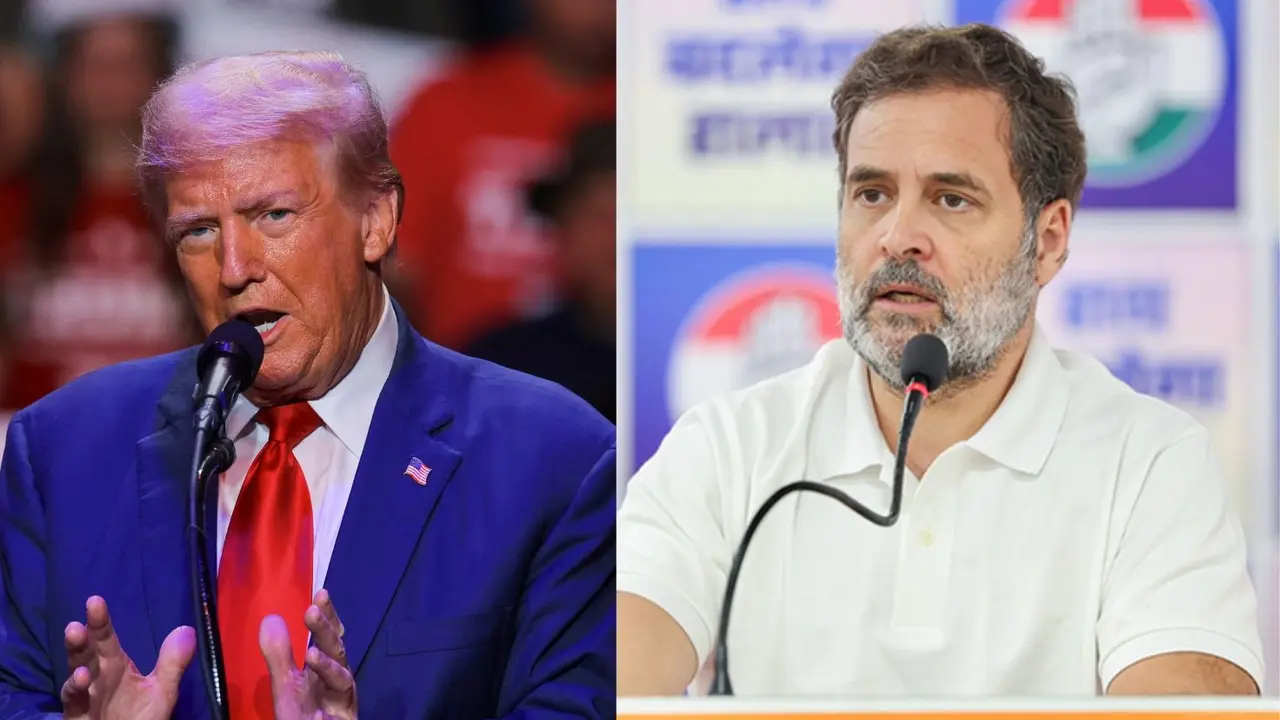
Amid sharp political criticism over India’s economic trajectory, global brokerage Morgan Stanley has projected a bullish outlook for Indian equities, forecasting the Sensex to hit 100,000 by June 2026 in its bull case scenario.
The report directly contrasts recent remarks by US President Donald Trump and Congress leader Rahul Gandhi, both of whom described the Indian economy as “dead.”
Morgan Stanley’s base case projects the Sensex at 89,000 in the next 12 months, implying a 10% upside from current levels, driven by stable domestic growth, benign oil prices, monetary easing, and steady retail investor participation.
In its bull case, which carries a 30% probability, the brokerage expects the benchmark to scale to 100,000, assuming oil prices remain below $65 per barrel, trade tensions ease, and reforms accelerate, with earnings growth projected at 19% CAGR through FY2028.
Advertisement
US President's Remarks On India
Earlier, US President Donald Trump declared the Indian and Russian economies as 'dead economies' on his social media platform, Truth Social.
Rahul Gandhi, echoing Trump’s criticism, alleged on Thursday that “everybody knows the Indian economy is dead except Prime Minister Modi and Finance Minister Sitharaman.”
Advertisement
“Trump is right. I am glad he has stated a fact,” Gandhi told reporters, adding that “Modi will do what Trump tells him to do” on trade deals.
The BJP countered Gandhi’s remarks, terming them a “shameful” insult to India’s economic achievements and aspirations.
Morgan Stanley Report
Despite the political war of words, Morgan Stanley remains upbeat on India’s structural growth story. The report cites strong demographics, improving infrastructure, policy stability, and a push towards manufacturing and energy transition as key drivers for long-term growth.
It also highlights India’s declining oil intensity, rising services exports, fiscal consolidation efforts, and subdued inflation volatility as factors supporting stable interest rates and higher equity valuations.
While acknowledging near-term risks such as weaker global growth, geopolitical tensions, and supply chain disruptions, Morgan Stanley believes India is set for a structural re-rating.
“The combination of high growth, low volatility, and falling interest rates supports higher market valuations,” the report stated, adding that the earnings slowdown seen since Q2 FY25 is ending.
As political leaders debate India’s economic direction, Morgan Stanley’s projection offers a starkly optimistic counterpoint, suggesting that the Sensex is well-poised to enter a new phase of growth, potentially reaching the historic 1 lakh mark by June 2026.