
The End of the Local Repair Shop? How India’s Appliance Ecosystem Is Changing
India’s appliance repair sector is shifting from informal technicians to organised, tech-driven service networks as rising device complexity, higher repair costs, and evolving consumer expectations reshape the industry.
- Republic Business
- 3 min read

;'%3e%3cpath%20d='m8,15.99c4.41,0,7.99-3.58,7.99-7.99S12.41,0,8,0,0,3.59,0,8s3.58,7.99,7.99,7.99Z'%20style='stroke:%23fff;%20stroke-miterlimit:10;%20stroke-width:.02px;'/%3e%3cpath%20d='m3.08,3.37l3.82,5.11-3.84,4.15h.87l3.37-3.64,2.72,3.64h2.94l-4.04-5.39,3.58-3.87h-.86l-3.1,3.35-2.5-3.35h-2.94Zm1.27.64h1.35l5.97,7.99h-1.35l-5.97-7.99Z'%20style='fill:%23fff;'/%3e%3c/g%3e%3c/svg%3e)


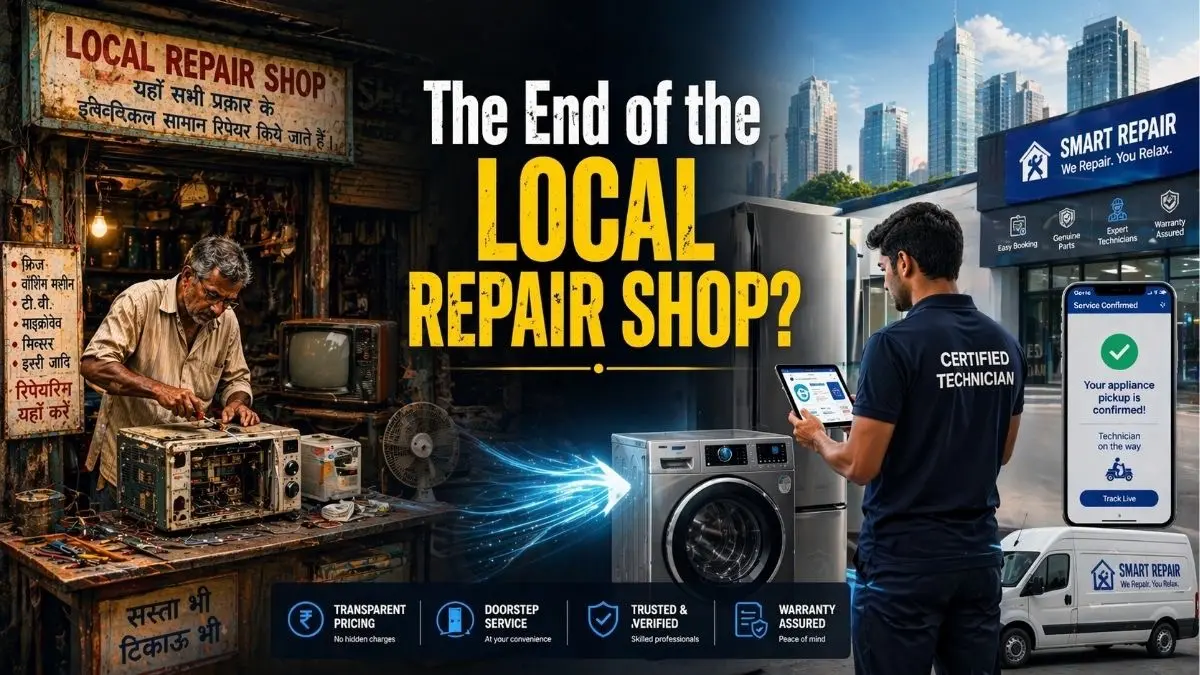
India’s appliance repair landscape is undergoing a structural shift, driven by the rapid evolution of consumer electronics and changing customer expectations. What was once a largely informal, technician-led ecosystem is now moving toward organised, tech-enabled service networks.
“For years, appliance repair in India followed a very simple, trust-based model. A customer would call a local technician, the issue would be fixed on the spot, and that was the end of the interaction,” said Neeraj Verma, Founder & CEO, Across Assist. “That model worked well when appliances were largely mechanical and easy to diagnose.”
However, appliances today are significantly more complex. From app-controlled air conditioners to sensor-driven washing machines and software-enabled kitchen devices, the underlying technology has changed rapidly over the last few years.
“Today’s appliances are not just machines, they are integrated electronic systems,” Verma explained. “Failures are increasingly electronic rather than mechanical, which means repairs require diagnostic tools, authorised components and trained professionals.”
Advertisement
This shift has also impacted repair costs. What was once a minor ₹300–₹500 fix has now escalated to ₹3,000–₹8,000 or more, depending on the product category.
“We are seeing a clear increase in repair costs across urban India,” Verma noted. “At the same time, a growing share of appliances now requires specialised servicing, which the traditional repair ecosystem is not fully equipped to handle.”
Advertisement
Industry estimates indicate that average appliance repair costs have risen by roughly 25% over the past five years, while nearly one-third of devices now require specialised intervention.
At the same time, consumer expectations are evolving.
“Breakdowns today are not just inconvenient, they are disruptive,” said Verma. “A faulty AC in peak summer or a refrigerator failure can immediately impact daily life. Customers are no longer willing to wait several days for resolution.”
This shift in expectations is reflected in purchasing behaviour as well. A growing number of consumers are opting for extended protection plans, particularly for high-value appliances.
“Customers are increasingly looking for predictability and peace of mind,” Verma added. “That is why we are seeing strong adoption of extended protection, especially in categories like air conditioners, refrigerators and premium kitchen appliances.”
As a result, the conversation is moving beyond simple repairs toward end-to-end service management.
“What customers now expect is a seamless experience — from pickup and diagnosis to repair, parts replacement and delivery,” Verma said. “It is no longer about fixing a product; it is about managing the entire outcome.”
Delivering this level of service at scale requires organised infrastructure rather than individual technicians.
“We are seeing the emergence of structured service networks comprising verified technicians, authorised partners and integrated logistics,” Verma explained. “This allows for better coordination, faster turnaround times and more consistent service quality.”
According to Verma, data is also beginning to play a critical role in shaping the future of appliance servicing.
“With access to data on usage patterns, failure rates and repair timelines, platforms can start predicting demand and improving efficiency,” he said. “Over time, this could shift the ecosystem from reactive repairs to more proactive servicing models.”
Despite these changes, Verma believes the local repair shop will not disappear entirely, but its role will evolve.
“The neighbourhood technician will continue to exist, especially for simpler repairs,” he said. “But for complex, high-value appliances, consumers are clearly moving toward more organised and reliable service ecosystems.”
The transition, he emphasised, is gradual but significant.
“We are moving from a repair-driven model to a response-driven ecosystem,” Verma concluded. “From individual service providers to integrated networks, and from one-time fixes to long-term reliability. That is the direction the industry is heading.”