
The Venezuela Effect To India's Energy Stability
Venezuela’s oil sector is at a turning point after years of decline. India’s relevance stems from existing investments, refinery compatibility and sensitivity to global oil supply shifts. While immediate impact is limited, Venezuela remains strategically important to India’s long-term energy planning.
- Republic Business
- 4 min read

;'%3e%3cpath%20d='m8,15.99c4.41,0,7.99-3.58,7.99-7.99S12.41,0,8,0,0,3.59,0,8s3.58,7.99,7.99,7.99Z'%20style='stroke:%23fff;%20stroke-miterlimit:10;%20stroke-width:.02px;'/%3e%3cpath%20d='m3.08,3.37l3.82,5.11-3.84,4.15h.87l3.37-3.64,2.72,3.64h2.94l-4.04-5.39,3.58-3.87h-.86l-3.1,3.35-2.5-3.35h-2.94Zm1.27.64h1.35l5.97,7.99h-1.35l-5.97-7.99Z'%20style='fill:%23fff;'/%3e%3c/g%3e%3c/svg%3e)


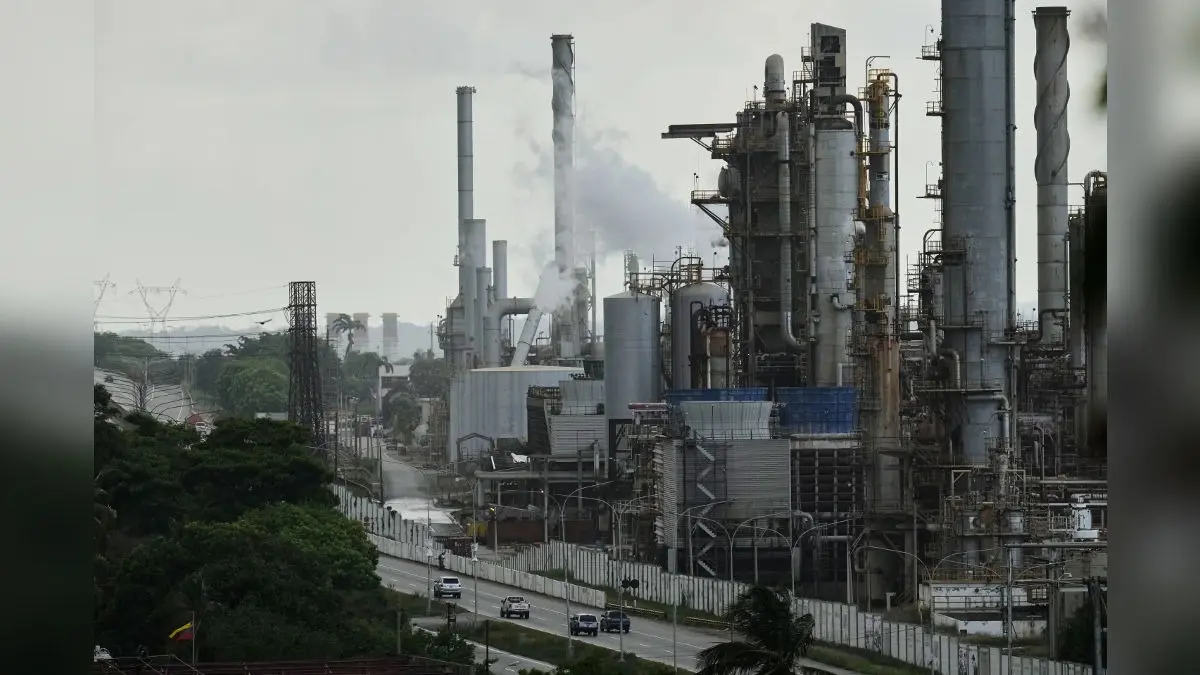
Venezuela is back in focus in global energy conversations as its oil sector faces the possibility of a reset after years of sanctions, political isolation and collapsing output. While the developments are unfolding far from India, they still carry relevance for New Delhi’s energy strategy.
Here’s why.
Venezuela’s Oil Sector Is Undergoing A Potential Reset
Venezuela holds an estimated 303 billion barrels of proven crude reserves, according to US Energy Information Administration, but its production has fallen sharply over the past decade due to sanctions, lack of investment and operational constraints. From historical peaks above 3 million bpd, production has declined to well under 1 million bpd, according to a report by Trading Economics, a Lisbon-based global economic data platform. Recent geopolitical developments suggest the country’s oil industry could see structural changes, that could include reworking of how production, exports and partnerships are managed. Any such reset has implications beyond Venezuela’s borders.
India Has Existing Stakes In Venezuela’s Oil Reserves
India’s state-owned energy company ONGC Videsh Ltd (OVL) invested in Venezuelan oilfields such as the San Cristoval field, where production has dropped to a fraction of its potential amid sanctions and lack of access to modern technology and services.
Advertisement
Venezuela has not paid OVL approximately USD 536 million in dividends due on its stake up to 2014, according to a report by PTI, and similar unpaid amounts for later years have left nearly USD 1 billion in claims frozen because audits were not permitted. If oil exports and revenue flows normalise, these dues could become recoverable.
At peak, Indian refiners imported over 400,000 barrels per day (bpd) of Venezuelan crude, making up roughly 10% of India’s crude basket at the time.
Advertisement
Indian Refineries Are Suited To Venezuelan Crude
Venezuelan oil is heavy and challenging to process. Indian refineries, like those operated by Reliance Industries and Hindustan Petroleum, are among the most complex in the world and are designed to handle such grades efficiently.
Before sanctions disrupted trade, Venezuelan crude formed an important part of India’s import basket. That compatibility still exists and remains relevant if access improves over time.
Global Oil Supply Shifts Affect India Directly
India imports the bulk of its crude oil, making it sensitive to changes in global supply. Any recovery in Venezuelan output adds to overall availability in the market. This can influence price dynamics even if India does not immediately resume imports.
For a country where oil prices feed directly into inflation and trade balances, such shifts matter.
Diversification Remains A Long-Term Priority
India continues to diversify its oil sources to reduce exposure to geopolitical risks and supply disruptions. Venezuela represents one of several potential sources that could re-enter the global supply chain if constraints ease.
Why This Matters Now?
Venezuela’s oil story matters to India because it intersects with three long-term interests: overseas energy investments, refining economics and supply diversification. As global energy equations evolve, countries with stranded oil assets and compatible infrastructure regain relevance.
Indian Companies With Exposure in Venezuela:
Oil and Gas Companies:
ONGC Videsh (OVL): Holds equity stake in 2 oil projects in Venezuela
Indian Oil Corp (IOC): Consortium partner in Venezuela's Carabobo heavy-oil project, Exposure via equity participation
Oil India: Minority partner in Venezuelan oil JV alongside OVL and IOC
Reliance Industries: Has historically been a major importer of Venezuelan crude
Nayara Energy: Has historically imported heavy crude from Venezuela
Mangalore Refinery and Petrochemicals (MRPL): Has historically imported Venezuelan oil (per reports)
Engineering & EPC Companies
Engineers India (EIL): Maintains an overseas office in Caracas, Venezuela to support international business activities
Pharma Companies:
Sun Pharma: Has a registered Venezuelan subsidiary
Dr. Reddy's: Had a subsidiary. However, it divested its entire stake in 2024
Cipla: Has historically been an exporter of essential medicines to Venezuela
Glenmark Pharma: Operates in Venezuela through its locally registered subsidiary
Metals & Industrial
Jindal Steel & Power: Operates Venezuela's largest iron-ore complex
Credits: Groww