
Trump Announces ‘Massive’ Japan Trade Deal With 15% Tariff, Calls It A 'Very Exciting Time' For US
In a major breakthrough ahead of a looming tariff deadline, US President Donald Trump announced a trade pact with Japan that slashes proposed tariffs to 15%, secures a $550 billion Japanese investment, and lifts auto market optimism. The Nikkei surged as Tokyo eyes potential gains despite political uncertainty.
- Republic Business
- 5 min read

;'%3e%3cpath%20d='m8,15.99c4.41,0,7.99-3.58,7.99-7.99S12.41,0,8,0,0,3.59,0,8s3.58,7.99,7.99,7.99Z'%20style='stroke:%23fff;%20stroke-miterlimit:10;%20stroke-width:.02px;'/%3e%3cpath%20d='m3.08,3.37l3.82,5.11-3.84,4.15h.87l3.37-3.64,2.72,3.64h2.94l-4.04-5.39,3.58-3.87h-.86l-3.1,3.35-2.5-3.35h-2.94Zm1.27.64h1.35l5.97,7.99h-1.35l-5.97-7.99Z'%20style='fill:%23fff;'/%3e%3c/g%3e%3c/svg%3e)


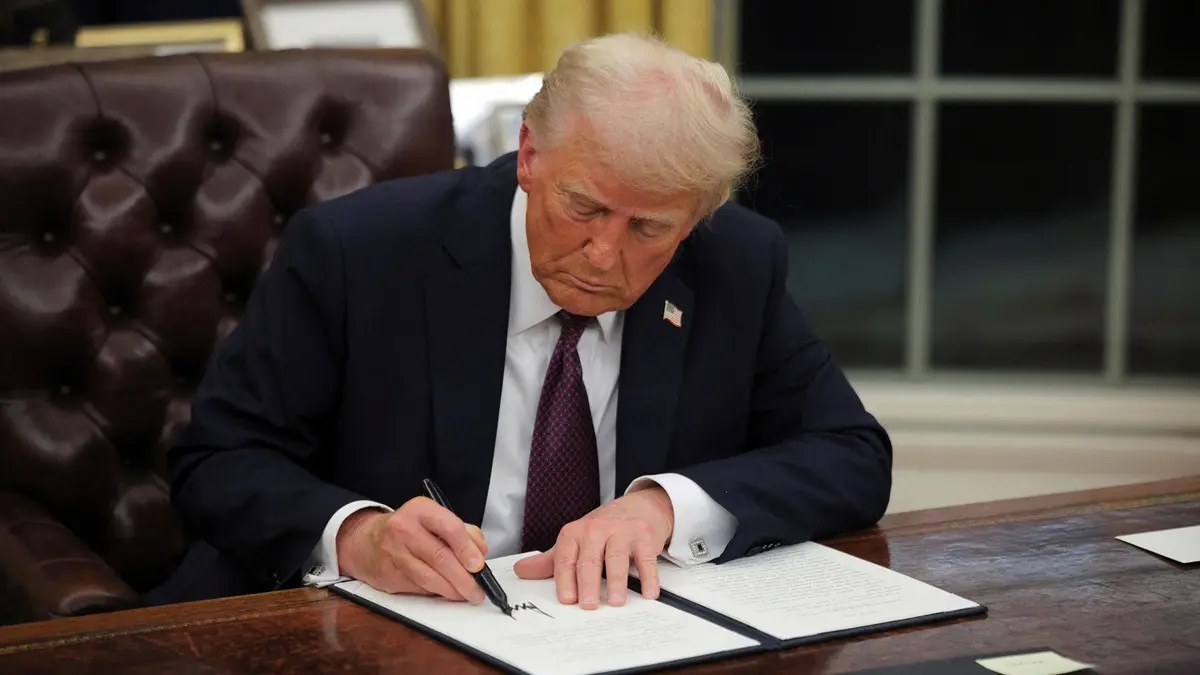
US President Donald Trump on Tuesday unveiled a significant trade agreement with Japan, just days ahead of an August 1 deadline for escalating tariffs. The deal slashes proposed tariffs on Japanese goods from 25% to 15%, including on automotive imports—a key sticking point in previous negotiations.
Trump, announcing the deal via his Truth Social platform, called it “a very exciting time for the United States of America,” adding, “we will continue to always have a great relationship with the Country of Japan.”
The deal also includes a commitment from Japan to invest $550 billion in the US and to further open its markets to American exports.
While the White House did not issue a formal press release or provide additional specifics, industry insiders and officials familiar with the agreement confirmed many of the major points.
Nikkei Jumps, Automakers Lead Rally
Following the announcement, Japanese financial markets reacted positively. The benchmark Nikkei index surged 2.6%, hitting its highest point in over a year.
Shares of major Japanese automakers led the charge. Toyota Motor Corp climbed more than 11%, while Honda Motor Co and Nissan Motor Co jumped over 8% each. The rally extended to South Korean automakers on hopes that Seoul might soon negotiate a similar trade arrangement.
“The 15% tariff rate is a better outcome than we feared,” said Kazutaka Maeda, an economist at Meiji Yasuda Research Institute. “With this, I expect the Japanese economy to avoid recession.”
Auto Industry Divided on Impact
While Japanese and Korean automakers celebrated, U.S. auto manufacturers responded with concern. Matt Blunt, President of the American Automotive Policy Council, which represents General Motors, Ford, and Stellantis, criticised the agreement.
“Any deal that charges a lower tariff for Japanese imports with virtually no US content than the tariff imposed on North American-built vehicles with high US content is a bad deal for US industry and US auto workers,” Blunt said.
US auto industry executives are particularly alarmed that imports from Canada and Mexico are still subject to 25% tariffs, potentially placing them at a competitive disadvantage.
Tokyo Reacts: “Mission Complete”
In Tokyo, Japanese Prime Minister Shigeru Ishiba said he had received an initial update from Japan’s top trade negotiator, Ryosei Akazawa, but withheld comments until full details were reviewed.
“I cannot speak on the implications until I have reviewed the text,” Ishiba said at a press briefing.
Facing intense political pressure following his party’s recent loss of control in the upper house, Ishiba said the trade deal’s impact could influence his decision on whether to step down.
Akazawa, who met with Trump in Washington, posted simply on X (formerly Twitter): “#Mission Complete.”
US-Japan Trade: An Unbalanced Equation
According to US Census Bureau data, two-way trade between the US and Japan amounted to $230 billion in 2024, with Japan running a $70 billion surplus. Autos remain a dominant factor in this imbalance.
In 2024 alone, the US imported $55 billion worth of vehicles and parts from Japan, compared to just $2 billion in US automotive exports to Japan. Trump has long expressed frustration over this disparity.
Behind the Scenes: Race Against the Clock
Tuesday’s announcement comes as Trump’s trade team works at full speed to conclude deals before the August 1 tariff deadline. Without resolutions, many countries face heightened tariffs on top of those already imposed since Trump first took office.
“We concluded the one deal ... and now we're going to conclude another one,” Trump said at the White House. “They’re forming a joint venture with us in Alaska ... for the LNG.”
According to White House sources, Japan has agreed to join the U.S. in a long-pursued liquefied natural gas (LNG) pipeline project in Alaska. Previously skeptical, Japanese officials have reportedly softened their stance in light of the broader trade deal and investment incentives.
Investors, Economists Weigh In
Japan is already the largest foreign investor in the U.S., with $2 trillion in holdings, including massive stakes by pension fund GPIF and Japanese insurers.
According to Bank of Japan data, direct Japanese investment in the U.S. reached $1.2 trillion by the end of 2024, with an additional $137 billion flowing into North America last year alone.
Kristina Clifton, a senior economist at Commonwealth Bank of Australia, said the outcome “could have been worse” for Japan given Trump’s earlier threats.
“Steel, aluminium, and also cars are important exports for Japan, so it’ll be interesting to see if there are any specific carve-outs for those,” she said.
Still Missing: Full Details and Formal Text
Despite the announcement, specifics remain scarce. The White House has not released a detailed statement, and Japanese officials are also yet to publish an official summary of the agreement.
This follows a pattern: Trump had earlier announced a deal with Vietnam, but weeks later, no formal documents had been released by either party. Agreements with Britain, Indonesia, and China are also pending final texts.
At the time of this publication, Reuters was unable to confirm all details of the Japan deal.
Read More - Brigade Hotel Ventures IPO: GMP, Price Band, and Other Details
What’s Next?
Trump’s move is seen as part of a broader strategy to cement trade victories and calm markets amid global uncertainty. Negotiators from the European Union are expected in Washington this week for similar talks.
While the Japanese side is hopeful, uncertainty over Ishiba’s political future and internal opposition to US-favored terms may still influence how the deal evolves.
For now, markets are cheering, automakers are split, and another complex chapter in U.S.-Asia trade is underway—with many details still unfolding.
(With Inputs From Reuters)