
Western Double Standards? US Expands Trade With Russia, But Punishes India
Russian President Vladimir Putin has disclosed that since Donald Trump returned to office, trade between Russia and the United States has increased by about 20 percent.
- Republic Business
- 3 min read

;'%3e%3cpath%20d='m8,15.99c4.41,0,7.99-3.58,7.99-7.99S12.41,0,8,0,0,3.59,0,8s3.58,7.99,7.99,7.99Z'%20style='stroke:%23fff;%20stroke-miterlimit:10;%20stroke-width:.02px;'/%3e%3cpath%20d='m3.08,3.37l3.82,5.11-3.84,4.15h.87l3.37-3.64,2.72,3.64h2.94l-4.04-5.39,3.58-3.87h-.86l-3.1,3.35-2.5-3.35h-2.94Zm1.27.64h1.35l5.97,7.99h-1.35l-5.97-7.99Z'%20style='fill:%23fff;'/%3e%3c/g%3e%3c/svg%3e)


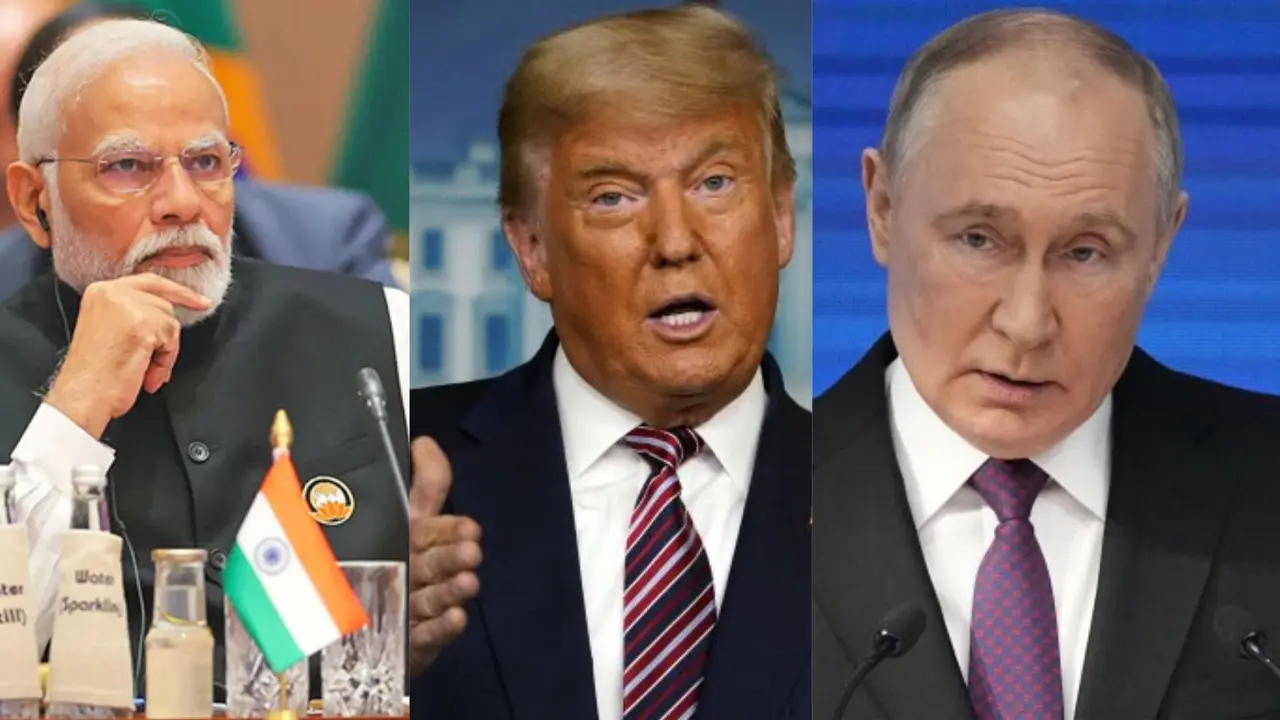
Russian President Vladimir Putin has disclosed that since Donald Trump returned to office, trade between Russia and the United States has increased by about 20 percent.
This statement, made after the Alaska summit between Trump and Putin, highlights a contradiction in US policy: while Washington expands its own trade with Moscow, it imposes tariffs and sanctions on countries like India for buying Russian energy.
Alaska Summit Ends Without Breakthrough
The Alaska summit was closely watched as Trump attempted to present himself as a peacemaker in the Ukraine conflict. He entered the talks warning Putin of “severe consequences” if Russia refused a ceasefire. In the end, there was no agreement on peace.
However, Trump spoke positively after the meeting, describing Russia as “incredibly rich in natural resources” and spanning “11 time zones.” He framed the encounter as a step toward world peace and an effort to improve US-Russia relations.
Advertisement
A Larger Geopolitical Game
For Trump, the meeting also had a larger geopolitical goal. Dr. Brahma Chellaney commented on this dynamic, writing, “Trump went into the Alaska summit threatening ‘severe consequences’ if Putin rejected a ceasefire.”
Chellaney highlighted, “He emerged without an accord, yet struck an upbeat tone about improving US-Russia relations, calling Russia incredibly rich in natural resources and spanning 11 time zones.”
Advertisement
“The meeting was a step toward world peace and a bid to peel Russia away from China so the two giants do not cement an unholy alliance against the US. In an ironic twist, Trump has now shifted the burden of ending the Ukraine war onto Zelensky and Europe, although neither of which appears eager to negotiate peace,” he said.
Shifting Sanctions on China and India
At the same time, Trump’s approach to sanctions reveals a pattern of selective application. Before the summit, he had threatened to extend secondary sanctions on China for buying Russian energy.
After the talks, however, he suggested those measures might not be necessary. “Because of what happened today, I think I don’t have to think about that,” Trump said when asked about new penalties on Beijing.
This shift may also affect India. Earlier this year, Trump announced 25 per cent additional tariffs on Indian goods, set to take effect on August 27.
The justification given was India’s continued imports of Russian oil. But after the Alaska summit, observers believe these tariffs may be shelved.
Tariffs as a Negotiating Tool
Chellaney argued that the tariffs on India were never a genuine policy tool. Instead, he described them as “a blunt extortion tool to strong-arm New Delhi into a trade deal on his terms.” With US-India trade talks scheduled for August 25, just two days before the tariff deadline, Trump may have created space to withdraw or postpone the measures.
The episode highlights the difficult position India faces. On one hand, Washington pressures New Delhi to reduce energy ties with Moscow. On the other, the United States itself has increased its own trade with Russia since Trump returned to office. This creates a perception of double standards.