
What Is Bharat Taxi, India’s First Cooperative Cab Service That Will Challenge Uber, Ola?
Bharat Taxi is India’s first cooperative ride-hailing platform, launched in Delhi with a driver-owned, fixed-fee model. By removing per-ride commissions and surge pricing, the service aims to improve driver earnings while offering competitive fares. With over three lakh drivers onboarded during its pilot phase, the platform plans to expand gradually, though scaling and service reliability will be key challenges.
- Republic Business
- 3 min read

;'%3e%3cpath%20d='m8,15.99c4.41,0,7.99-3.58,7.99-7.99S12.41,0,8,0,0,3.59,0,8s3.58,7.99,7.99,7.99Z'%20style='stroke:%23fff;%20stroke-miterlimit:10;%20stroke-width:.02px;'/%3e%3cpath%20d='m3.08,3.37l3.82,5.11-3.84,4.15h.87l3.37-3.64,2.72,3.64h2.94l-4.04-5.39,3.58-3.87h-.86l-3.1,3.35-2.5-3.35h-2.94Zm1.27.64h1.35l5.97,7.99h-1.35l-5.97-7.99Z'%20style='fill:%23fff;'/%3e%3c/g%3e%3c/svg%3e)


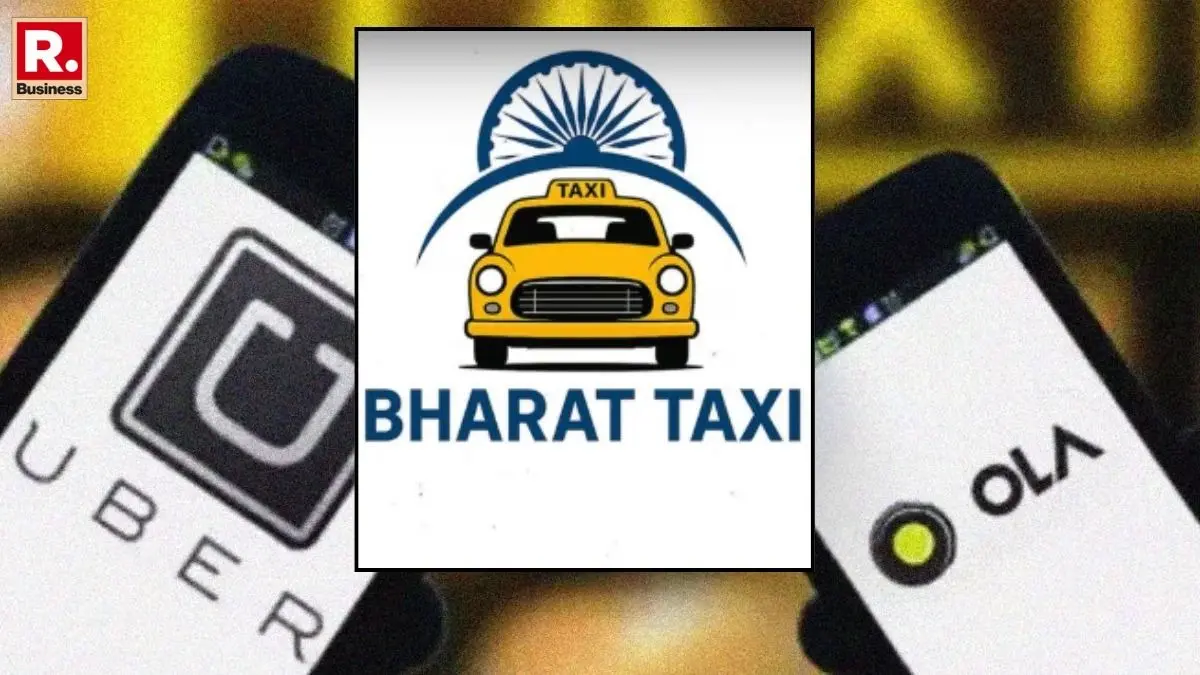
India’s ride-hailing market has a new entrant with a distinctly different operating model. Bharat Taxi was launched today in Delhi by Union Home and Cooperation Minister Amit Shah. It is being positioned as the country’s first cooperative-based cab aggregation service, aiming to challenge established players such as Uber and Ola by changing how drivers are paid and how the platform is owned.
Unlike private ride-hailing companies that operate on commission-based models, Bharat Taxi is structured as a driver-owned cooperative, “Sarathi Hi Malik -driver is the owner,” with a focus on fixed costs, shared ownership, and predictable pricing.
How Bharat Taxi’s Model Works?
Bharat Taxi operates under a cooperative framework in which registered drivers become members rather than contractual gig workers. Instead of paying a percentage commission on every trip, drivers pay a fixed daily platform access fee, reported to be around ₹30 per day. This allows drivers to retain a larger share of fare earnings, regardless of trip volume.
According to officials associated with the rollout, removing per-ride commissions helps reduce pressure on driver incomes and enables the platform to offer lower fares compared with existing aggregators, particularly on routine and airport routes. The service also does not rely on dynamic surge pricing, a common point of friction for users on private platforms.
Advertisement
Scale and Early Adoption
Bharat Taxi’s public launch follows a pilot phase conducted over the past few months. During this period, the platform onboarded over three lakh drivers and registered more than one lakh users, primarily across Delhi-NCR and parts of Gujarat. Daily ride volumes during the pilot averaged close to 10,000 trips, thus indicating early traction ahead of the wider rollout.
The service has started operations with a focus on major urban centres, where ride-hailing demand is highest, and plans to expand gradually to other cities and states.
Advertisement
In addition to pricing, Bharat Taxi has emphasised driver welfare as a key differentiator. The cooperative structure allows drivers to participate in profit-sharing, while also opening access to group benefits such as insurance coverage, emergency support, and retirement-linked savings, areas where gig workers often lack formal protection.
On the passenger side, the platform has built-in safety measures, including verified driver profiles, centralised support systems, and coordination with local authorities for grievance redressal. Dedicated support centres have been set up in select locations to assist both drivers and riders.
How It Compares With Uber and Ola?
India’s ride-hailing market is currently dominated by a handful of large private platforms that rely on algorithm-driven pricing, incentives, and commissions. While these players benefit from scale, technology, and user familiarity, driver dissatisfaction over earnings volatility has been a recurring issue.
Bharat Taxi’s cooperative model shifts the focus from maximising platform margins to cost predictability and shared ownership. However, analysts note that its long-term success will depend on execution, particularly service availability, wait times, app reliability, and expansion beyond initial markets.