
Will Rs 10 Excise Duty Cut Cost Over Rs 1.6 Trillion To Centre's Exchequer?
Nomura's oil and gas analyst Bineet Banka estimates that the blended marketing margins of OMCs have fallen to nearly Rs 50 per litre of under-recoveries vs pre-crisis gains of ~ Rs 6 per litre.
- Republic Business
- 3 min read

;'%3e%3cpath%20d='m8,15.99c4.41,0,7.99-3.58,7.99-7.99S12.41,0,8,0,0,3.59,0,8s3.58,7.99,7.99,7.99Z'%20style='stroke:%23fff;%20stroke-miterlimit:10;%20stroke-width:.02px;'/%3e%3cpath%20d='m3.08,3.37l3.82,5.11-3.84,4.15h.87l3.37-3.64,2.72,3.64h2.94l-4.04-5.39,3.58-3.87h-.86l-3.1,3.35-2.5-3.35h-2.94Zm1.27.64h1.35l5.97,7.99h-1.35l-5.97-7.99Z'%20style='fill:%23fff;'/%3e%3c/g%3e%3c/svg%3e)


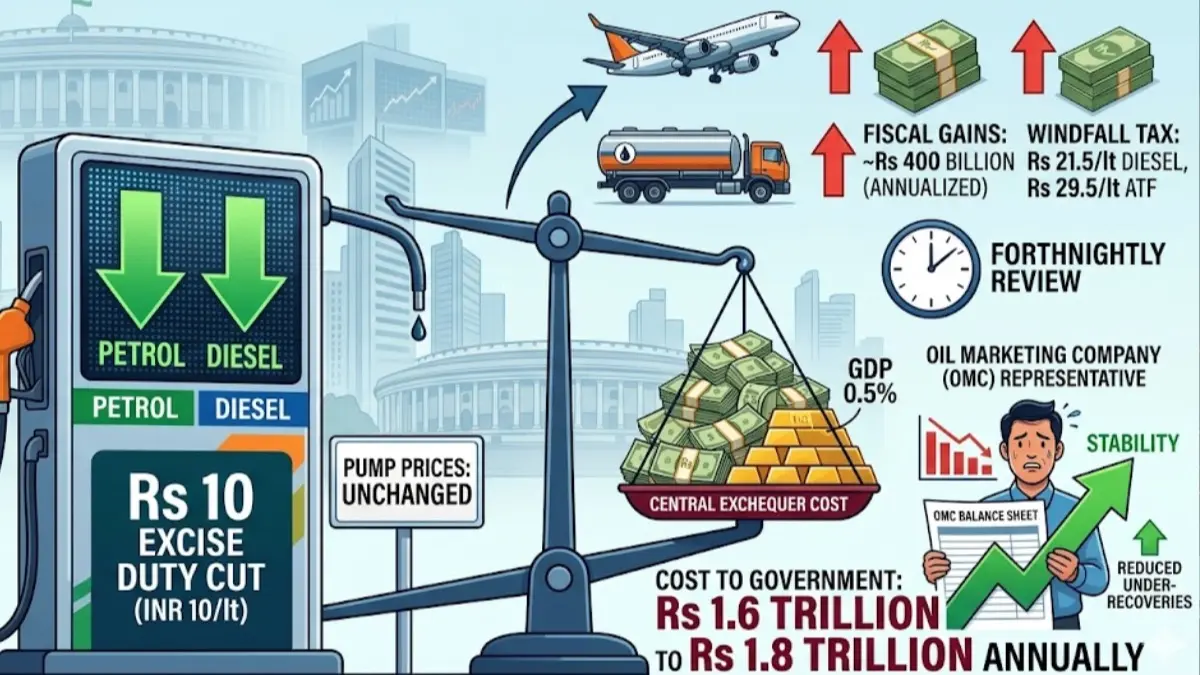
The central government's latest excise duty cut of Rs 10 on both fuels diesel, and petrol is likely to cost the administration's exchequer ~0.5% of GDP, which translated between Rs 1.6 trillion to Rs 1.8 trillion.
What Has Transpired?
The government announced an Rs 10 per litre cut in the special excise duties on petrol and diesel, with the duty on petrol lowered to Rs 3 per lite from Rs 13 per litre and on diesel down to nil from Rs 10 per litre.
"Note that this doesn’t entirely eliminate excise duties – the central government will continue to charge basic excise duty and cesses on petrol and diesel (Rs 1.40/lt and Rs 7.50/lt, respectively on petrol, and INR1.80/lt and INR6/lt of levy on diesel)," Nomura noted in a brokerage note.
Additionally, states apply VAT as a percentage of the price of petrol/diesel, inclusive of the excise duties and dealer commissions, with rates, broadly ranging from 17% to 23% (ad valorem), which remain unchanged for now.
Advertisement
The government has also announced windfall taxes on exports of diesel and aviation turbine fuel (ATF) of INR21.5/lt and INR29.5/lt, respectively. These will be reviewed on a fortnightly basis.
Why Did The Excise Duty Reduction Take Place?
Since the start of the Iran war and the sharp rise in crude oil prices, India’s oil marketing companies (OMCs) have been at the frontline, absorbing the shock through their balance sheets, while pump retail prices have stayed unchanged.
Advertisement
Nomura's oil and gas analyst, Bineet Banka estimates that the blended marketing margins of OMCs have fallen to nearly Rs 50 per litre of under-recoveries vs pre-crisis gains of ~ Rs 6 per litre.
As pump prices remain unchanged despite the excise duty cuts, the government’s aim seems to be to reduce the burden on OMCs’ balance sheets and to share some of the burden of higher crude oil prices.
This is unlike the duty cuts announced in 2021-22 in the wake of the Russia Ukraine war, which led to a fall in retail fuel prices.
The government’s imposition of windfall taxes on diesel and ATF exports is reminiscent of similar taxes imposed in 2022 in reaction to the Russia-Ukraine war, though they were discontinued within a month (see India: Government reverses course on the oil windfall taxes, 20 July 2022). The aim is to reduce exports and encourage refiners to supply to the domestic market.
"Based on our estimates, the cut in excise duties could cost the central government Rs 1.6 trillion or 0.5% of GDP). Officials suggested revenue loss of Rs 70 billion or 0.02% of GDP) for two weeks, which puts the annualised loss in the broad ball-park of our estimate of Rs 1.8 trillion or 0.53% of GDP," Normura noted.
All other things being equal, the higher windfall taxes on diesel and ATF exports should lead to fiscal gains for the central government.
Officials have suggested Rs 15 billion of revenue gains in two weeks, which on an annualised basis suggests close to Rs 400 billion or 0.1% of GDP.
However, the government has indicated that this might be temporary, with the tax to be reviewed every fortnight.