
Op Sindoor Showed India’s Land, Air & Naval Forces Are In Lethal Cohesion: Arnab Goswami
Speaking at Republic World’s flagship Forces First Conclave 2025 in Delhi, Editor-in-Chief Arnab Goswami called the current era “the most militarised decade since World War II.” Addressing top military leaders, he emphasised India’s strategic rise amid global turbulence and hailed Operation Sindoor as a defining moment in integrated warfare.
- Defence News
- 8 min read

;'%3e%3cpath%20d='m8,15.99c4.41,0,7.99-3.58,7.99-7.99S12.41,0,8,0,0,3.59,0,8s3.58,7.99,7.99,7.99Z'%20style='stroke:%23fff;%20stroke-miterlimit:10;%20stroke-width:.02px;'/%3e%3cpath%20d='m3.08,3.37l3.82,5.11-3.84,4.15h.87l3.37-3.64,2.72,3.64h2.94l-4.04-5.39,3.58-3.87h-.86l-3.1,3.35-2.5-3.35h-2.94Zm1.27.64h1.35l5.97,7.99h-1.35l-5.97-7.99Z'%20style='fill:%23fff;'/%3e%3c/g%3e%3c/svg%3e)


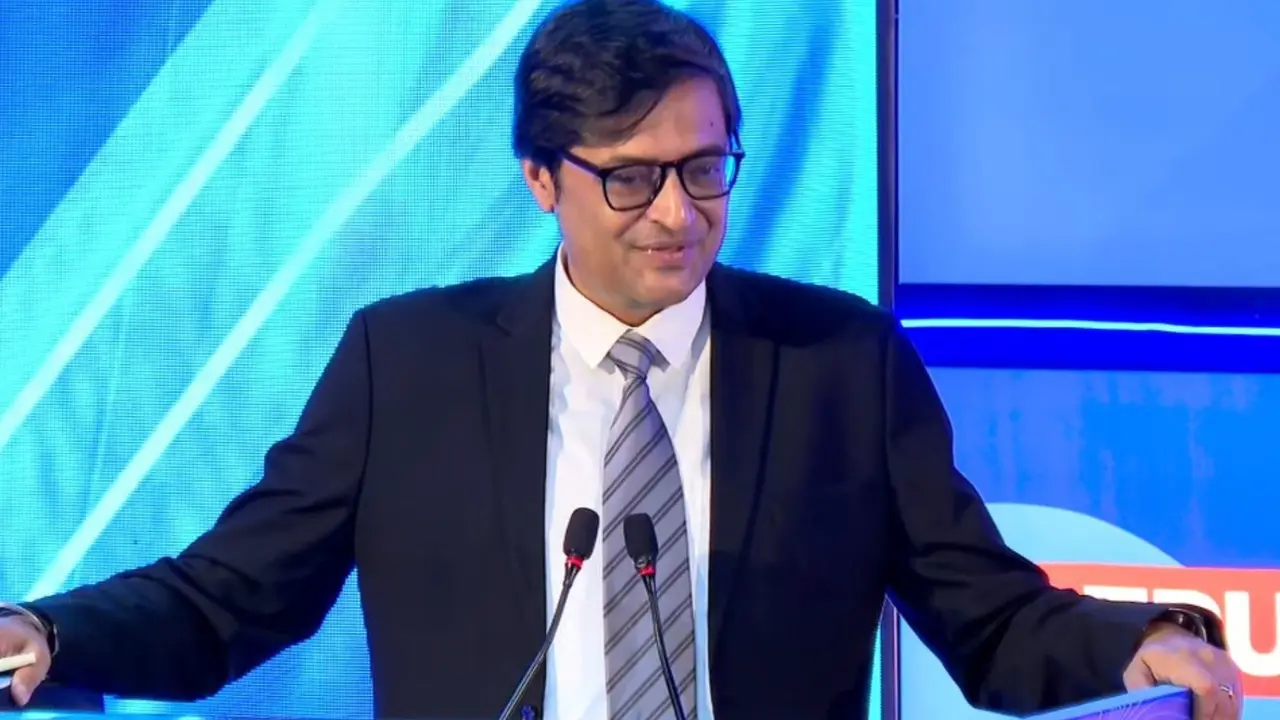
As global conflicts reshape geopolitics, Republic World’s Forces First Conclave 2025, themed “Living in the Era of Global Conflicts”, brought together India’s top military leadership and strategic thinkers at the Manekshaw Centre in Delhi on Saturday.
The day-long conclave, hosted in association with the Centre for Land Warfare Studies (CLAWS), aims to foster meaningful dialogue on the evolving character of warfare, national defence preparedness, and India’s role in a rapidly militarising world.
‘Most Militarised Decade Since World War II’
In his opening address, Republic Media Network’s Editor-in-Chief Arnab Goswami set the tone with a powerful observation:
“We are in an age of uncertainty and we are manoeuvring through it. Our rise comes with tremendous tumult in the global order. From Ukraine to the Red Sea to the Taiwan Strait, there are over 40-45 active conflicts in the world today. The world is witnessing ‘the most militarised decade since World War II.’”
Goswami noted that the global defence expenditure is projected to touch $3 trillion, while AI warfare and cyber threats are fundamentally redefining the nature of combat.
“Cyber attacks on defence networks have tripled. Wars are no longer mechanical alone, but algorithmic — fought through drones, satellites, cyberspace, and narrative influence,” he said.
India’s Strategic Rise and Operation Sindoor
Reflecting on India’s military achievements, Goswami hailed Operation Sindoor (May 7–10, 2025) as a milestone that showcased the country’s growing defence integration and technological prowess.
“Operation Sindoor showed the world that India’s land, air, and naval forces are in splendid and lethal cohesion, acting with unprecedented precision,” he said.
He underlined that the operation proved India’s multi-domain warfare capabilities, AI-enabled systems, and indigenous defence innovation, from Akash missile systems to ISRO’s satellite coordination and NAVIC navigation technologies.
“It marked India’s entry into a new warfare era where technological fusion and indigenous capability define military indigenisation,” he said.
Here's a look at Republic Media Network’s Editor-in-Chief Arnab Goswami's speech
"On behalf of Republic Media Network, thank you for joining us for the inaugural Forces First Conclave 2025.
This is India’s largest and most high-profile military conclave since Operation Sindoor, and it is truly humbling that we have the opportunity to host it in association with the Centre for Land Warfare Studies (CLAWS).
This collaboration is both an honour and a responsibility we deeply cherish.
Advertisement
I would also like to warmly welcome and thank all the serving officers and accomplished veterans who are here and will take the stage later today:
Lt Gen Devendra Sharma, GOC-in-C ARTRAC; Lt Gen Ajay Chandpuria, GOC 11 Corps; Lt Gen Abhijit S. Pendharkar, GOC 3 Corps; Lt Gen Rajiv Ghai, Deputy Chief of Army Staff (Strategy); Lt Gen Sumer Ivan D’Cunha, SM, DG & Colonel Commandant, Army Air Defence; Lt Gen Dushyant Singh, PVSM, AVSM (Retd), DG CLAWS; Maj Gen Sandeep Sharda, ADG (Strategic Communication); Air Marshal Diptendu Choudhury; Lt Gen M.U. Nair; Lt Gen A.K. Bhatt; Lt Gen Raj Shukla; Maj Gen G.D. Bakshi; and Ms Dipti Mohil Chawla, Additional Secretary, Ministry of Defence.
We are honoured to be joined by 57 serving officers — we salute you and express our deepest gratitude for your service, leadership, and unwavering commitment to putting the Nation First every single day.
We also extend a warm welcome to Defence Attachés and representatives from critical partner countries who are with us today.
A special thanks to Mr Baba Kalyani, Chairman and Managing Director of Bharat Forge, for being here and for his unwavering support of this event.
Advertisement
Background to the Conclave
The Forces First Conclave is the result of a simple yet persistent idea that guided Republic from the start.
When we asked ourselves what this network should stand for, one slogan rose above all else:
“Nation First, Forces First.”
That conviction is embossed across our newsrooms — at headquarters and in our bureaus in Kolkata and Bengaluru — and it guides every story we tell, every word we broadcast, and every heartbeat of our mission.
Today, we stand at Bharat’s crossroads of history and strategy.
Bharat is a nation at a strategic inflection point.
Militarily, in the north, our soldiers operate at altitudes exceeding 18,000 feet, where oxygen is scarce and temperatures plunge to –30°C.
In the west, Operation Sindoor showed the world that India’s land, air, and naval forces can act in splendid and lethal cohesion, projecting power with precision — a true testament to the synergy, discipline, and credibility of our armed forces.
We are also at an inflection point because Bharat’s own BrahMos missiles are now exported to Vietnam and the Philippines, and the Russian Army wears Made in Bihar combat boots.
India today is not just defending its borders — it is building the future of global defence.
The Age of Uncertainty
But Bharat’s rise comes amid a turbulent global order.
Across the world — from Ukraine to the Red Sea, Taiwan Strait to the Sahel — there are over 40 active conflicts.
We are living through the most militarised decade since World War II.
Global defence spending has touched $2.44 trillion, and AI warfare alone commands over $20 billion.
Cyberattacks on defence networks have tripled in the last five years.
We are gathered here in an age where geopolitics is no longer about borders, but bandwidths.
Wars are now algorithmic — fought through drones, satellites, cyber intrusions, and narrative warfare.
Autonomous systems, AI targeting, and hypersonic weapons have made deterrence timeframes vanish.
Our conflicts are no longer just kinetic — they’re cognitive.
As General Upendra Dwivedi said in his address at IIT Madras, “Narrative warfare is no longer secondary to battlefield success; it is part of the operation’s architecture from the outset.”
He explained that it is about “influencing the domestic population, the adversary’s population, and the neutral population.”
Wars are no longer fought in silos — the skies and cyberspace are the new frontlines of conflict.
The battlefield has changed forever — and with it, our response must too.
Operation Sindoor: A Defining Moment
Operation Sindoor sent a clear message to the world about how India responds in this new-age battlefield.
Integrated Warfare: It demonstrated India’s evolving capability for multi-domain warfare, seamlessly integrating land, air, cyber, and space operations in real time.
Precision and Technological Coordination: It showcased precision-driven coordination between multiple branches of defence — powered by data, AI, and advanced communications.
Indigenous Systems at the Core: The operation relied heavily on indigenous technologies — from the Akashteer system and AI-enabled platforms to ISRO satellites, NAVIC navigation, and drone swarms — reflecting India’s growing self-reliance.
Step Toward Theatre Command Integration: Operation Sindoor underscored the need for theatre commands, aligning with General Dwivedi’s vision that “theatreisation is absolutely necessary and inevitable for Bharat.”
India’s Entry into a New Warfare Era: It symbolised Bharat’s entry into an era defined by technological fusion, indigenous innovation, and domain integration.
And this transformation did not happen by accident — it happened because India built itself for this moment.
The Numbers Behind the Transformation
India’s defence budget rose from ₹2.5 lakh crore in 2013–14 to ₹6.21 lakh crore in 2024–25.
Defence production crossed ₹1.51 lakh crore.
Defence exports soared to ₹23,622 crore — a tenfold increase in a decade.
Over 550 defence items are now indigenised — from avionics to missile parts.
More than 400 startups are building UAVs, exoskeletons, and AI command systems.
Platforms like Tejas, Akash-NG, Astra, AMCA, and BrahMos-NG mark a generational leap in India’s design and innovation capability.
The Defence Charter for the Future
We are here to ideate and build a Defence Charter for the Next 25 Years — a national doctrine grounded in seven non-negotiable principles:
AatmaNirbhar or Nothing: By 2050, India must achieve 100% indigenisation. Bharat builds its own shields.
Tech-Led Warfare: AI, hypersonics, and quantum technologies will power the future of integrated warfare.
Iron Borders: The LAC and LoC will be unbreachable fortresses; theatreisation will be fully operational.
Jawan First: The soldier remains the heart of Bharat’s security doctrine.
Global Muscle: Bharat will forge alliances that amplify its strength and choke adversaries’ influence.
Youth Unleashed: With 40% of our population under 25, India’s youth will code the next BrahMos and design the next Tejas.
Zero Tolerance Motto: No grey-zone warfare. No half measures. Bharat’s enemies get one warning — then annihilation.
The Moral Dimension
Our strength is not just military — it’s moral.
Vasudhaiva Kutumbakam runs in the veins of every strategic action we take.
As General Upendra Dwivedi said, India’s future security rests on a “whole-of-nation approach”, where soldiers, scientists, industry, academia, and citizens work in unison.
It is our collective responsibility and resolve that will build a modern, resilient, and assertive India."
Honouring India’s Defence Leadership
The event will see the participation from several senior officers, including Lt Gen Devendra Sharma, Lt Gen Ajay Chandpuria, Lt Gen Abhijit Pendarkar, Lt Gen Rajiv Gai, Lt Gen Sumer Ivan Dekuna, Lt Gen Dushyant Singh (CLAWS), Air Marshal Deeptendu Chaudhary, Lt Gen M.U. Nair, Lt Gen A.K. Bhatt, Lt Gen Raj Shukla, and Major General G.D. Bakshi, among others.
Goswami also extended gratitude to Bharat Forge CMD Baba Kalyani, acknowledging his “unwavering support for the forces and defence manufacturing ecosystem.”
Over 57 serving officers joined the conclave, reflecting the military’s growing engagement with the national media and strategic community.
Read More - Army Chief General Upendra Dwivedi LIVE At Forces First Conclave
About the Conclave
The Forces First Conclave 2025, India’s most high-profile military forum, is being hosted by Republic World in partnership with CLAWS at the Manekshaw Centre, New Delhi. The event runs from 9 AM to 5 PM on October 18, featuring discussions with top military commanders, strategic experts, and defence innovators on India’s role in the global security landscape.