
From BrahMos to Hypersonic Missiles: India Showcases Battlefield Power on 77th Republic Day
India's 77th Republic Day parade was a potent display of military might and defence self-reliance, as it featured indigenous systems like the RUDRA, Prachand, and the hypersonic LR-AShM missile.
- Defence News
- 6 min read

;'%3e%3cpath%20d='m8,15.99c4.41,0,7.99-3.58,7.99-7.99S12.41,0,8,0,0,3.59,0,8s3.58,7.99,7.99,7.99Z'%20style='stroke:%23fff;%20stroke-miterlimit:10;%20stroke-width:.02px;'/%3e%3cpath%20d='m3.08,3.37l3.82,5.11-3.84,4.15h.87l3.37-3.64,2.72,3.64h2.94l-4.04-5.39,3.58-3.87h-.86l-3.1,3.35-2.5-3.35h-2.94Zm1.27.64h1.35l5.97,7.99h-1.35l-5.97-7.99Z'%20style='fill:%23fff;'/%3e%3c/g%3e%3c/svg%3e)


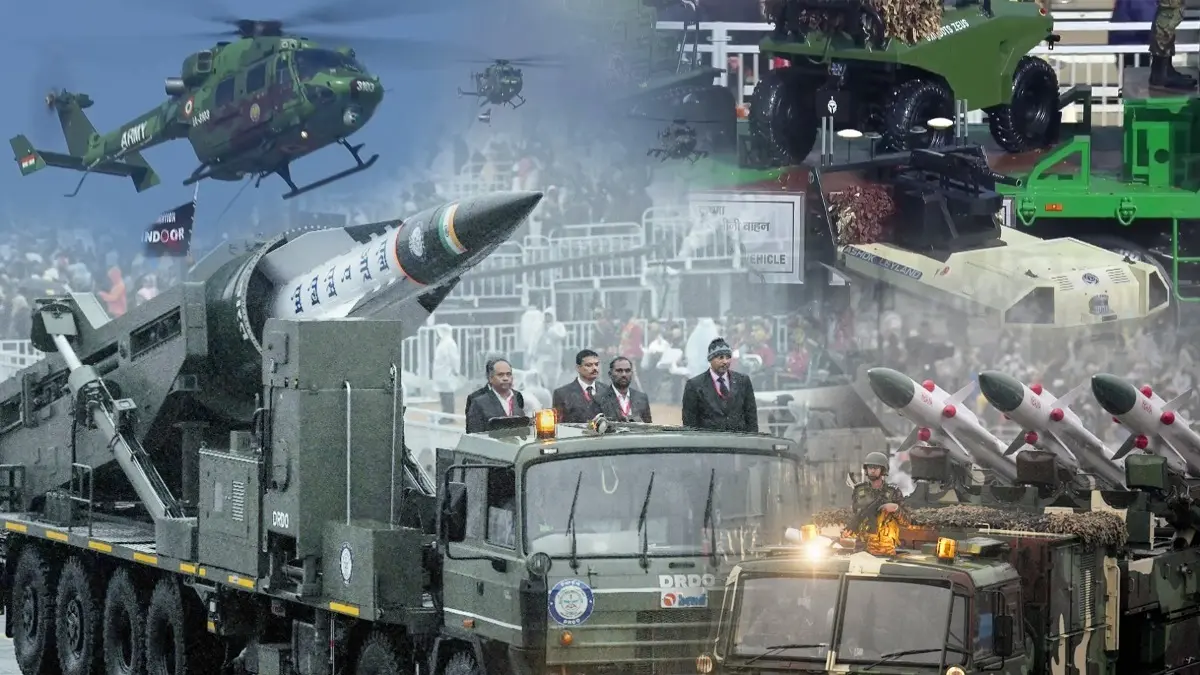
New Delhi: As India marked its 77th Republic Day, Kartavya Path transformed into a live showcase of the nation’s military strength, technological advancement and growing self-reliance in defence production.
From hypersonic missiles to battle tanks and attack helicopters, including RUDRA, Apache AH-64E, and the Light Combat Helicopter (LCH) Prachand, nearly every major indigenous and frontline weapon system was featured in a grand display on the battlefield.
The parade held added significance as the first Republic Day celebration after Operation Sindoor, underscoring India’s evolving military posture across land, air and sea.
Hypersonic leap: LR-AShM enters spotlight
One of the most closely watched highlights was the Defence Research and Development Organisation’s Long Range Anti-Ship Missile (LR-AShM), a hypersonic glide weapon system that places India among an elite group of nations with hypersonic strike capability.
Advertisement
Designed to meet the coastal battery requirements of the Indian Navy, the LR-AShM is capable of engaging both static and moving targets at ranges of up to 1,500 kilometres.
The missile follows a quasi-ballistic trajectory, reaching speeds of Mach 10 at launch and sustaining an average speed of Mach 5 with multiple skips, making detection by enemy ground- and ship-based radars extremely difficult.
Advertisement
Configured with a two-stage solid propulsion rocket motor system, the LR-AShM is expected to emerge as one of India’s most lethal strategic assets as indigenous defence technologies continue to mature.
BrahMos, Akash and Suryastra reinforce strike power
Alongside the hypersonic missile, the parade featured established and proven weapon systems such as the BrahMos supersonic cruise missile and the Akash air defence system, reinforcing India’s layered strike and air defence capabilities.
The BrahMos supersonic cruise missile system, led by Captain Animesh Rohila of the 344 Missile Regiment, rolled past Kartavya Path as a symbol of India's strategic strike capability.
Developed under an Indo-Russian joint venture, BrahMos is a ramjet-powered missile capable of speeds up to Mach 2.8.
With precision strike capability and extended range, it is one of the fastest supersonic cruise missiles in the world. The system is deployed on a mobile autonomous launcher mounted on a robust Tata 12x12 high-mobility vehicle, carrying three ready-to-fire missiles. BrahMos has been inducted into all three services of the Indian Defence Forces.
Making its first appearance was ‘Suryastra’, a rocket launcher system with deep strike capability, adding to the army’s long-range firepower and battlefield dominance.
Attack helicopters dominate the skies
The aerial segment showcased India’s advanced rotary-wing combat fleet in a powerful formation flight featuring RUDRA, Apache AH-64E and the Light Combat Helicopter Prachand.
RUDRA, the armed variant of the Advanced Light Helicopter Dhruv, demonstrated its role as a key battlefield force multiplier.
Designed to deliver lethal close air support, RUDRA can neutralise enemy infantry, armoured vehicles, tanks and even hostile helicopters. Its effectiveness increases when deployed in coordination with the Indian Air Force, missiles and artillery units.
The formation was led by Lieutenant Colonel Ahmed Pasha and Group Captain Arunva Pal, underlining jointmanship and integrated operations across services.
Dhruv flies with Operation Sindoor Flag
A powerful visual came from the indigenous Advanced Light Helicopter Dhruv flying with the flag of Operation Sindoor. Equipped with long-range radar and day-night surveillance cameras, the helicopter can identify targets even in dense camouflage.
The aircraft was piloted by Colonel Vijay Pratap, an Army Medal awardee, highlighting both technological capability and individual gallantry.
Bhishma, Arjun Mk I Battle Tanks
India’s mechanised and armoured strength formed a central part of the ground display, beginning with the T-90 Bhishma main battle tank, led by Captain Vipanjot Singh Virk of the 77 Armoured Regiment.
Built on the hunter-killer concept, the T-90 Bhishma is armed with a 125 mm smoothbore gun, machine guns and laser-guided missiles capable of striking targets up to five kilometres away.
Recently upgraded with enhanced firepower, mobility and drone-enabled surveillance, the tank has proven its effectiveness in high-altitude operations and during Operation Sindoor.
The indigenously developed Arjun Mk I main battle tank followed, led by Major Hitesh Mehta of the 75 Armoured Regiment. Armed with a 120 mm rifled gun and protected by Kanchan armour and NBC protection, Arjun reflects India’s commitment to self-reliance and advanced battlefield survivability.
For the first time, the parade showcased a phased battle array format of the Indian Army, including its aerial component. The reconnaissance element featured the 61 Cavalry in active combat uniform, followed by the High Mobility Reconnaissance Vehicle, India’s first indigenously designed Armoured Light Specialist Vehicle.
Dhwaj formation and leadership presence
As the parade commenced, spectators witnessed the iconic ‘Dhwaj Formation’, with four Mi-17 1V helicopters of the 129 Helicopter Unit flying in an inverted Y formation. The helicopters carried the National Ensign along with the service flags of the Indian Army, Navy and Air Force.
Prime Minister Narendra Modi laid a wreath at the National War Memorial ahead of the parade. He was accompanied by Defence Minister Rajnath Singh, Chief of Defence Staff General Anil Chauhan, Chief of Army Staff General Upendra Dwivedi, Chief of Air Staff Air Chief Marshal A. P. S. Singh and Chief of Naval Staff Admiral Dinesh Tripathi.
President Droupadi Murmu presided over the celebrations, with European Council President António Costa and European Commission President Ursula von der Leyen attending as chief guests.
Stretching from Rashtrapati Bhawan to the National War Memorial, Kartavya Path was elaborately decorated to reflect India’s journey, blending the legacy of Vande Mataram with modern military strength, cultural diversity and citizen participation.
The 77th Republic Day parade stood out as a clear signal of India’s defence ambitions, showcasing not just hardware, but a maturing ecosystem of indigenous innovation, joint operations and strategic readiness across all domains.
(With inputs from Agency)