
How DRDO’s NASM-SR Missile Equips India to Counter Any Maritime Aggression by Pakistan & China
With stealthy sea-skimming flight, infrared seeker precision, and man-in-loop guidance, NASM-SR is a game-changer.
- Defence News
- 4 min read

;'%3e%3cpath%20d='m8,15.99c4.41,0,7.99-3.58,7.99-7.99S12.41,0,8,0,0,3.59,0,8s3.58,7.99,7.99,7.99Z'%20style='stroke:%23fff;%20stroke-miterlimit:10;%20stroke-width:.02px;'/%3e%3cpath%20d='m3.08,3.37l3.82,5.11-3.84,4.15h.87l3.37-3.64,2.72,3.64h2.94l-4.04-5.39,3.58-3.87h-.86l-3.1,3.35-2.5-3.35h-2.94Zm1.27.64h1.35l5.97,7.99h-1.35l-5.97-7.99Z'%20style='fill:%23fff;'/%3e%3c/g%3e%3c/svg%3e)


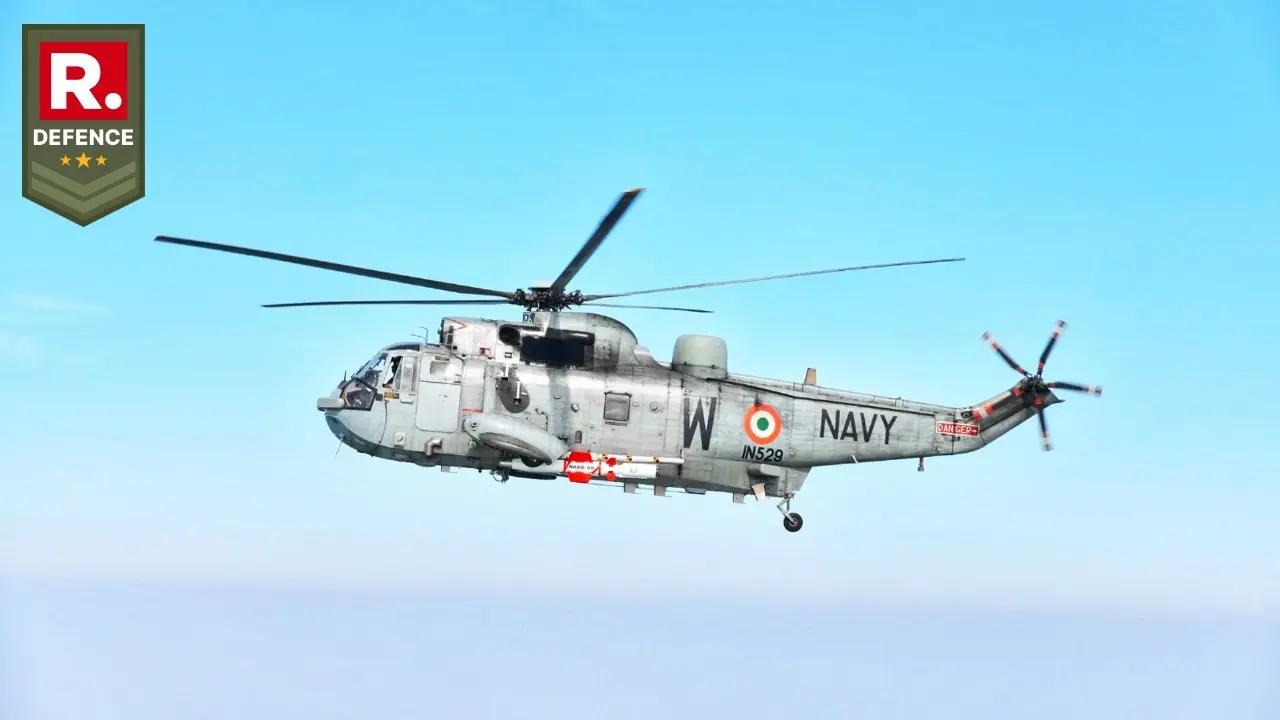
Odisha, India — India has just taken a major leap in naval warfare capabilities. On February 25, the Defence Research & Development Organisation (DRDO) and the Indian Navy successfully tested the Naval Anti-Ship Missile – Short Range (NASM-SR) from the Integrated Test Range (ITR), Chandipur. Fired from an Indian Navy Seaking helicopter, the missile hit its target—a small ship in sea-skimming mode—with pinpoint accuracy, validating a host of advanced features that make it a game-changer in maritime warfare.
This first indigenously developed short-range air-launched anti-ship missile marks a crucial step in India's quest for self-reliance in defence (Aatmanirbhar Bharat) and significantly boosts the Indian Navy’s combat readiness. With an estimated range of 55 km, the NASM-SR is tailor-made for coastal defence, anti-access/area-denial (A2/AD) operations, and preemptive strikes against hostile naval forces.
But beyond the successful test, the missile’s deployment is significant in the context of rising tensions in the Indian Ocean Region (IOR), where India must be prepared for potential confrontations with both Pakistan’s expanding naval force and China’s aggressive maritime posturing.
Why NASM-SR is a Game-Changer for the Indian Navy?
Unlike India’s existing Kh-35 Uran (Russian origin) and Harpoon (American origin) anti-ship missiles, the NASM-SR is fully indigenous. This eliminates foreign dependency, ensures uninterrupted supplies during wartime, and gives India full control over software upgrades and modifications.
Advertisement

Some of the missile’s standout features include:
- Man-in-Loop Guidance for In-Flight Target Selection: Pilots can change targets mid-flight, making it useful against evasive enemy warships. The two-way data link allows for real-time battle management, ensuring the missile does not get tricked by decoys or electronic countermeasures (ECM).
- Sea-Skimming Mode for Stealth Attacks: The missile flies just a few meters above the water, making it extremely difficult for enemy radars to detect and intercept. Most naval air defence systems are designed to track and intercept high-altitude threats, meaning NASM-SR can bypass traditional missile defence shields.
- Pinpoint Accuracy with Indigenous Infrared Seeker: NASM-SR uses an Indigenous Imaging Infra-Red (IIR) Seeker, allowing it to lock onto specific targets even in a crowded battle scenario. This ensures higher precision in contested waters, especially when dealing with enemy fleets operating in close formations.
- Compact Size for Rapid Deployment: Weighing less than 400 kg, the NASM-SR can be launched from multiple naval platforms, including Seeking & MH-60R helicopters, and carrier-based jets like the MiG-29K.
- Future Twin-Engine Deck-Based Fighters (TEDBF): This versatility ensures rapid and flexible deployment during combat situations.
How NASM-SR Counters Pakistan’s Naval Expansion
Pakistan has been aggressively expanding its navy to counter India’s regional dominance. It has been acquiring advanced warships and submarines from China, including the Type 054A/P Frigates – Four modern multi-role frigates equipped with HHQ-16 surface-to-air missiles and CM-302 supersonic anti-ship missiles (capable of hitting targets over 290 km away).
Advertisement
Another expansion is the Hangor-Class Submarines (Chinese Yuan-Class SSKs). Pakistan is set to receive eight diesel-electric attack submarines by 2028, giving it silent underwater strike capabilities. Meanwhile, the Babur-III Nuclear-Capable Cruise Missile has a range of 450 km, potentially allowing it to strike Indian naval bases.
The NSAM-SR missiles can deliver preemptive strikes on Pakistani warships. In the event of hostilities, Indian Navy helicopters can quickly launch NASM-SR missiles against enemy warships before they enter Indian waters.
Its sea-skimming capability makes it nearly impossible for Pakistani frigates’ radar systems to detect and intercept in time. The missile can be used in coordination with P-8I Poseidon aircraft for rapid anti-submarine warfare (ASW) strikes. It can target surfaced submarines or submarine-supporting vessels, crippling Pakistan’s underwater warfare capabilities.
Moreover, Pakistan has been practising naval blockades and amphibious assault drills with China. NASM-SR enables India to neutralize landing ships or transport vessels before they reach shore, preventing surprise enemy landings.
With tensions rising in the Indian Ocean, NASM-SR isn’t just another missile—it’s a strategic deterrent that reinforces India’s naval superiority. In a war-like scenario, this missile could decide who controls the seas. And with India now equipped with this advanced indigenous weapon, the message is loud and clear—New Delhi is ready to dominate the high seas.