
How Indian Navy's ₹60,000 Cr Rafale-M Jet Deal will Challenge China’s Naval Dominance, Enhance IAF's Fleet
India is set to finalize its ₹60,000 crore Rafale Marine deal with France, marking a major leap in naval and aerial firepower.
- Defence News
- 4 min read

;'%3e%3cpath%20d='m8,15.99c4.41,0,7.99-3.58,7.99-7.99S12.41,0,8,0,0,3.59,0,8s3.58,7.99,7.99,7.99Z'%20style='stroke:%23fff;%20stroke-miterlimit:10;%20stroke-width:.02px;'/%3e%3cpath%20d='m3.08,3.37l3.82,5.11-3.84,4.15h.87l3.37-3.64,2.72,3.64h2.94l-4.04-5.39,3.58-3.87h-.86l-3.1,3.35-2.5-3.35h-2.94Zm1.27.64h1.35l5.97,7.99h-1.35l-5.97-7.99Z'%20style='fill:%23fff;'/%3e%3c/g%3e%3c/svg%3e)


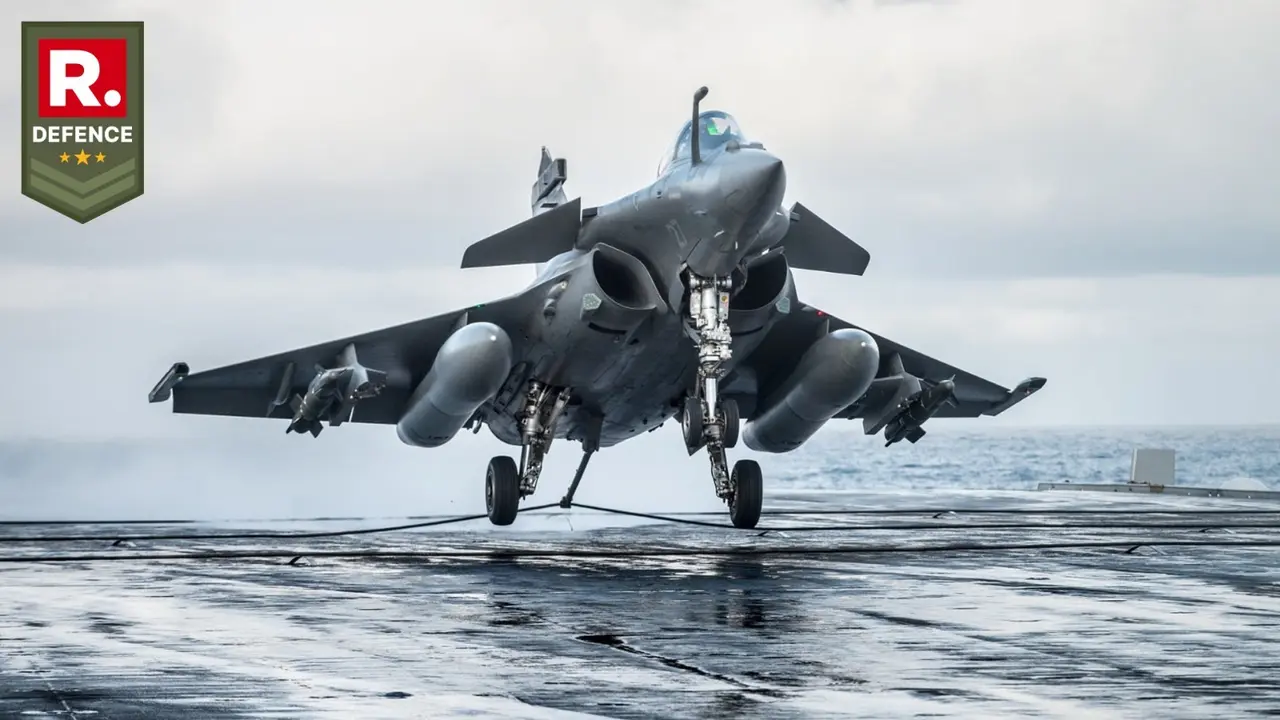
New Delhi, India - India’s much-anticipated ₹60,000 crore Rafale Marine jet deal with France is more than just another arms acquisition—it’s a game-changer for both the Indian Navy and the Indian Air Force (IAF). While the Indian Navy will get 26 Rafale Marine fighters to operate from INS Vikramaditya, the deal also brings key upgrades to the IAF’s existing 36 Rafale fleet, including the much-needed buddy-buddy refuelling system that will extend operational range.
Sources say the deal is in its final stages of clearance by the Cabinet Committee on Security (CCS), and once signed, it will mark a major step in bolstering India’s maritime dominance in the Indian Ocean Region (IOR)—a region increasingly shaped by strategic rivalries and military posturing.
Rafale Marine: A Force Multiplier for the Indian Navy
For the Indian Navy, the acquisition of 22 single-seater and four twin-seater Rafale Marine jets is a crucial step towards modernizing its carrier-based fighter fleet. Currently, the Navy relies on the MiG-29K, which has faced operational challenges, particularly in high-intensity combat scenarios.

The arrival of Rafale Marine will significantly enhance India’s naval airpower, offering:
Advertisement
- Superior Combat Capabilities: The 4.5-generation Rafale Marine comes with cutting-edge avionics, active electronically scanned array (AESA) radar, and advanced electronic warfare systems—far ahead of the MiG-29K in terms of sensor fusion and survivability.
- Better Carrier Operations: The aircraft will be modified to integrate seamlessly with INS Vikramaditya, enabling precision strike capabilities, longer endurance, and improved dogfighting potential.
- Interoperability with the IAF: With the Navy and the Air Force operating Rafales, joint operations and logistics will be streamlined, making cross-branch coordination more effective.
How This Strengthens India’s Position in the IOR
The Indian Ocean Region has become a hotspot for strategic manoeuvring, with China rapidly expanding its naval footprint, and operating bases in Djibouti, Gwadar, and Hambantota. In response, India is bolstering its maritime presence, and the Rafale Marine jets will be central to this effort.
The buddy-buddy refuelling system will allow one Rafale to refuel another mid-air, drastically extending the fleet’s combat endurance over vast oceanic expanses. This is critical when operating far from the mainland or friendly bases. With Rafale Marine jets on INS Vikramaditya, the Navy will have a quick-strike capability against potential threats, whether in the Strait of Malacca, the South China Sea, or near the Andaman and Nicobar Islands.
Advertisement
Edge Over China’s Carrier Fleet: China’s J-15 fighters, which operate from its aircraft carriers, are bulkier and less manoeuvrable than Rafales. The Indian Navy’s lighter, more agile, and technologically superior Rafales will provide a clear edge in carrier-based aerial warfare.
Boost for the Indian Air Force
While the Navy gets new aircraft, the IAF isn’t left behind. The deal includes a package that enhances the IAF’s existing Rafales with:
- Buddy-buddy refuelling for extended range and combat endurance.
- Advanced ground-based support systems for better maintenance and quick deployment.
- Software upgrades to improve mission planning and execution.
With India’s focus on network-centric warfare, these upgrades will ensure the IAF’s Rafales remain one of the most potent air dominance platforms in the region.
What’s Next? Indigenous Fighters on the Horizon
The Rafale Marine is a stopgap solution until India rolls out its own Twin-Engine Deck-Based Fighter (TEDBF), currently under development by the Defence Research and Development Organisation (DRDO). The TEDBF, expected to be operational in the next decade, will be the first indigenous carrier-based stealth fighter, reducing dependency on foreign platforms in the long run.
With 26 Rafale Marine jets joining the Indian Navy’s arsenal and significant upgrades to the IAF’s Rafale fleet, India is reinforcing its position as the dominant air and naval power in the Indian Ocean Region. In an era where military strength is as much about deterrence as it is about combat readiness, the Rafale Marine deal is a loud and clear message—India is here to stay, and it will defend its waters with cutting-edge firepower.