
'More destructive than US': Chinese Expert Warns Japan's Rising Military Role Risks Igniting South China Sea Conflict
A top Chinese analyst warns Japan's growing military footprint in the South China Sea could be more destabilizing than the U.S., as Beijing rejects the 2016 Hague ruling.
- Defence News
- 3 min read

;'%3e%3cpath%20d='m8,15.99c4.41,0,7.99-3.58,7.99-7.99S12.41,0,8,0,0,3.59,0,8s3.58,7.99,7.99,7.99Z'%20style='stroke:%23fff;%20stroke-miterlimit:10;%20stroke-width:.02px;'/%3e%3cpath%20d='m3.08,3.37l3.82,5.11-3.84,4.15h.87l3.37-3.64,2.72,3.64h2.94l-4.04-5.39,3.58-3.87h-.86l-3.1,3.35-2.5-3.35h-2.94Zm1.27.64h1.35l5.97,7.99h-1.35l-5.97-7.99Z'%20style='fill:%23fff;'/%3e%3c/g%3e%3c/svg%3e)


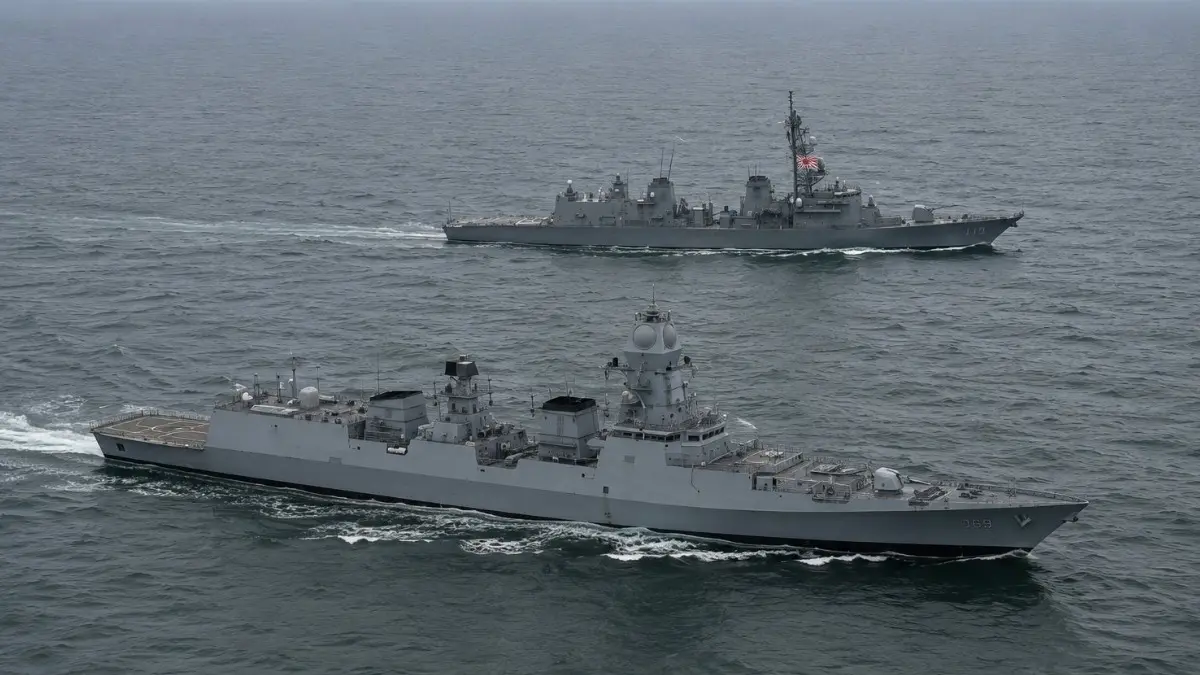
A prominent Chinese maritime expert has warned that Japan's growing military footprint in the South China Sea could prove more destabilizing than the presence of the United States. This warning comes amid rising regional tensions following the 10th anniversary of the landmark 2016 Hague arbitration ruling, which rejected Beijing's sweeping maritime claims.
Speaking at a security roundtable in Hong Kong on Monday, Wu Shicun, the founding president of China's National Institute for South China Sea Studies, noted a sharp increase in military deployments, joint exercises, and maritime patrols by non-regional nations. He stated that these actions have increasingly normalized what he described as "unilateral infringements."
Wu's comments followed Beijing's rejection of renewed international support for the tribunal's decision, which China continues to dismiss as "null and void."
Japan's Growing Military Role
Japan’s involvement in this year's Balikatan military drills alongside the United States and the Philippines was a primary focus of Wu’s criticism. He highlighted Tokyo’s deployment of over 1,400 personnel, three warships, and transport aircraft, alongside the first overseas live-firing of Japan's Type 88 surface-to-ship missile system against a decommissioned Philippine Navy vessel.
Advertisement
"This is the first time that Japan has shown off its military muscle since the end of World War II," Wu said. "Japan's military forces' deployment into the South China Sea is inherently destructive, carrying a potential risk that may ultimately surpass even that of the United States."
Wu further contended that the ongoing reliance on the 2016 arbitration ruling by Manila and its allies would hinder long-term stability in the contested waters. "As long as Manila and its partners do not give up using the ruling to serve their own interests, peace and stability in the South China Sea cannot be guaranteed," he said.
Advertisement
Beijing Rejects International Criticism
The remarks coincide with fresh diplomatic friction after statements from 14 nations, including the U.S. and the Philippines, reaffirmed the Hague ruling as legally binding and criticized China's non-compliance.
Japan separately noted that Beijing's stance ran "against the principle of peaceful settlement of disputes." In response, China summoned a senior Japanese embassy official to lodge a formal protest. China's foreign ministry asserted that Japan is "not a party to the South China Sea dispute" and has "no right to point fingers" at Beijing's territorial claims. The ministry also criticized Tokyo's recent security actions—such as exporting defense equipment to the Philippines, overseas military deployments, and missile tests—arguing they go "far beyond the scope of self-defence" outlined in Japan's post-war pacifist framework.
Separately, Qi Dahai, director general of the Chinese foreign ministry's Department of Treaty and Law, accused Washington of intensifying regional friction by deepening military ties with its allies.
"It builds small cliques, issues so-called joint statements, sows discord and fans the flames in the region," Qi said. China continues to claim sovereignty over the majority of the South China Sea, despite the 2016 ruling determining that its expansive "nine-dash line" lacks a legal basis under the UN Convention on the Law of the Sea. While Beijing rejects the entire arbitration process, the Philippines, the U.S., Japan, and other nations maintain the decision is the proper legal framework for managing the strategic waterway.