
INS Udaygiri, INS Himgiri Commissioned: All About Indian Navy's Advanced Frontline Frigates
Udaygiri and Himgiri will join the Eastern Fleet, significantly bolstering India’s ability to safeguard its interests across the Indian Ocean Region.
- Defence News
- 3 min read

;'%3e%3cpath%20d='m8,15.99c4.41,0,7.99-3.58,7.99-7.99S12.41,0,8,0,0,3.59,0,8s3.58,7.99,7.99,7.99Z'%20style='stroke:%23fff;%20stroke-miterlimit:10;%20stroke-width:.02px;'/%3e%3cpath%20d='m3.08,3.37l3.82,5.11-3.84,4.15h.87l3.37-3.64,2.72,3.64h2.94l-4.04-5.39,3.58-3.87h-.86l-3.1,3.35-2.5-3.35h-2.94Zm1.27.64h1.35l5.97,7.99h-1.35l-5.97-7.99Z'%20style='fill:%23fff;'/%3e%3c/g%3e%3c/svg%3e)


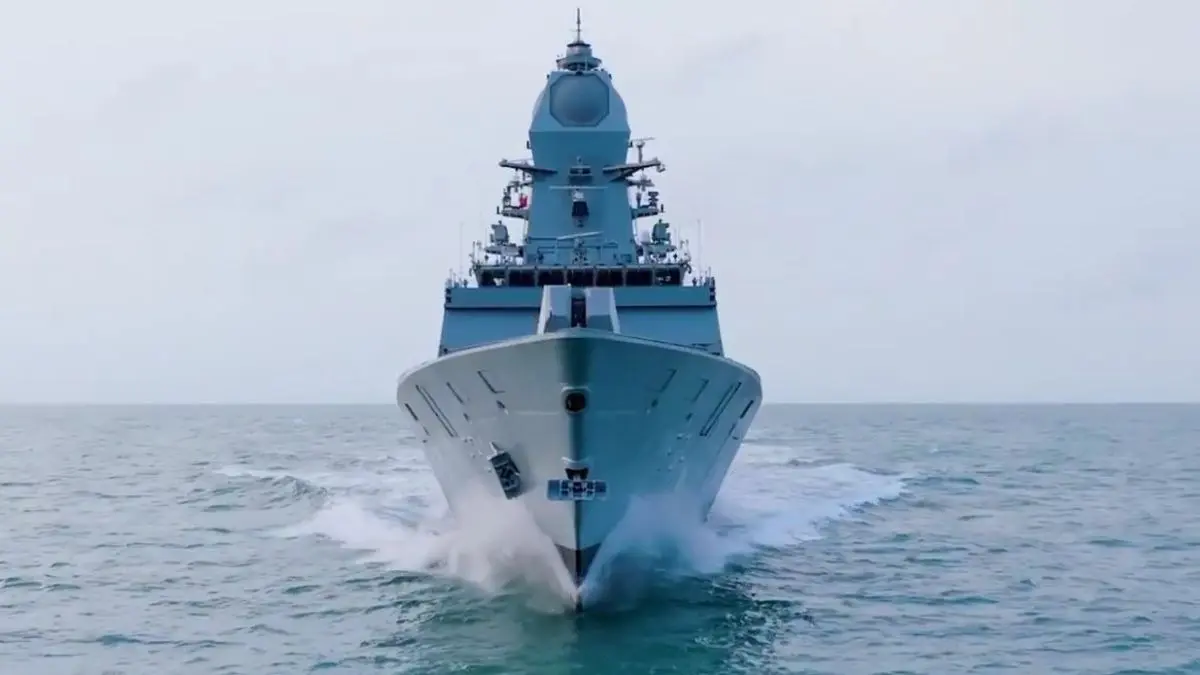
In a historic moment for India’s maritime defence, the Indian Navy has commissioned two state-of-the-art Project 17A stealth frigates — INS Udaygiri and INS Himgiri — on Tuesday, August 26. Hosted by the Eastern Naval Command at Visakhapatnam, the event saw Defence Minister Rajnath Singh preside over the ceremony, marking the first time two major frontline surface combatants, built at two different Indian shipyards.
This landmark event not only reflects India’s rapidly growing maritime ambitions but also underscores the Navy’s commitment to indigenous shipbuilding and self-reliance.
All About Udaygiri and Himgiri
Part of the Project 17A programme, Udaygiri and Himgiri are advanced successors of the Shivalik-class frigates. At 6,700 tonnes, they are larger, stealthier, and more capable than their predecessors, featuring a reduced radar signature and enhanced sensors and weapons for full-spectrum maritime operations in blue-water conditions.
Both ships are powered by a Combined Diesel or Gas (CODOG) propulsion system, blending efficiency with power, and are equipped with an Integrated Platform Management System for streamlined operations.
Advertisement
On the weapons front, the frigates pack serious firepower: supersonic surface-to-surface missiles, medium-range surface-to-air missiles, a 76mm main gun, close-in weapon systems, and anti-submarine warfare suites, giving them the ability to take on threats from the air, surface, and beneath the seas.
A Testament to Indigenous Prowess
INS Udaygiri, built by Mazagon Dock Shipbuilders Ltd. (MDL) in Mumbai, holds a special distinction as the 100th ship designed by the Indian Navy’s Warship Design Bureau (WDB). INS Himgiri, on the other hand, was constructed by Garden Reach Shipbuilders & Engineers (GRSE) in Kolkata, making this simultaneous commissioning a shining example of collaboration between India’s premier shipyards.
Advertisement
These frigates are also a story of “Aatmanirbhar Bharat” in action. With 75 per cent indigenous content and support from over 200 MSMEs, they represent an industrial ecosystem that supports nearly 4,000 direct and over 10,000 indirect jobs. Udaygiri, in particular, showcases the success of modular construction, having been the fastest of her class to be delivered post-launch.
Honouring a Legacy
Both ships carry names with history. The original INS Udaygiri (F35) and INS Himgiri (F34) served the Indian Navy with distinction for over three decades before being decommissioned. The new frigates inherit not just their names but also their legacy, symbolising continuity in tradition while heralding a new era of capability.
Strengthening India’s Maritime Power
Udaygiri and Himgiri will join the Eastern Fleet, significantly bolstering India’s ability to safeguard its interests across the Indian Ocean Region.
This commissioning caps an extraordinary year for Indian shipbuilding. In 2025 alone, the Navy welcomed the destroyer INS Surat, frigate INS Nilgiri, submarine INS Vaghsheer, ASW Shallow Water Craft INS Arnala, and the Diving Support Vessel INS Nistar.
For a nation that once relied heavily on foreign platforms, this shift signals a confident, self-reliant Navy — one that is designing, building, and deploying complex warships tailored to its unique operational needs. As the two grey hulls take their place in the waters of Visakhapatnam, one message rings clear: India’s oceans are guarded by ships built in India, designed by Indians, and crewed by Indians.