
Why India’s New Mach 5.5 RudraM-II Air-to-Surface Missile Is a Game-Changer for Air Warfare
India successfully tests the indigenous RudraM-II air-to-surface missile under extreme conditions, validating a massive Mach 5.5 force multiplier for the IAF.
- Defence News
- 3 min read

;'%3e%3cpath%20d='m8,15.99c4.41,0,7.99-3.58,7.99-7.99S12.41,0,8,0,0,3.59,0,8s3.58,7.99,7.99,7.99Z'%20style='stroke:%23fff;%20stroke-miterlimit:10;%20stroke-width:.02px;'/%3e%3cpath%20d='m3.08,3.37l3.82,5.11-3.84,4.15h.87l3.37-3.64,2.72,3.64h2.94l-4.04-5.39,3.58-3.87h-.86l-3.1,3.35-2.5-3.35h-2.94Zm1.27.64h1.35l5.97,7.99h-1.35l-5.97-7.99Z'%20style='fill:%23fff;'/%3e%3c/g%3e%3c/svg%3e)


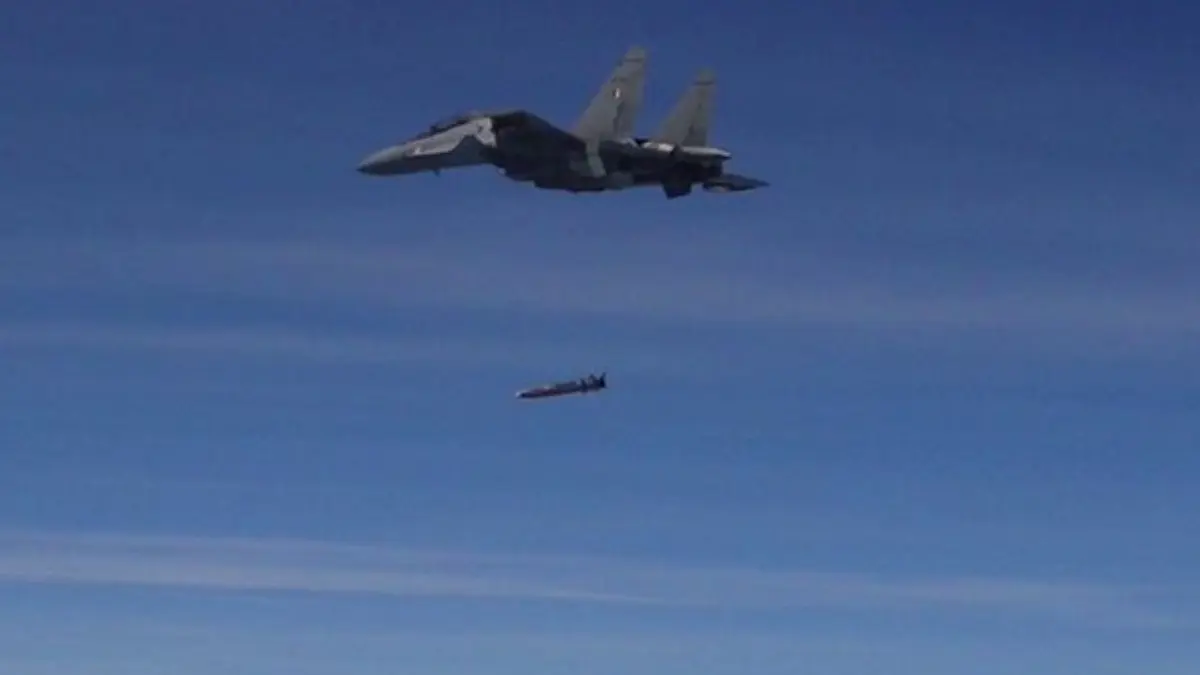
In a major boost to India's defense technology, the Defence Research & Development Organisation (DRDO) and the Indian Air Force (IAF) have successfully conducted flight-tests of the indigenous RudraM-II air-to-surface missile. The advanced weapon system was launched from a Sukhoi Su-30MKI fighter jet platform at the Integrated Test Range (ITR) in Chandipur, off the coast of Odisha.
According to the Ministry of Defence, the missile was released under extreme conditions and followed a critical trajectory, validating the capability of all its integrated subsystems. After launch, the solid-propellant missile guided itself to a predefined target with pinpoint accuracy. Range instruments, including electro-optical systems, radar, telemetry stations, and an onboard ship, captured the flight data to confirm that all trial objectives were fully met.
Capabilities and Specifications of RudraM-II
RudraM-II is an indigenously developed, high-speed anti-radiation missile designed for air-to-surface missions. It serves as a key force multiplier for the IAF, intended to eventually replace the older Russian-origin Kh-31 missiles currently in service.
- Peak Speed: Capable of reaching Mach 5.5.
- Striking Range: Approximately 300 km.
- Payload: Equipped to carry a warhead weighing up to 200 kg.
- Deployment Altitude: Can be launched from aircraft flying at altitudes ranging from 3 km to 15 km.
- Guidance System: Uses a hybrid navigation network combining an inertial navigation system, GPS, and a sophisticated passive homing head that detects enemy radio frequency emissions across a wide frequency band.
Collaborative Indigenous Development
The missile program represents a massive collaborative effort under India's self-reliance initiative. Research Centre Imarat (RCI), Hyderabad, served as the nodal DRDO laboratory for the project.
Advertisement
Other contributing DRDO facilities include:
- Defence Research and Development Laboratory (DRDL)
- High Energy Materials Research Laboratory (HEMRL)
- Armament Research & Development Establishment (ARDE)
- Integrated Test Range (ITR)
The program also received vital support from Development-cum-Production Partners (DcPPs) and aerospace agencies, including Hindustan Aeronautics Limited (HAL), the Regional Centre for Military Airworthiness (RCMA), and the Missile System Quality Assurance Agency (MSQAA), alongside various private industry partners.
Advertisement
Defense Minister Rajnath Singh lauded the efforts of the DRDO, the IAF, public sector undertakings, and industry stakeholders.
“The tests have demonstrated the growing maturity of indigenous defence technologies, contributing significantly to Aatmanirbharta in advanced weapon systems,” Singh stated.
The Secretary of the Department of Defence R&D and Chairman of DRDO also extended congratulations to the teams involved in achieving this milestone.
Evolution of the RudraM Missile Series
This successful trial builds upon a series of milestones in India's anti-radiation missile roadmap:
The 2024 RudraM-II Trials
An earlier flight-test of the RudraM-II was successfully conducted from a Sukhoi Su-30MKI off the Odisha coast in May 2024. That trial specifically validated the missile's propulsion system alongside its control and guidance algorithms.
The RudraM-I (NGARM) Framework
Prior to the RudraM-II advancements, DRDO successfully flight-tested India's first New Generation Anti-Radiation Missile (NGARM), known as RudraM-I, at the Chandan Range in Rajasthan. Designed primarily for Suppression of Enemy Air Defences (SEAD) missions, the RudraM-I achieved its intended range and struck its target with a miss distance of just five meters.
The RudraM-I trial successfully validated critical technologies, including safe weapon separation from the Su-30MKI aircraft, a dual-pulse solid propulsion system, guidance algorithms, electro-mechanical actuation systems, an end-game processor based on laser altimeter measurements, and the safe-arm mechanism used for terminal phase warhead detonation. DRDL Hyderabad acted as the nodal lab for RudraM-I, supported by RCI, Advanced Systems Laboratory (ASL), Defence Electronics Research Laboratory (DLRL), IRDE, and the Terminal Ballistics Research Laboratory (TBRL).