
From Vendor Tenders to Mismatched Scripts: The Expanding Crisis Surrounding CBSE's 2026 Digital Checking
Just a day prior to this statement, the CBSE had also refuted claims that its digital evaluation portal was compromised or leaked online, clarifying that a URL circulating on social media was merely a testing site with dummy data.
- Education News
- 4 min read

;'%3e%3cpath%20d='m8,15.99c4.41,0,7.99-3.58,7.99-7.99S12.41,0,8,0,0,3.59,0,8s3.58,7.99,7.99,7.99Z'%20style='stroke:%23fff;%20stroke-miterlimit:10;%20stroke-width:.02px;'/%3e%3cpath%20d='m3.08,3.37l3.82,5.11-3.84,4.15h.87l3.37-3.64,2.72,3.64h2.94l-4.04-5.39,3.58-3.87h-.86l-3.1,3.35-2.5-3.35h-2.94Zm1.27.64h1.35l5.97,7.99h-1.35l-5.97-7.99Z'%20style='fill:%23fff;'/%3e%3c/g%3e%3c/svg%3e)


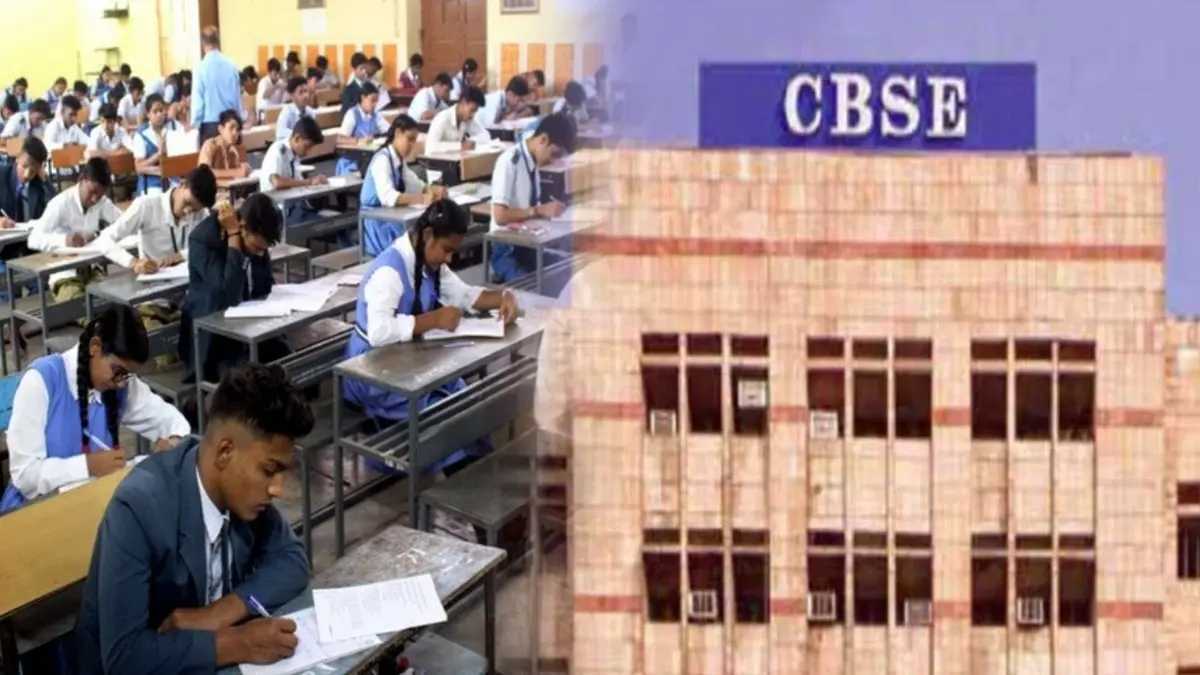
The Central Board of Secondary Education (CBSE) has firmly dismissed allegations regarding procedural lapses in the allocation of its digital evaluation contract. The board termed the ongoing accusations as "erroneous, misleading and not based on facts".
The clarification was issued directly on social media platform X (formerly Twitter) in response to intense scrutiny and political criticism surrounding the evaluation of the 2026 Board Examinations. Defending its selection process, the schooling board clarified that it followed all required legal and financial frameworks established by the central government.
The board stated,"CBSE rejects the allegations regarding the award of contract to Coempt Edutech. It is erroneous, misleading and not based on facts. CBSE has followed the General Financial Rules protocols scrupulously in the awarding of the contract to the agency." To establish the timeline of the partnership, the board pointed out that the procurement process had been active for nearly a year.
"CBSE floated the RFP (Request for Proposal) for Digital Evaluation of Answer books for Board Exams 2026 on Central Public Procurement portal on 28.08.2025 and awarded the contract to the qualified bidder," the board added in its official statement.
Advertisement
The On-Screen Marking System Row
Just a day prior to this statement, the CBSE had also refuted claims that its digital evaluation portal was compromised or leaked online, clarifying that a URL circulating on social media was merely a testing site with dummy data, and that actual student records remained completely secure.
Mismatched Handwriting on Uploaded Scripts
The main grievance from students is that the scanned copies of answer sheets uploaded by the CBSE under their roll numbers did not match their actual handwriting. Students discovered these irregularities after paying fees to download photocopies of their answer scripts to verify their low scores. A Delhi-based student named Vedant sparked a massive social media uproar after his post on X (formerly Twitter) garnered over 2.5 million views. Vedant claimed that the Physics answer sheet uploaded by the CBSE was entirely written by someone else.
Advertisement
He noted that the letter formation, spacing, slant, sentence flow, and general presentation differed completely from his handwritten notes and his other exam papers (like English and Computer Science).
The unexpected low marks in Physics severely damaged his PCM (Physics, Chemistry, Mathematics) aggregate, threatening his eligibility for professional college admissions.
Following an application, CBSE accepted the oversight and assured Vedant that his right copy had been sent to him over the email.
Another Class 12 student, Sanjana, went public with similar allegations regarding her Chemistry answer sheet. She pointed out a structural flaw in the digitization process: while the first page of the answer booklet (which carried her personal details and roll number) was genuinely hers, the internal pages containing the actual answers were written in someone else's handwriting.
Grievances of Teachers
While students bore the brunt of the systemic fallout, evaluators and teachers faced their own severe grievances against the newly implemented On-Screen Marking (OSM) system, criticizing it as deeply flawed, unergonomic, and rushed.
Teachers reported that looking at thousands of digitally scanned pages caused immense eye strain and headaches, especially since many of the uploaded PDFs were blurry, low-resolution, or suffered from alignment issues that forced them to squint to read student handwriting.
Furthermore, the newly introduced digital interface proved clunky and counterintuitive; early versions lacked basic ‘save’ or seamless undo options, while a complicated, rigid step-by-step schema for inputting question-wise marks significantly slowed down their usual assessment pace.
The board continues to maintain that its multi-tiered re-evaluation and verification processes are robust enough to address any individual grading grievances.