
'Holistic and multidisciplinary': Why Jamia Millia Islamia's VC is praising NEP 2020
National Education Policy aims to give students increased flexibility to study across subjects of arts, humanities, sciences, sports, and vocational subjects.
- Education News
- 2 min read

;'%3e%3cpath%20d='m8,15.99c4.41,0,7.99-3.58,7.99-7.99S12.41,0,8,0,0,3.59,0,8s3.58,7.99,7.99,7.99Z'%20style='stroke:%23fff;%20stroke-miterlimit:10;%20stroke-width:.02px;'/%3e%3cpath%20d='m3.08,3.37l3.82,5.11-3.84,4.15h.87l3.37-3.64,2.72,3.64h2.94l-4.04-5.39,3.58-3.87h-.86l-3.1,3.35-2.5-3.35h-2.94Zm1.27.64h1.35l5.97,7.99h-1.35l-5.97-7.99Z'%20style='fill:%23fff;'/%3e%3c/g%3e%3c/svg%3e)


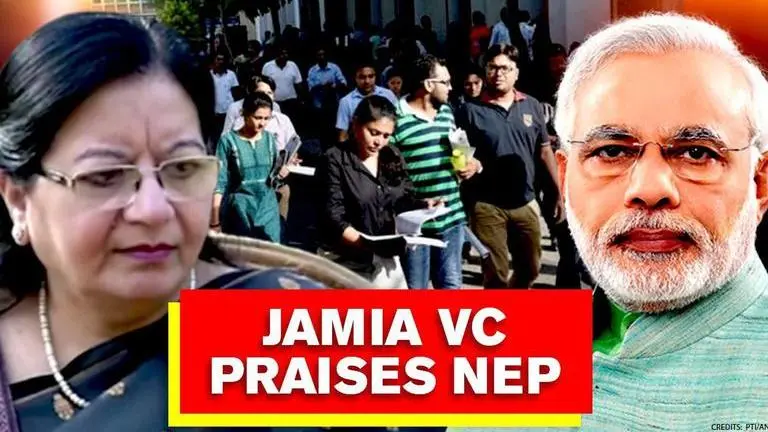
As the National Education Policy 2020 was announced on Wednesday after the cabinet meeting chaired by Prime Minister Narendra Modi, Professor Najma Akhtar, Jamia Millia Islamia Vice-Chancellor, has praised the policy calling it "ground-breaking" and "holistic".
"The NEP will create new opportunities for students in the domain of higher education. They can pursue education with greater flexibility in a seamless learning environment. They can enter, exit and re-enter as per their convenience and career choices," said Akhtar.
"The NEP is groundbreaking! The higher education in India will now be holistic and multidisciplinary with a shared focus on Science, Arts and Humanities," she added.
"The focus on the use of new technologies in the NEP will ramp up digital learning in India. The MHRD has already created a foundation through SWAYAM- the Massive Open Online Course platform- for the construction of dynamic verticals," she added.
Advertisement
Advertisement
Highlights of NEP 2020
The NEP aims to promote India as a global study destination providing premium education at affordable costs. An International Students Office at each institution hosting foreign students will be set up. High performing Indian universities will be encouraged to set up campuses in other countries. Selected universities like those from among the top 100 universities in the world will be facilitated to operate in India.
The new education policy aims to give students increased flexibility and choice of subjects to study across the arts, humanities, sciences, sports, and vocational subjects. Departments in Languages, Literature, Music, Philosophy, Indology, Art, Dance, Theatre, Education, Mathematics, Statistics, Pure and Applied Sciences, Sociology, Economics, Sports, Translation and Interpretation, etc. will be established and strengthened at all higher education institutions (HEIs).
Giving special emphasis to regional languages, the Cabinet also stated that Sanskrit Universities would be transformed into multidisciplinary institutions of higher learning, adding that an Indian Institute of Translation and Interpretation (IITI) would also be set up to study and teach Sanskrit and other Indian languages.
The new education policy will create an independent regulatory body called the State School Regulatory Authority. NEP aims to provide pre-primary education to all by 2025. It aims at compulsory school education for all children in the age group of 3-18 years by 2030. It proposes new curricular with 5+3+3+4 structure. It continues with the three-language formula and adds "The Languages of India" with an aim to preserve all local languages.