
NCERT’s Class 9 Textbook Alters Indus Valley ‘Dancing Girl’; Social Media Backlash Calls It a Comedy of Education
NCERT’s Class 9 art textbook has altered the iconic Indus Valley “Dancing Girl,” shading her darker and covering parts of the torso. The move has sparked backlash, with critics calling it a distortion of history and a “comedy of education.”
- Education News
- 3 min read

;'%3e%3cpath%20d='m8,15.99c4.41,0,7.99-3.58,7.99-7.99S12.41,0,8,0,0,3.59,0,8s3.58,7.99,7.99,7.99Z'%20style='stroke:%23fff;%20stroke-miterlimit:10;%20stroke-width:.02px;'/%3e%3cpath%20d='m3.08,3.37l3.82,5.11-3.84,4.15h.87l3.37-3.64,2.72,3.64h2.94l-4.04-5.39,3.58-3.87h-.86l-3.1,3.35-2.5-3.35h-2.94Zm1.27.64h1.35l5.97,7.99h-1.35l-5.97-7.99Z'%20style='fill:%23fff;'/%3e%3c/g%3e%3c/svg%3e)


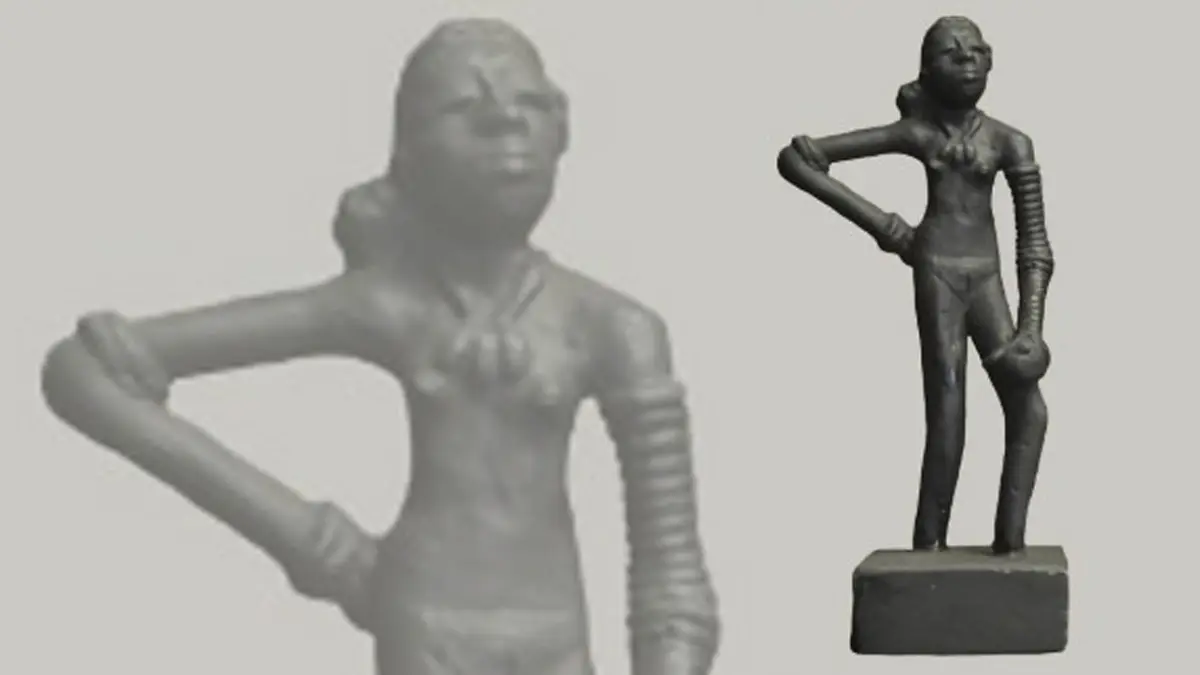
The “Dancing Girl” of Mohenjo-Daro has always been more than just a figurine in a textbook. Bronze, barely 10.5 cm tall, 4,500 years old, standing with one hand on her hip, bangles stacked up her arm. For generations of Indian students, she was the face of the Indus Valley Civilisation.
Now, in NCERT’s newly released Class 9 art education textbook, she looks different. The image has been shaded darker, and parts of the torso have been covered. It’s not the original form that archaeologists uncovered in Mohenjo-Daro, and it’s not the version students have seen for decades.
The change is part of NCERT’s first-ever arts education series rolled out under the National Education Policy (NEP) and National Curriculum Framework (NCF). Textbooks from Classes 1 to 9 have been published so far, meant to integrate arts into mainstream schooling. But instead of applause, this particular illustration has triggered backlash.
On social media, the reaction has been swift and biting. Critics say education has turned into a comedy, accusing NCERT of sanitising history and altering heritage. “Why cover what was uncovered? Why change what is history?” one user wrote. Others argued that the figurine’s power lies in its rawness, its unapologetic form, and that altering it for classrooms is a distortion.
Advertisement
An NCERT official admitted the matter has been referred to the textbook development team. “There is no specific reason. In the Grade 6 Social Science textbook, the Dancing Girl appears in its original form,” the official said.
This isn’t the first time the figurine has been reimagined. In May 2023, during International Museum Day, Prime Minister Narendra Modi unveiled a mascot at the International Museum Expo in Delhi, a modern adaptation of the Dancing Girl. That version was taller, fairer, dressed in pink and off-white. Historians and archaeologists criticised it for stripping away the essence of the original.
Advertisement
The latest textbook change feels like another round of the same debate. A figurine that survived millennia is being reshaped in classrooms today. For many, the question is not about art education or curriculum reform, it’s about respect for history.
The Dancing Girl was discovered as she was. Bronze, bare, adorned only with bangles and a necklace. That’s how she entered textbooks, museums, and memory. And that’s how critics believe she should remain.
For now, NCERT’s altered image has turned a 4,500-year-old artefact into a flashpoint in the present, with students, teachers, and historians asking: why rewrite what was already written in bronze?