
How RSS' 'Mission Trishul' Boosted NDA's Fortunes in Bihar Assembly Elections?
Analysts said that the RSS strategy worked effectively, leading to a dent in the traditional Muslim and Yadav vote bases in Bihar. The voting trends showed the NDA leading in most of the seats held by these communities. The RSS plans to stick to the same strategy for 2026 Bengal elections.
- Election News
- 3 min read

;'%3e%3cpath%20d='m8,15.99c4.41,0,7.99-3.58,7.99-7.99S12.41,0,8,0,0,3.59,0,8s3.58,7.99,7.99,7.99Z'%20style='stroke:%23fff;%20stroke-miterlimit:10;%20stroke-width:.02px;'/%3e%3cpath%20d='m3.08,3.37l3.82,5.11-3.84,4.15h.87l3.37-3.64,2.72,3.64h2.94l-4.04-5.39,3.58-3.87h-.86l-3.1,3.35-2.5-3.35h-2.94Zm1.27.64h1.35l5.97,7.99h-1.35l-5.97-7.99Z'%20style='fill:%23fff;'/%3e%3c/g%3e%3c/svg%3e)


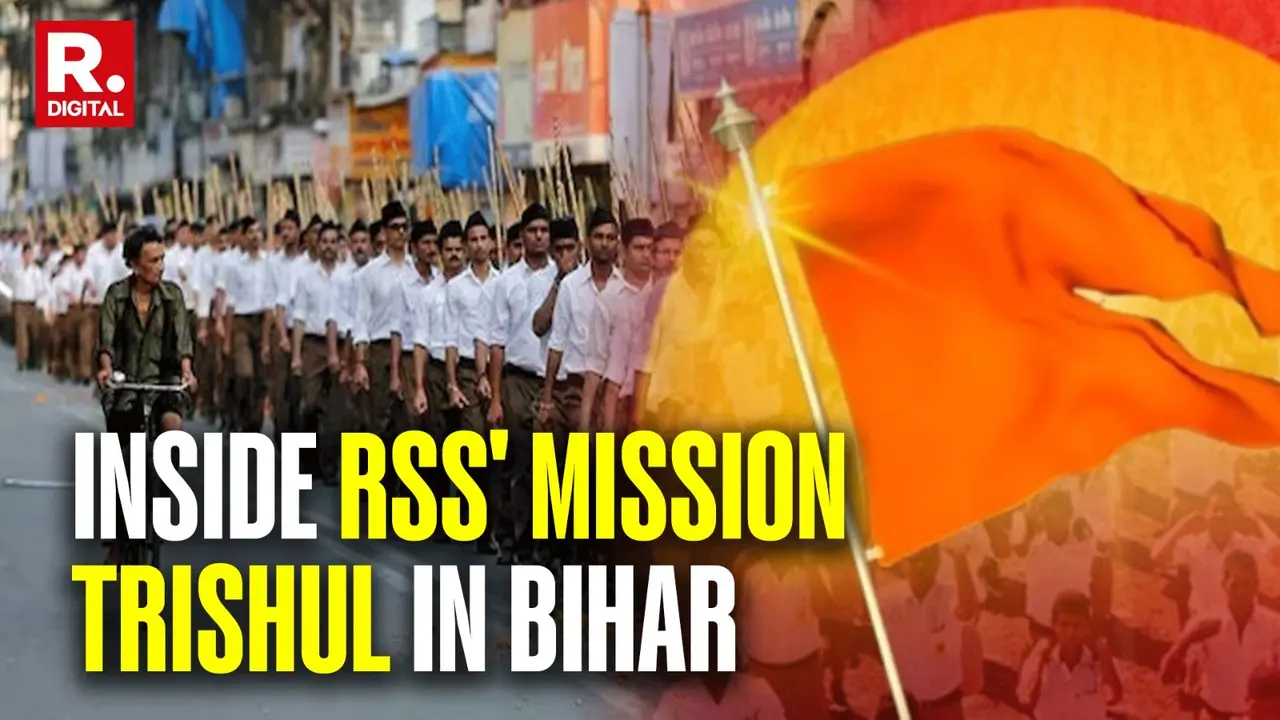
As the early trends of vote counting in the Bihar Assembly elections predicted a clear mandate for the NDA, it became important to analyze the instrumental role played by the Rashtriya Swayamsevak Sangh (RSS), the ideological parent of the Bharatiya Janata Party (BJP), in boosting the NDA's fortunes in the state. The RSS had launched a special campaign named “Mission Trishul” earlier this year to draw voters toward the BJP.
Sources said that the RSS held between 50,000 and 60,000 meetings in Bihar ahead of the polls as part of “Mission Trishul”, with an average of 200 to 300 meetings in each constituency.
According to analysts, the RSS strategy worked effectively, leading to a dent in the traditional Muslim and Yadav vote bases in Bihar. The voting trends showed the NDA leading in most of the seats traditionally held by these communities.
The mobilization strategy employed by the RSS bore fruit and helped the NDA secure a majority in the Bihar Assembly polls. Sources stated that the RSS seeks not only political dominance but also ideological supremacy across India.
Advertisement
What is Mission Trishul?
“Mission Trishul”, which began in February of this year, was curated and monitored by the RSS leadership. According to sources, RSS chief Mohan Bhagwat himself was involved in the operations.
The mission involved three primary steps:
Advertisement
a) Identifying Dissatisfied Voters (Grassroots Surveys)
The first step involved a detailed, grassroots-level identification of voters unhappy with the current governments. It involved pinpointing rural voters dissatisfied with specific governance issues, such as unemployment, infrastructure deficits, and general governance lapses.
b) Highlighting Local and National Issues
The RSS is reportedly working to amplify specific issues relevant to local populations and connect them to the BJP’s broader national themes of development and cultural nationalism. Major emphasis was placed on job creation, agricultural reforms, and caste-based reservations in Bihar.
c) Consolidation of Bases
The RSS devised a strategy of identity politics to solidify voter bases under a Hindu nationalist umbrella. Efforts were made to unify groups and communities under a Hindu nationalist framework.
Sources said other right-wing organizations, including the ABVP, Bajrang Dal, VHP, and Mazdoor Sangh, also cooperated with the RSS and campaigned under "Mission Trishul."
Reports said that RSS volunteers identified favorable and unfavorable booths for the BJP and worked relentlessly to ensure that BJP supporters were mobilized to vote in Bihar.
The RSS had previously helped the BJP win elections in Delhi, Haryana, and Maharashtra through devised strategies, including voter awareness programs and important meetings designed to gravitate voters toward the BJP.
Future Plans: West Bengal
The RSS plans to stick to the same strategy for the upcoming West Bengal Assembly elections in 2026 and has already begun preparations including employing volunteers, sources said.
Its goal is to counter the influence of the Mamata Banerjee-led Trinamool Congress (TMC) by helping the BJP gain more voters and greater influence in the eastern region.
The plan for West Bengal involves highlighting issues like corruption, "appeasement politics," the need for economic revitalization, and the perceived decline in law and order.
Sources also said that the RSS plans to organize large-scale religious events to promote a sense of Hindu unity, especially in regions with a significant minority population, and carry out "Ghar Wapsi" (homecoming) programs.
The NDA’s victory in the Bihar polls, which was predicted by most analysts and exit polls, has further boosted the RSS’s confidence to carry out its silent revolution in advancing its ideological goals in other parts of the country where the BJP is not in power.