
May 4 Final Verdict Explained: How BJP’s Bengal Breakthrough, Assam Hat-Trick & TVK’s Tamil Nadu Takover Project India’s Shifting Political Dimension
2026 Assembly election results across five states signal a major political shift, with big changes in West Bengal, Tamil Nadu, Kerala and Assam, reshaping India’s electoral landscape.
- Election News
- 6 min read

;'%3e%3cpath%20d='m8,15.99c4.41,0,7.99-3.58,7.99-7.99S12.41,0,8,0,0,3.59,0,8s3.58,7.99,7.99,7.99Z'%20style='stroke:%23fff;%20stroke-miterlimit:10;%20stroke-width:.02px;'/%3e%3cpath%20d='m3.08,3.37l3.82,5.11-3.84,4.15h.87l3.37-3.64,2.72,3.64h2.94l-4.04-5.39,3.58-3.87h-.86l-3.1,3.35-2.5-3.35h-2.94Zm1.27.64h1.35l5.97,7.99h-1.35l-5.97-7.99Z'%20style='fill:%23fff;'/%3e%3c/g%3e%3c/svg%3e)


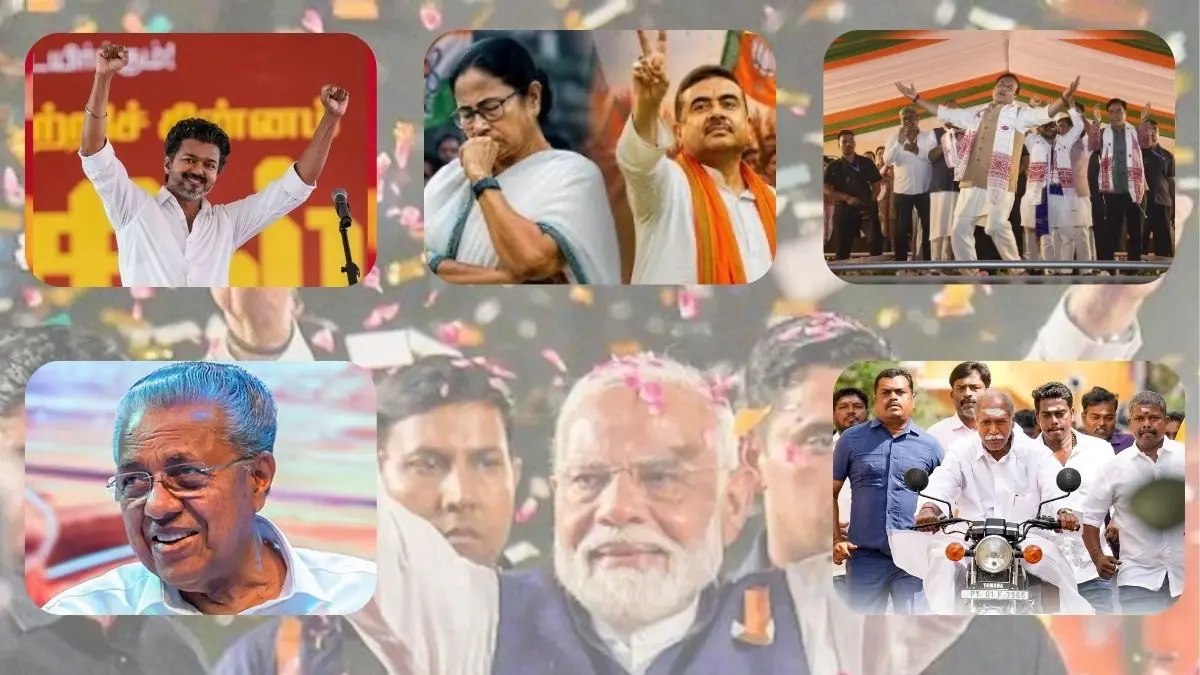
New Delhi: The vote counting on May 4 in West Bengal, Assam, Tamil Nadu, Kerala, and Puducherry was far from a regular results day. What followed was a huge political transition, one that not only tested established strongholds but also highlighted a major shift in voter mood across states.
From an incredible rise in West Bengal to a breakthrough moment in Tamil Nadu and a reshaped mandate in Kerala, the results indicate a bigger shift in India's political structure, with traditional pillars falling apart and new power centres developing.
BJP Heads for First-Ever Government in West Bengal
West Bengal presented the most remarkable result of the day, with the Bharatiya Janata Party winning more than 200 seats and crossing the halfway mark in the 294-member Assembly. BJP won 206 seats, while the Trinamool Congress won 81 seats. The outcome effectively ends Mamata Banerjee’s fifteen-year hold on power.
While the TMC maintained its dominance in minority-dominated areas, factors such as rural dissatisfaction and disagreement over the SIR voter roll plan appear to have undermined its conventional support. A big political shock unfolded in Bhabanipur, where Mamata Banerjee lost her seat to BJP leader Suvendu Adhikari. Adhikari received 73,917 votes, beating Banerjee, who received 58,812 votes, by a margin of 15,105.
Advertisement
Reacting sharply to the outcome, Banerjee termed the verdict “immoral” and alleged large-scale irregularities.
"They have looted more than 100 seats," she said, adding that her party would "bounce back".
As celebrations began, Prime Minister Narendra Modi arrived at the BJP headquarters in New Delhi and addressed party workers. "From Gangotri to Gangasagar, the lotus has bloomed everywhere, in Uttarakhand, Uttar Pradesh, Bihar, and now West Bengal. Today, in the states situated along the banks of the Ganga, there are BJP-NDA governments," he said.
Advertisement
He also linked the opposition’s defeat to their stand on the Women’s Reservation Bill, “These anti-women parties prevented the amendment to the Nari Shakti Vandan Adhiniyam from being passed in Parliament. That is why I said a few days ago that parties opposing the women's reservation bill will have to face the wrath of women. Today, sisters and daughters have punished the Congress, TMC, and DMK," he said.
Assam Gives NDA a Strong Second Mandate
In Assam, the BJP-led NDA held power with a solid showing, allowing Himanta Biswa Sarma to serve as Chief Minister for a second term. The coalition led in 102 of the 126 seats. The BJP won 82 seats, with its partners, the Bodoland People's Front (BPF) and Asom Gana Parishad (AGP), winning 10 seats each. The Congress was dropped to 19 seats, while its ally Raijor Dal won two.
The results suggested support for a campaign centered on development, security, and social stability. Simultaneously, the poll emphasized religious division, with the BJP controlling indigenous and urban areas, while Muslim votes were split between Congress and AIUDF. The BJP’s vote share increased from 33.6 per cent in 2016 to 38.59 per cent in 2026, a nearly five per cent rise attributed to consolidation of Hindu voters.
Tamil Nadu Sees a Break from Old Political Order
Tamil Nadu witnessed what many are calling a political shifting point, as actor-turned-politician Vijay and his party Tamilaga Vettri Kazhagam (TVK) challenged the long-standing dominance of the DMK and AIADMK.
TVK won 108 seats, becoming the single largest party and pushing the AIADMK-BJP combination to third place.
Vijay won convincingly in both of his constituencies. In Tiruchirapalli East, he received 91,381 votes and won by a margin of 27,416. In Perambur, he received an even bigger margin of 53,715 votes.
One of the most shocking results occurred from Kolathur, when TVK's V S Babu defeated Chief Minister M K Stalin. Babu, a former DMK legislator who joined TVK in February, polled 82,997 votes, defeating Stalin, who secured 74,202 votes, by 8,795 votes. AIADMK candidate P Santhana Krishnan trailed with 18,430 votes.
Kerala Votes for Change, BJP Opens Its Account
Kerala had a significant political change, with the Congress-led United Democratic Front (UDF) surpassing the ruling Left Democratic Front (LDF).
According to figures from all 140 constituencies, the UDF won 102 seats, while the LDF received 35. Several prominent ministers trailed, indicating voter fatigue with the Left government's quest to win a third term.
Following the results, Chief Minister Pinarayi Vijayan resigned, which was approved by Governor Rajendra Vishwanath Arlekar. Only seven cabinet members remained in their seats, Pinarayi Vijayan, PA Mohamed Riyas, K Rajan, GR Anil, KN Balagopal, P Prasad, and Saji Cherian.
At the same time, the BJP achieved a historic victory by winning its first Assembly seats in the state. BB Gopakumar won from Chathamangalam in Kollam district, while BJP state president Rajeev Chandrasekhar won from Nemom and V Muraleedharan from Kazhakoottam. The party failed to open an account in 2021.
NDA Retains Power in Puducherry
After a close campaign in Puducherry, the NDA won decisively. With 18 seats in the 30-member Assembly, the coalition has achieved majority status, surpassing the halfway point of 16. The All India NR Congress (AINRC), led by Chief Minister N Rangasamy, was the greatest contributor, with 12 seats.
Within the coalition, the BJP gained four seats, while AIADMK and LJK each received one. The opposition DMK gained five seats, while the Congress got one. Rangasamy won both the Thattanchavady and Mangalam constituencies.
A Mini General Election
The 2026 Assembly results in five states seemed more like a mini general election, with nationwide political consequences. From a dramatic shift in West Bengal to the advent of a new actor in Tamil Nadu, as well as shifting power dynamics in Kerala and Assam, the results indicate an overall shift in voter sentiment. The mandate indicates that long-held strongholds are being challenged, and a new the political landscape is emerging across the country.