
Researchers discover venomous platypuses can glow under UV lights
In their latest study, researchers from Northland College revealed that venomous platypus glowed green when put under Ultra Violet (UV) lights.
- Entertainment News
- 2 min read

;'%3e%3cpath%20d='m8,15.99c4.41,0,7.99-3.58,7.99-7.99S12.41,0,8,0,0,3.59,0,8s3.58,7.99,7.99,7.99Z'%20style='stroke:%23fff;%20stroke-miterlimit:10;%20stroke-width:.02px;'/%3e%3cpath%20d='m3.08,3.37l3.82,5.11-3.84,4.15h.87l3.37-3.64,2.72,3.64h2.94l-4.04-5.39,3.58-3.87h-.86l-3.1,3.35-2.5-3.35h-2.94Zm1.27.64h1.35l5.97,7.99h-1.35l-5.97-7.99Z'%20style='fill:%23fff;'/%3e%3c/g%3e%3c/svg%3e)


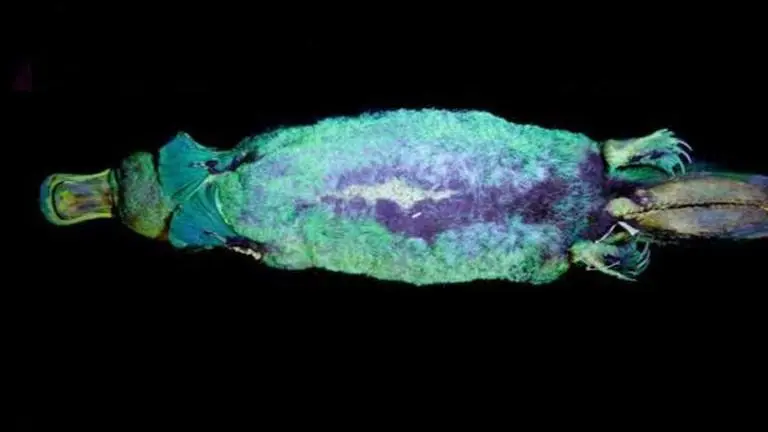
In a latest study, researchers from Northland College revealed that Platypuses glow green when put under Ultra Violet (UV) lights. In the study, that was published in journal Mammalia, they revealed that their fur absorbed light and later emitted it at a different wavelength, a feature incredibly rare to find in mammals.
Platypus are semi-aquatic mammals
Platypus, more commonly known as duck-billed platypus are semiaquatic egg-laying mammals that are usually found in lakes and swamps. The species have a sensitive pliable bill shaped like ducks, webbed feet and are venomous. In the latest addition to their considerably unique features, researchers also found that they can glow in dark.
“Living monotremes represent an ancient mammalian lineage with a long independent evolutionary history,’ explained the researchers in their study titled ‘Platypus’ luminosity’. Elaborating further, they opined that the platypuses might have developed luminosity in a bid to see each other or locate others in deep dark waters.
Advertisement
“Platypuses are typically nocturnal–crepuscular and use a suite of unique phenotypic traits to exploit low-light aquatic environments at dawn, dusk, overnight, and in murky water. Swimming with their eyes closed, they rely on mechanoreception and electroreception to locate prey underwater,” they wrote.
Writing about what piqued their interest in the species, lead researcher and author Professor Paula Spaeth Anich explained that it was “a mix of serendipity and curiosity” that led them to shine a UV light on the platypuses at the Field Museum. Talking about future research, she added that they were now intrigued to find how deep in the mammalian tree the trait of bio fluorescent fur went. The rare feature of luminosity has previously been documented only in flying squirrels and opossums.
Advertisement
Images: Mammalia 2020/De Gruyter