
74.3% Turnout Highest In 50 Years, No Winner In Sight: Israel Faces Hung Knesset In First Election Since Oct 7 Massacre
Exit polls from Channels 11,12,13 show no bloc reaching 61 seats in Israel with the opposition at 50-53, Netanyahu alliance around 50, Arab parties 17-18 as kingmakers as turnout hit record 74.3% in first election since October 7 massacre.
- Global News
- 7 min read


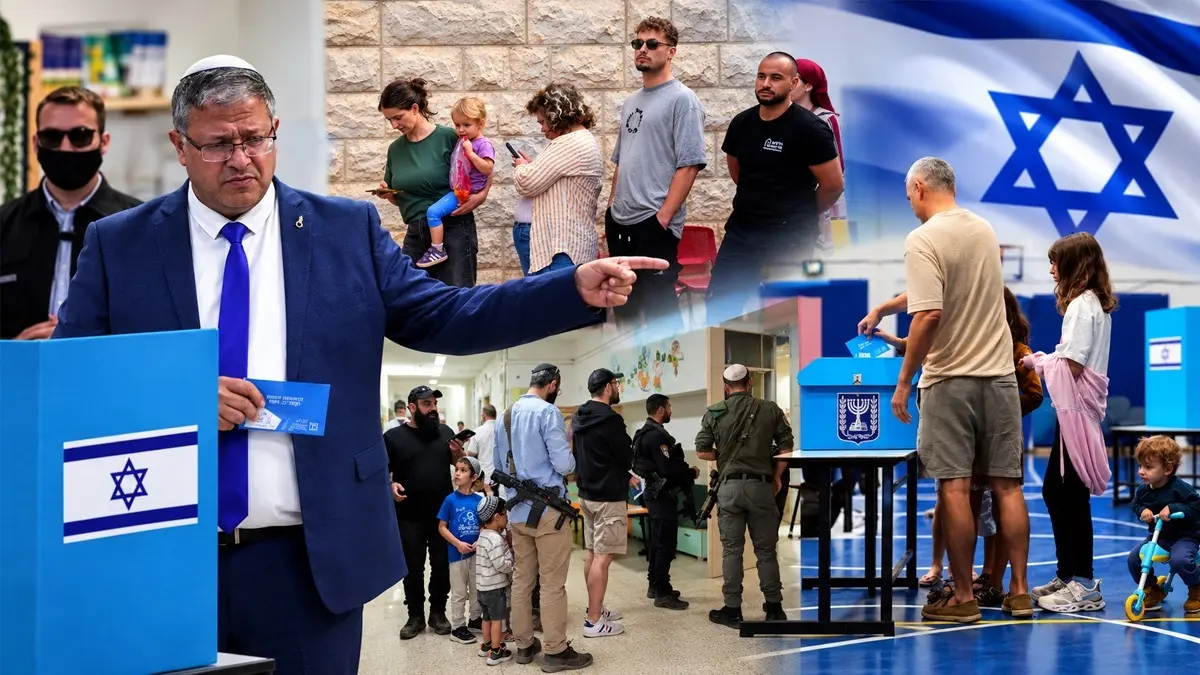
Jerusalem: Israel has been left staring at a fractured mandate after exit polls released on Tuesday night showed neither Prime Minister Benjamin Netanyahu nor his rivals securing a clear majority. According to reports, the projections published by Channels 11, 12 and 13 suggested the country remains deeply split, with both camps falling short of the 61-seat mark required in the 120-member Knesset.
The opposition bloc, comprising Yashar, B’Yachad, Yisrael Beytenu and the Democrats, was tipped to win between 50 and 53 seats, while the alliance led by Netanyahu was forecast to end up with around 50 seats. The figures left neither side with a straightforward route to power. Meanwhile, the Arab parties have emerged as decisive players, with the Joint List and Ra’am together projected to secure 17 to 18 seats. The projection has positioned them as possible kingmakers in a twisting round of coalition bargaining.
Despite their numerical importance, most opposition leaders have ruled out a formal partnership with Arab factions, with the notable exception of Democrats chairman Yair Golan. Likud, led by Netanyahu, was projected to remain the single largest party with 24 to 25 seats, just ahead of Gadi Eisenkot’s Yashar party, which was expected to claim 21 to 23 seats, as per the network surveys.
Record Turnout As Voters Flock To Polls
Pre-election polling had already indicated that clearing the 61-seat threshold would be difficult for either camp. However, the most surprising event was the scale of public participation. Data compiled by the Central Elections Committee (CEC), which has tracked turnout at fixed intervals since 1973, showed voting climbing to the highest level in over 5 decades.
Advertisement
The national participation had surged to 74.3% by 8 pm, a sharp rise from the 70.63% recorded at the same time during the 2022 polls. Earlier in the day, turnout reportedly stood at 66.7% by 6 pm, up 9 points from the 57.7% seen at that hour in the last election and the highest ever recorded at that point in the country’s history. The momentum built throughout the day, with turnout at 31.5% by midday and 55.7% by 4 pm, comfortably beating previous benchmarks.
Over 74% of eligible voters had cast ballots by 8 pm, 8 percentage points higher than in the last elections in 2022, with over 7 million people eligible to vote and tens of thousands reportedly arriving from overseas. The surge complicated calculations for smaller right-wing outfits hovering around the threshold. The Jerusalem Post stated that Ofer Winter’s People of Israel and Yoaz Hendel’s The Reservists-Economic party were both projected to miss the mandatory 3.25% cut-off needed to enter parliament, further narrowing Netanyahu’s path.
Advertisement
War, Security And Democracy At Heart Of Historic Vote
The ongoing polls are Israel’s first general election since the Hamas-led massacre of October 7 in the year 2023, taking place against a backdrop of raw divisions over security accountability, leadership and the future of democratic institutions. Prime Minister Netanyahu, who has dominated national politics for 19 years, faced his stiffest challenge from former IDF Chief of Staff Gadi Eisenkot and his Yashar Party, which had led several opinion polls heading into voting day.
Earlier in the day, as voters' queues lengthened, both leaders made last-ditch appeals. Netanyahu released an urgent video message urging Likud supporters to vote immediately, warning that heavy mobilisation among Arab parties and rivals could usher in a “leftist government”. Terming the ballot as a critical turning point, he urged his base to rally family and neighbours and to avoid backing splinter right-wing lists. “Only this way do we win, and it is possible to win, but you must go out!” he said, calling on voters to support Likud using the ballot letters, Mahal.
On the other hand, Eisenkot hit back sharply, accusing the Prime Minister of using “tricks, lies and intimidation” to drive turnout. In a social media post, he warned that such tactics endangered the prospects for change and urged his supporters to stay active until polls closed at 10 pm. Starting his day with visits to communities attacked on October 7, he said, “If someone in the government had a shred of responsibility, they would start the morning here.” Later, addressing a cheering crowd, he called on all Israelis to vote to remove “the worst government Israel has known,” adding, “we are on perhaps the most critical day since the founding of the state.”
High Emotions On Ground
Amidst an intense political faceoff in the elections, emotions ran high on the ground. In Kiryat Shmona, a Netanyahu stronghold near the Lebanon border, one man was seen kicking and tearing down a poster of Eisenkot. In Tel Aviv, families of those killed on October 7 and former hostages held a moment of silence. “Remember all those whose voices are no more,” said Yona Adam, whose daughter Mapal Adam was killed. Around 330,000 young Israelis, many allegedly facing compulsory military service under the shadow of war, were eligible to vote for the first time.
Scattered allegations of irregularities were reported, though Dean Livne, acting director-general of the elections commission, said that complaints were far fewer than in previous cycles. Also, the security, military conscription and institutional integrity dominated concerns. In addition to this, Israel has grown increasingly isolated over the conduct in Gaza and the West Bank, with support among Americans falling, sanctions imposed by European partners, and Netanyahu himself facing an international arrest warrant over alleged crimes against humanity in Gaza. Iran also loomed large, with Netanyahu warning Tehran that it would face “a devastating blow” if it attacked Israel.
Supporters view Netanyahu as a steady statesman who steered Israel through a war of redemption after the darkest hour and is defending the security and Jewish identity against international pressure and liberal elites. The opposition portrays him as a polarising figure, embroiled in a corruption trial, who prolonged the Gaza war and hostage crisis for political gain while weakening the judiciary and allowing ultra-Orthodox men to avoid conscription.
On the other hand, Eisenkot is seen by backers as a capable leader with strong security credentials, personally touched by the war after his son and two nephews were killed in Gaza, and as a bulwark against illiberalism. The parties likely to support him have pledged to restore Israel’s international standing, push for conscription of ultra-Orthodox men and protect judicial independence.
Israel's Coalition Puzzle
The process of coalition building will now begin, with Israel’s president tasked with asking the party leader best placed to form a government, usually the head of the largest party, to assemble a coalition. In case Likud emerges as the largest, Netanyahu could claim that right. Meanwhile, there will be heavy pressure on Eisenkot to reach a deal with Arab parties, while Netanyahu and allies are likely to cast any such alliance as illegitimate and even treasonous.
No single party has ever won an outright majority in the 120-seat parliament, forcing leaders to forge coalitions. The minority governments are also possible but must rely on outside support to pass laws. Netanyahu had warned earlier that Arab parties that could make or break the election were receiving “truly massive support” and were heading to the polls in “unprecedented numbers".
The political analysts suggested that in case no one can cobble together a majority, fresh elections could be held early next year. Israel held 5 elections between April 2019 and November 2022 because of a similar stalemate.