
India At UNGA Warns Against 'Weaponisation' Of Human Rights, Calls Out Double Standards
India's First Secretary Bhavika Mangalanandan urges dialogue and international cooperation at UNGA, cautioning against politicisation, selective targeting and double standards in human rights.
- Global News
- 6 min read


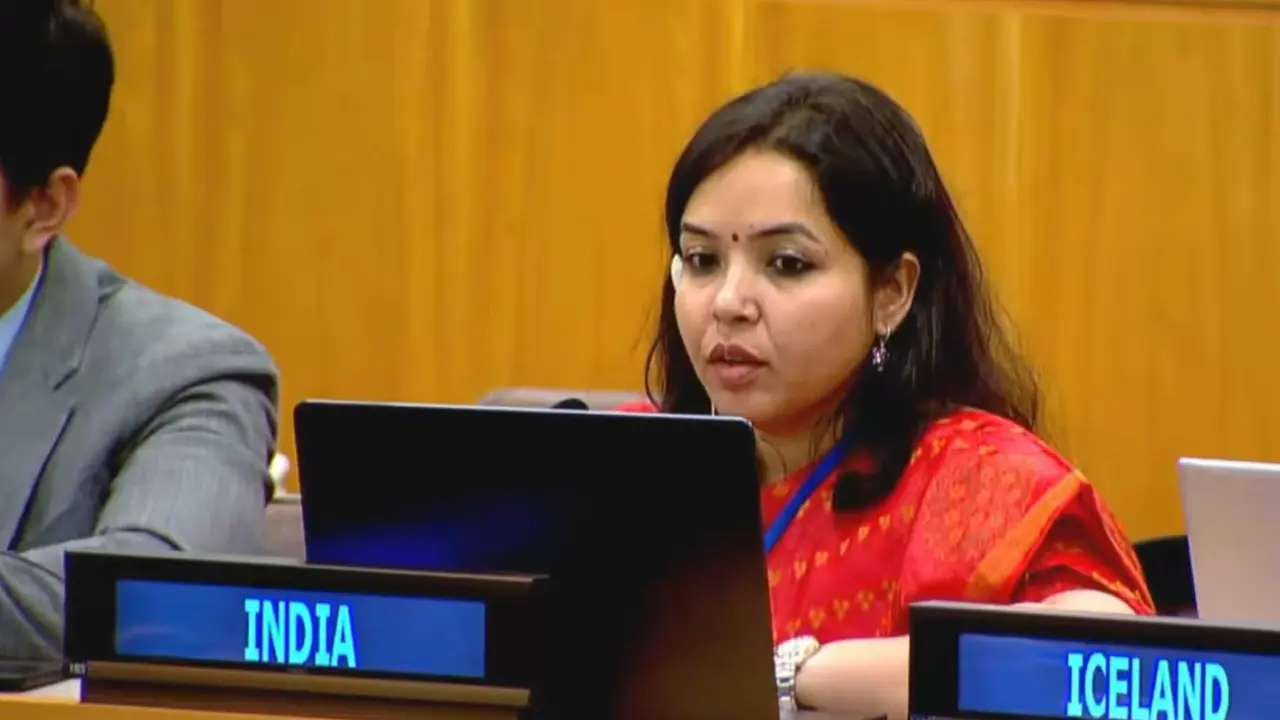
New York: India has called for advancing human rights through dialogue, capacity-building and genuine partnerships, while cautioning against politicisation, selectivity and double standards during a debate on the report of the Human Rights Council at the United Nations General Assembly (UNGA).
Speaking at the UN General Assembly on Friday (local time), India's First Secretary Bhavika Mangalanandan highlighted the need for equal treatment of all categories of human rights, enhanced international cooperation and a balanced approach towards the functioning of the Human Rights Council.
In a post on X, the Permanent Mission of India to the United Nations said Mangalanandan highlighted India's position on preventing the politicisation and weaponisation of human rights.
Addressing the Assembly, Mangalanandan began by thanking the President of the Human Rights Council for the briefing and for leading the work of the Council. "This year marks 20 years since the General Assembly established the Human Rights Council by resolution 60/251, and 60 years since the adoption of the two International Covenants on Human Rights," she said.
Advertisement
She noted that India had returned to the Council for its seventh term for the period 2022-24 and reiterated the country's position on promoting human rights through cooperation, engagement and mutual understanding.
"Human rights are best advanced through dialogue, capacity-building, and genuine partnerships, and not by politicisation, selectivity, or double standards. This is critical if the Council is to speak in one voice and dispel the allegation of weaponisation of human rights," she said, recalling the position articulated by India's External Affairs Minister at the beginning of the country's 2022-24 term.
Advertisement
Making four observations on the functioning of the Human Rights Council, Mangalanandan said its credibility depended on maintaining even-handedness and ensuring that all countries were treated fairly.
"Country-specific mandates, pursued without the engagement of the country concerned, seldom improve the situation on the ground. On the contrary, they deepen divisions within the Council. The Universal Periodic Review, which is built on cooperation, engagement with member states concerned, and treats all states equally, remains the appropriate platform," she said.
Her second observation focused on the need to accord equal importance to all categories of human rights, including economic, social and cultural rights, alongside civil and political rights.
"All human rights must be treated in a fair and equal manner, on the same footing, and with the same emphasis. Economic, social, and cultural rights and the right to development deserve the same attention as civil and political rights. For much of the developing world, poverty, debt, and limited access to financing and technology remain the most immediate obstacles to the enjoyment of human rights. These call for international cooperation and not coercion," she added.
She further said India supported the Human Rights Council's resolution on the enhancement of international cooperation in the field of human rights. On her third observation, Mangalanandan stressed that technical assistance and capacity-building should be extended at the request and with the consent of the state concerned.
"We note the Council's work this year in support of South Sudan, Mali, and Haiti, and on women's access to education and work in digital and cyber security-related fields," she said.
Her fourth observation concerned the need for the Council to fulfil its mandate within available resources. Referring to the efficiency measures outlined in the President's statement of December 8, 2025, she noted the three-year programme of work and voluntary rationalisation of initiatives.
"Rationalisation should remain member-driven and transparent. It should not fall disproportionately on mandates that address development and economic, social, and cultural rights," she said.
Emphasising the importance of adequate funding for the human rights pillar, she said, "The human rights pillar needs adequate and predictable funding through the regular budget so that its priorities are not shaped by earmarked voluntary contributions."
She also called for greater coordination between Geneva and New York, including reducing overlap between their work. "This also calls for greater coherence between Geneva and New York, including by reducing overlap between their work. We should consider mechanisms that avoid resolutions and initiatives on the same topic and of similar nature both in the Council and Assembly," she said.
Mangalanandan further raised concerns over what she termed an increasing tendency for the Council to dictate reporting to the Third Committee, including reporting by Special Rapporteurs, saying this further undermines the need for a specialised council.
Raising the issue of terrorism, she said it remains among the gravest threats to the enjoyment of human rights, particularly the right to life. "Mr President, terrorism remains among the gravest threats to the enjoyment of human rights, above all, the right to life. The Council has recognised this in its resolution on international cooperation this year. We would encourage the Council to give this threat the sustained attention it warrants on the basis of zero tolerance," she said.
Mangalanandan further said India brings a pluralistic and balanced perspective to the Human Rights Council and remains committed to working with all members and observers. "Mr President, as a member, India brings to the Council a pluralistic and balanced perspective and remains ready to work with all members and observers to help bridge divides," she said.
This comes as earlier on October 20, India asserted that human rights should not be used as an instrument of political pressure or selective country targeting, while calling for accountability, transparency and cooperation to address enforced disappearances at the United Nations General Assembly's Third Committee.
Delivering India's statement on the agenda item concerning the Working Group on Enforced or Involuntary Disappearances, Ministry of External Affairs Deputy Secretary Barkha Tamrakar highlighted the constitutional and institutional safeguards available in India to address allegations of human rights violations.
The Permanent Mission of India to the UN said Tamrakar reaffirmed the role of Article 21 of the Constitution, judicial remedies, human rights commissions, independent media and civil society in ensuring transparency and providing avenues for redressal. “Human rights not to be used as an instrument of political pressure or selective country targeting,” Tamrakar said in her statement.
She described India as a vibrant democracy anchored in the rule of law and emphasised that constitutional provisions and independent institutions provided safeguards against alleged enforced disappearances.