
'Freedom For All...': Hundreds Hit Streets In Tel Aviv, Jerusalem, Haifa, Demand Jewish-Arab Government
Hundreds protest in Tel Aviv, Jerusalem and Haifa, demanding a Jewish-Arab government as partial election results leave Benjamin Netanyahu’s bloc short of a majority and coalition talks intensify in Israel.
- Global News
- 4 min read


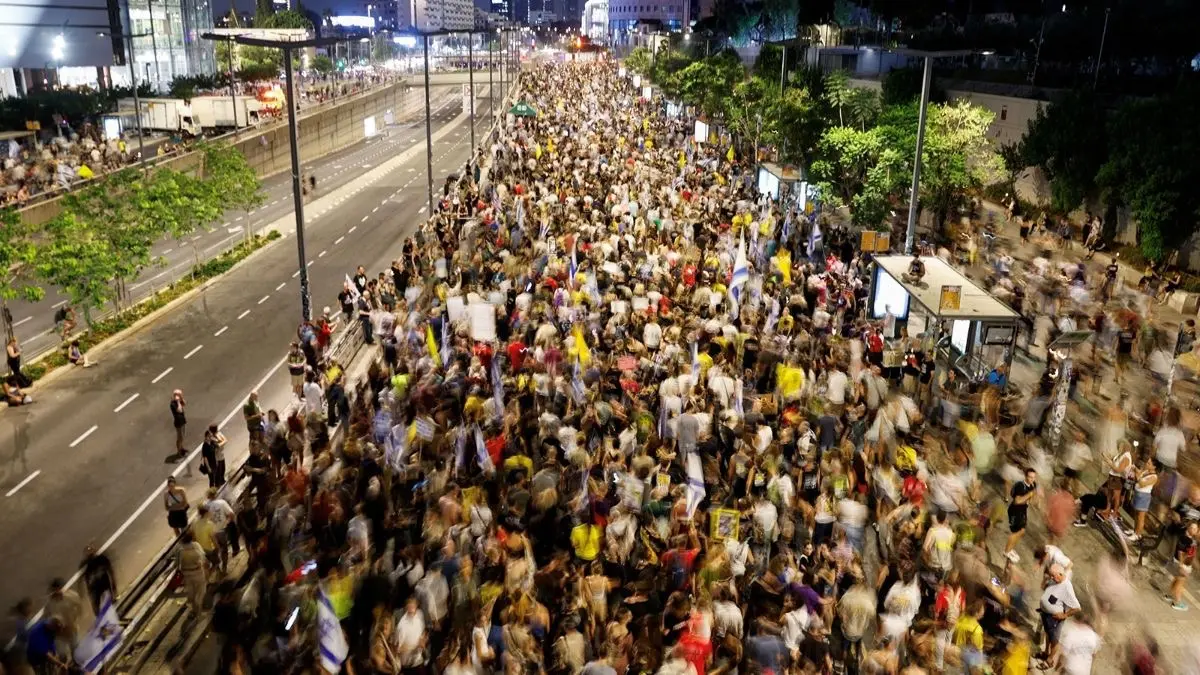
Jerusalem: Around 300 people gathered in Jerusalem, Tel Aviv and Haifa to demand the formation of a Jewish-Arab government, according to Israeli daily Haaretz, as Israel’s high-stakes election results pointed to a divided political landscape.
The demonstrations took place at Paris Square in Jerusalem, Mesila Park in Tel Aviv and UNESCO Square in Haifa. Protesters held placards bearing slogans such as “Freedom for all, from the river to the sea” and “Yes to a Jewish-Arab government”, calling for inclusive governance.
The protests are happening during an election that is very tense, and neither side in politics has a clear way to form a government yet. Some early findings show that there are disagreements among the opposition groups, especially about whether parties led by Arab countries should join a government team.
Netanyahu’s Opponents Seek Change Amid Divided Results
According to the numbers shared by Israel’s Central Elections Committee at 11:35 pm local time, 90 percent of the votes had been counted in 97.5 percent of the ballot boxes. The group supporting Netanyahu had 53 seats, and the other group had 48 seats.
Advertisement
When Arab-led parties are included, Netanyahu's opponents together have 67 out of the 120 seats in the Knesset. However, the opposition is still split, with Jewish-led parties having 48 seats and Arab-led parties having 19. Most Jewish-led groups don't want to work with Arab-led groups, which makes it hard to form coalitions.
Gadi Eisenkot, the head of the Yashar party and a top opposition candidate, said the results showed people rejecting Netanyahu's government. He mentioned the government's handling of the October 7 attacks and the military service issue.
Advertisement
“This is the will of the people, who expressed no confidence in the government of October 7 and draft evasion, and in the draft-dodgers’ bloc as a whole,” Eisenkot wrote on X.
He pledged to continue efforts to replace the government, saying: “We have more long days of work ahead of us, but we are focused on the weighty task entrusted to us: bringing change to Israel and establishing a Zionist government committed to military conscription,” Eisenkot added, following what he described as a long day of meetings, vowing to “rise to the great challenge ahead of us”.
Golan Pushes For Coalition Talks, Arab Parties In Focus
Yair Golan, the leader of the left-wing The Democrats, has announced that he will meet with three party leaders to discuss the formation of a government. Gadi Eisenkot, the head of Yashar, and Yair Lapid, the deputy leader of B'Yachad, are expected to participate in talks, as reported by The Times of Israel.
Golan is part of a group made up of four Zionist opposition groups, and he is the only leader in that group who publicly supports including Arab political parties in a coalition.
“I hope to meet with all of them by Sunday,” Golan told Channel 12 in his first media interaction since polling closed. He declined to identify all the leaders he planned to meet when asked whether Yisrael Beytenu chairman Avigdor Liberman was on his Thursday schedule.
Golan said he intended to persuade opposition leaders that they shared “an overarching mission: to bring hope to the people of Israel”.
He also argued that a new government was needed to address security challenges, halt the incumbent administration’s judicial overhaul and restore hope among young Israelis, who he said were “asking whether they even want to live in this country”.
Final Seat Count Remains Uncertain
The election results are still temporary because the vote counting is not finished yet. The Reservists party got 2.6 percent of the votes, the People of Israel got 1.6 percent, and the Charedi Public faction got 0.2 percent. All of these were below Israel’s 3.25 percent threshold needed to qualify.
The Central Elections Committee has warned that the numbers are not complete. Double-envelope ballots, which include votes from active-duty soldiers, are typically handled after other ballots and might affect the final number of seats distribution.