
‘Unity In Diversity Is Bharat's DNA’: Mohan Bhagwat Draws Civilisational Line Between US Pluralism And Indian Oneness At MSG
At Madison Square Garden, RSS chief Mohan Bhagwat said unity in diversity is in Bharat's DNA, contrasting America's pluralism with Bharat's civilisational oneness and saying Bharat's destiny is to make world realise we are one.
- Global News
- 6 min read

;'%3e%3cpath%20d='m8,15.99c4.41,0,7.99-3.58,7.99-7.99S12.41,0,8,0,0,3.59,0,8s3.58,7.99,7.99,7.99Z'%20style='stroke:%23fff;%20stroke-miterlimit:10;%20stroke-width:.02px;'/%3e%3cpath%20d='m3.08,3.37l3.82,5.11-3.84,4.15h.87l3.37-3.64,2.72,3.64h2.94l-4.04-5.39,3.58-3.87h-.86l-3.1,3.35-2.5-3.35h-2.94Zm1.27.64h1.35l5.97,7.99h-1.35l-5.97-7.99Z'%20style='fill:%23fff;'/%3e%3c/g%3e%3c/svg%3e)


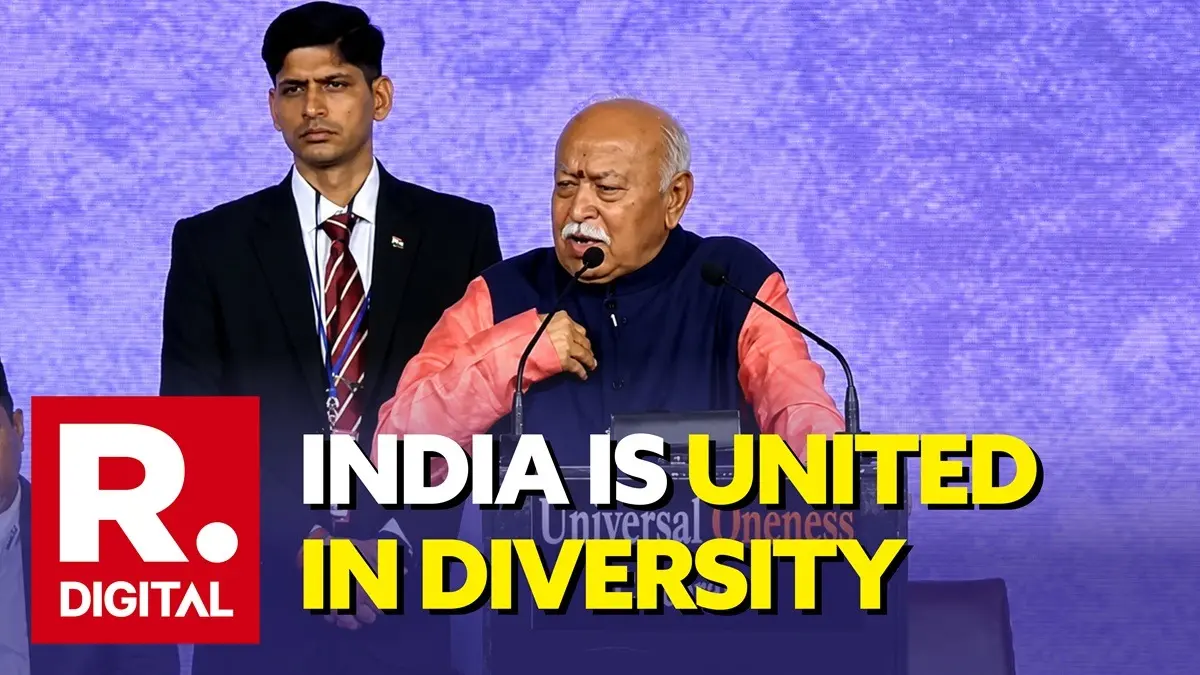
New York: At New York’s iconic Madison Square Garden, Rashtriya Swayamsevak Sangh (RSS) Sarsanghchalak Mohan Bhagwat drew a deep civilisational distinction between pluralism as practised in the West and unity as lived in Bharat. Addressing the Indian diaspora at the event, Bhagwat stressed that for India, unity in diversity is not a political experiment but part of its DNA.
Addressing the historic ‘Universal Oneness Celebration’ organised as part of the RSS centenary year outreach, Mohan Bhagwat asserted that the gathering was not merely an event but a celebration of a timeless truth. Explaining the core spirit behind the historic programme, he addressed the packed audience of Indian diaspora members and interfaith leaders, saying, “We are here to celebrate Oneness.”
The RSS chief emphasised that while America has admirably embraced pluralism by welcoming diverse communities from across the world, Bharat’s idea goes deeper, saying that diversity is not something to be managed but to be revered as a manifestation of the same oneness that binds all existence.
'Destiny of Bharat Is To Make World Realise We Are One'
Invoking Swami Vivekananda, RSS Chief Bhagwat remarked that the monk had famously stated that every nation has a mission to accomplish and a destiny to fulfil. He underlined that the destiny of Bharat is to make the world realise that we are one. Quoting Vivekananda’s vision, he said that Bharat’s role in the world order is to teach humanity to see unity beyond differences.
Advertisement
He noted that this civilisational ethos demands that diversity has to be celebrated, respected and accepted, not merely tolerated. It is this acceptance that allows varied faiths, languages and traditions to coexist as different expressions of one truth.
Celebration Of Oneness In New York City
Bhagwat’s address, delivered during his 3-nation outreach covering the United States, Canada and the United Kingdom, framed the Madison Square Garden event as a reflection of Bharat’s eternal message to the world, emphasising that truth is one, though sages explained it differently, and humanity is one family.
Advertisement
Earlier in the day, addressing the 'One World One Humanity' interfaith gathering in New York, the RSS chief made a strong pitch for global religious harmony. He said that while faiths may follow different paths and rituals, their ultimate objective remains the same, which is the pursuit of truth and divinity.
Speaking to a multicultural audience ahead of the RSS centenary celebrations, Bhagwat cautioned against mistaking external religious practices for the final goal of spiritual realisation. He acknowledged that rituals are essential to maintain discipline within a faith and guide seekers on the path to divinity, but warned that they should not overshadow the core purpose of religion, which he said is to lead humanity to truth.
To support his point, the RSS chief used a simple analogy of a pointing finger and light. He explained that if a person focuses only on the finger that is pointing towards a light, and not on the light itself, the very purpose of the gesture is defeated. He stated that people often get stuck in external forms instead of seeking the spiritual truth beyond them.
Divinity Known By Many Names, Paths Like Rivers To Ocean
The Sarsanghchalak noted that the ultimate reality has been called by different names across traditions, and even modern science now refers to it as consciousness. Quoting ancient Hindu scriptures, he asserted that variations in spiritual practices are natural because human inclinations and perceptions differ.
He likened diverse spiritual paths to rivers that eventually merge into the same ocean, saying that some paths may be straight, some crooked, some long and some short, but all waters that fall on earth ultimately flow to the sea. Similarly, all faiths are treading different routes to find the same divinity.
Need To Educate Society Against Deflections
Bhagwat underlined that the inclusive worldview is central to the Indian tradition, which Hindu society has endeavoured to preserve through history despite foreign invasions and cultural losses. He stressed the need for continuous societal awakening, warning that if society is not constantly educated, ideological deflections tend to creep in.
Reflecting on historical challenges, Bhagwat said if society is not continuously educated, deflections creep in. He said at some point in history, which he could not pinpoint, such deflections happened and the country became a target of foreign invasions, leading to the loss of many traditions.
Reiterating his message of inclusivity, he said, "If any Hindu thinks that there should be no Muslim in Bharat, he will not remain Hindu. If you want to call yourself Hindu, you must believe that all paths are leading to the same goal and that every human has dignity. There is no difference between human beings."
Bhagwat's Big Remark On Hindu Rashtra
In a strong message delivered from New York, RSS chief Mohan Bhagwat said that seeking to expel Muslims from India is not Hindutva, and a Hindu who desires a Bharat without Muslims may not remain a Hindu. Addressing the 'One World, One Humanity' programme, he said that the core of Hindu Rashtra is not based on exclusion, but on the ancient Indian belief that truth is one and humanity is its product.
The RSS chief asserted that while religions may be different, humanity is one. He said that his work is rooted in a tradition that believes truth is singular but is termed in many ways, as human beings are limited by their own experiences and perceptions. He asserted that understanding this limitation is central to respecting all paths to divinity.
Truth Is One, But Seen Differently
To explain his point, Bhagwat gave an analogy from his own background as a veterinary doctor. He said dogs see only in black and white, and however much one tries, a dog cannot be made to see the world as humans do. That does not make the dog's experience false, as it is real to the dog, just as human perception of 7 colours is real to humans, even though the underlying truth is the same.
He clarified his own role, stating that he is not a religious scholar or authority, but is working in a society which traditionally holds that religions might be different but humanity is one. He reiterated that rituals are necessary to maintain discipline within a faith and to tread the path to divinity, but in today's world, religions have largely come to be defined only by rituals.